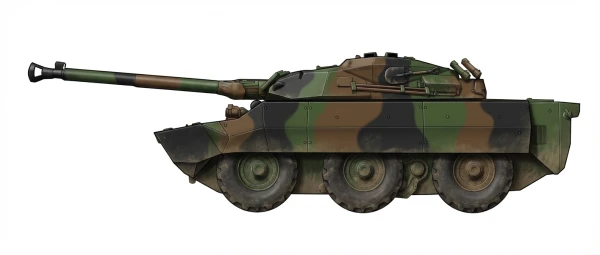
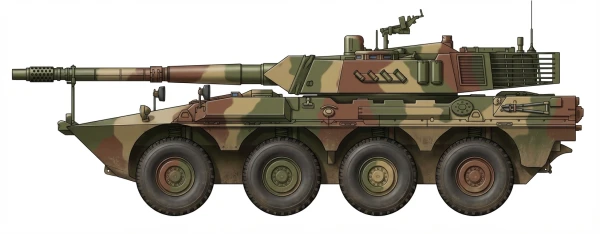
The French AMX-10 RC (1981) and Italian Centauro (1991) were engineered for separate armored cavalry requirements. GIAT built a 17.2-ton 6x6 reconnaissance vehicle around a medium-pressure 105mm gun. The CIO consortium designed a 25-ton 8x8 platform specifically as a tank destroyer capable of matching Leopard 1 firepower.
Development and Design
The AMX-10 RC emerged from a 1970s requirement for an amphibious cavalry scout. GIAT utilized an aluminum hull and a skid-steering mechanism on a 6x6 chassis, pairing it with a hydropneumatic suspension to adjust ground clearance. Amphibious capability was later stripped from the 464-unit fleet to accommodate add-on armor. The Centauro originated in 1986 from an Italian Army requirement to defend the Adriatic coast against Warsaw Pact amphibious assaults. OTO Melara and Iveco Fiat built a heavier, all-welded steel 8x8 chassis with independent suspension. This platform later evolved into the Centauro 2, integrating composite armor and mine-blast hull shaping.
Protection and Firepower
The 7.8-ton weight disparity dictates the survivability and lethality gap between the platforms:
The AMX-10 RC’s aluminum hull stops 14.5mm rounds, but combat in Ukraine demonstrated its vulnerability to 152mm artillery fragmentation. Its 105mm F2 BK MECA L/47 is an unstabilized, medium-pressure gun, requiring the vehicle to halt before firing.
The Centauro utilizes a steel hull resistant to 14.5mm fire, upgradable with appliqué armor to stop 30mm projectiles. Its OTO-Melara 105mm/52 caliber rifled gun fires standard NATO tank ammunition, fully gyro-stabilized and integrated with the TURMS fire control system for fire-on-the-move capability.
Mobility and Logistics
Skid-steering allows the AMX-10 RC to pivot in place like a tracked vehicle, operating well in confined urban terrain. Prolonged road marches, however, cause high wear on its gearbox. It reaches 85 km/h via a Baudouin diesel engine. The Centauro achieves 105 km/h using a 520 hp Iveco V6, aided by active steering on the first, second, and fourth axles. Both vehicles maintain an 800 km operational range. The heavier Centauro requires more robust bridging and recovery assets, though its 8x8 configuration provides higher mechanical redundancy against mine damage compared to the 6x6 French platform.
Deployment and Combat Record
French cavalry deployed the AMX-10 RC in the 1991 Gulf War, Mali, and Afghanistan, where its mobility suited asymmetrical counter-insurgency and flanking maneuvers. The 2023 Ukrainian counteroffensive exposed its limitations in high-intensity, symmetric warfare; the unstabilized gun and thin armor led to high attrition during mechanized assaults. The Centauro engaged hostile forces in Somalia (1993 Checkpoint Pasta) and Iraq (2004 Nasiriyah). In these environments, its stabilized gun provided accurate overwatch, and the steel hull absorbed RPG splash damage and heavy machine gun fire.
Conclusion
The Centauro is the superior combat vehicle for modern mechanized warfare. The AMX-10 RC is restricted strictly to a reconnaissance role; its unstabilized gun and light aluminum hull make it obsolete for peer-level engagements. The Centauro provides actual tank-destroyer lethality with fire-on-the-move accuracy and higher baseline survivability. Militaries prioritizing kinetic operations must select the Italian 8x8 architecture over the 1970s French cavalry design.
The Centauro is faster with a maximum road speed of 105 km/h compared to the AMX-10 RC's 85 km/h.
Which has longer operational range, the AMX-10 RC or Centauro?
The Centauro has a longer operational range at 800 km compared to the AMX-10 RC's 800 km.
Which is heavier, the AMX-10 RC or Centauro?
The Centauro is heavier at 25.0 tons combat weight compared to the AMX-10 RC's 17.2 tons.
Which is larger, the AMX-10 RC or Centauro?
The AMX-10 RC is longer at 9.15 meters compared to the Centauro's 8.56 meters.
How many crew members do the AMX-10 RC and Centauro require?
Both the AMX-10 RC and Centauro require a crew of 4.
Which has been built in greater numbers, the AMX-10 RC or Centauro?
The AMX-10 RC has been produced in greater numbers with 464 units compared to 244 units of the Centauro.
What are the main armaments of the AMX-10 RC and Centauro?
The AMX-10 RC is armed with 105 mm F2 BK MECA L/47 medium-pressure gun while the Centauro carries 1 OTO-Melara 105mm rifled barrel gun as its main armament.