Nexter Griffon vs VAB
Nexter Griffon vs VAB at a glance — weight 24,500 vs 13,800 kg, top speed 90 vs 92 km/h, range 800 vs 1,000 km, crew — vs 2.
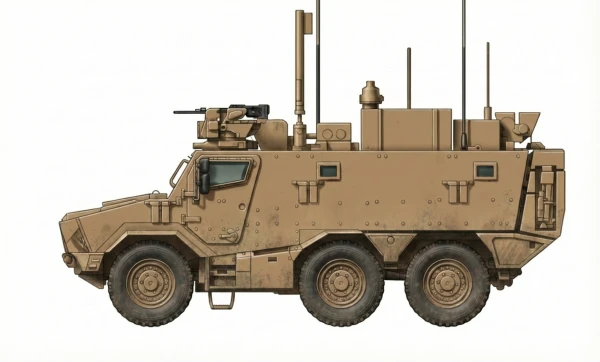
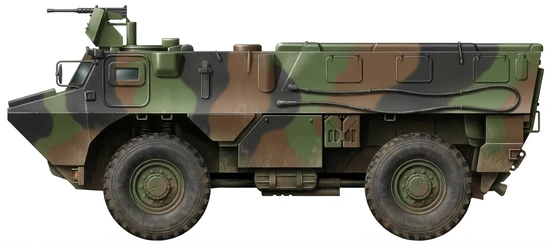
| Nexter Griffon | VAB | |
|---|---|---|
| Origin country | 🇫🇷 France | 🇫🇷 France |
| Category | Armored Personnel Carrier | Armored Personnel Carrier |
| Type | Multirole armoured personnel carrier | 6x6 Armored Personnel Carrier |
| Manufacturer | Arquus / Nexter / Thales | GIAT Industries / Renault Trucks Defense |
| Number produced | 575 units | 5,000 units |
| Estimated unit price | $1.1 million | $-- million |
| Combat weight | 24.5 tons | 13.8 tons |
| Maximum speed | 90 km/h | 92 km/h |
| Operational range | 800 km | 1,000 km |
| Length | 7.58 m | 5.98 m |
| Width | 2.54 m | 2.49 m |
| Height | 2.60 m | 2.06 m |
| Crew | 10 (1 pilot, 1 gunner + 8 soldiers max) | 2 |
| Nexter Griffon | VAB | |
|---|---|---|
| Main armament | 7.62 mm or 12.7 mm machine gun | 1 7.62mm machine gun |
| Secondary weapon | 40 mm LGA | -- |
| Engine | Renault 400 ch (300kW) | MAN 6-Cylinder Diesel Engines with 235 hp |
Detailed Comparison
The Griffon VBMR (Véhicule Blindé Multi-Rôle) functions as the direct successor to the VAB (Véhicule de l'Avant Blindé) within the French Army's SCORPION modernization program. While the VAB entered service in 1979 as a lightweight, amphibious transport designed for Cold War mobilization, the Griffon, commissioned in 2019, represents a heavier, networked platform optimized for asymmetric warfare and digital integration.
Development and Design
The VAB was developed by GIAT/Renault to provide a simple, 13.8-ton monocoque steel hull capable of amphibious operations. Its design emphasizes a low profile and mechanical reliability, with over 5,000 units produced. Conversely, the Griffon is a 24.5-ton 6x6 platform developed by a consortium (Nexter, Arquus, Thales). It utilizes a semi-modular architecture to support various mission profiles. A defining technical divergence is the Griffon's vetronics suite; it integrates the SICS combat information system and CONTACT software-defined radios for real-time data sharing ("infovalorization"), a capability absent in the analog-era design of the standard VAB.
Protection and Firepower
Protection standards have shifted significantly between the two vehicles.
- Armor: The VAB relies on high-hardness steel, effective against small arms and shrapnel. Later "Ultima" upgrades added ceramic plating and belly reinforcement against IEDs, but at the cost of amphibious capability. The Griffon was designed with IED and mine resistance as a baseline, offering superior ballistic protection through modular armor kits and a standard CBRN overpressure system.
- Armament: The VAB typically mounts a manually operated 7.62mm or 12.7mm machine gun, exposing the gunner. The Griffon standardizes the Hornet remote weapon station (RWS), allowing under-armor operation of machine guns or 40mm grenade launchers, coupled with acoustic gunshot detection sensors for automated threat slew-to-cue.
Mobility and Logistics
The VAB is powered by a 235 hp MAN diesel engine, achieving speeds of 92 km/h with an operational range of 1,000 km. Its lighter footprint facilitates transport by tactical airlifters such as the C-130. The Griffon utilizes a Renault 400 hp turbodiesel to manage its increased mass. While it matches the VAB's top speed of 90 km/h, its range is reduced to 800 km. The Griffon compensates for its size with a rear-axle steering system to reduce its turning radius, but its weight necessitates heavy lift capabilities like the A400M for air transport.
Deployment and Combat Record
The VAB possesses an extensive combat history, participating in conflicts in Lebanon, the Persian Gulf, the Balkans, Afghanistan, and the Sahel (Operation Barkhane). It is currently active in high-intensity combat in Ukraine. The Griffon is in the initial phase of its service life, replacing VAB regiments in the French Army and fulfilling export orders for Belgium and Luxembourg under the CaMo program.
Conclusion
The VAB remains a functional asset for forces requiring high strategic mobility and mechanical simplicity, though its survivability is compromised in high-threat environments. The Griffon offers a distinct advantage in force protection and situational awareness, essential for modern combined arms operations. It effectively trades the logistical lightness of the VAB for the survivability and digital connectivity required on the contemporary battlefield.