BTR-82A vs IAV Stryker
BTR-82A vs IAV Stryker at a glance — weight 15,400 vs 17,263 kg, top speed 90 vs 97 km/h, range 600 vs 500 km, crew — vs 2.
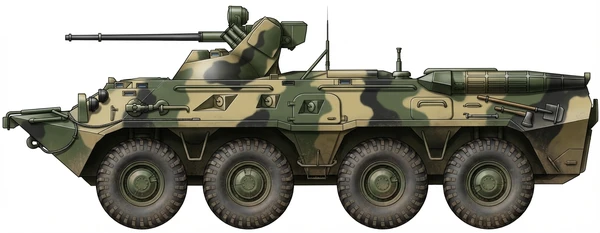
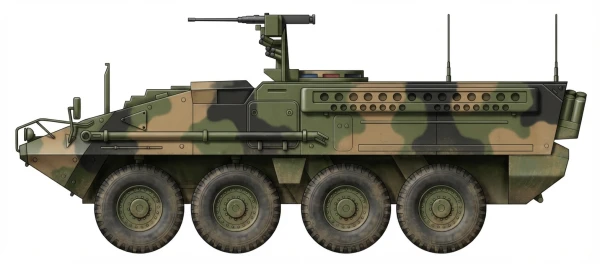
| BTR-82A | IAV Stryker | |
|---|---|---|
| Origin country | 🇷🇺 Russia | 🇺🇸 United States |
| Category | Armored Personnel Carrier | Armored Personnel Carrier |
| Type | Amphibious armored personnel carrier | 8x8 Armored Personnel Carrier |
| Manufacturer | Arzamas Machine-Building Plant | General Motors |
| Number produced | 5,000 units | 1,000 units |
| Estimated unit price | $-- million | $4.9 million |
| Combat weight | 15.4 tons | 17.3 tons |
| Maximum speed | 90 km/h | 97 km/h |
| Operational range | 600 km | 500 km |
| Length | 7.70 m | 6.99 m |
| Width | 2.90 m | 2.72 m |
| Height | 2.41 m | 2.64 m |
| Crew | 3 (+7 passengers) | 2 |
| BTR-82A | IAV Stryker | |
|---|---|---|
| Main armament | 14.5 mm KPVT machine gun | 1 M-2 HB 12.7mm machine gun |
| Secondary weapon | 30 mm 2A72 autocannon | 1 Mk-19 40mm grenade launcher |
| Engine | diesel KamAZ-7403 260 hp (190 kW) | Diesel Engine with 350 hp |
Detailed Comparison
The IAV Stryker and the BTR-82A are 8x8 wheeled armored platforms designed to provide mobility and fire support to infantry formations. The Stryker, derived from the Canadian LAV III, emerged from the U.S. Army's post-Cold War transformation requirements to bridge the gap between light and heavy forces, while the BTR-82A constitutes a modernization of the Soviet-era BTR-80 chassis. Both vehicles utilize wheeled configurations for strategic mobility but differ in armament focus, protection levels, and amphibious capabilities.
Development and Design
Developed by General Dynamics Land Systems-Canada, the IAV Stryker entered service in 2002. It utilizes a high-hardness steel hull, with later iterations integrating a Double V-Hull (DVH) to mitigate blast effects from improvised explosive devices (IEDs). The design emphasizes modularity, supporting variants from mortar carriers to the M-SHORAD air defense system.
The BTR-82A, adopted by the Russian Ministry of Defense in 2013, updates the BTR-80 lineage. Manufactured by Arzamas Machine-Building Plant, it retains the rear-engine layout of its predecessors but integrates a new turret and internal spall liners. Unlike the Stryker, the BTR-82A was designed as a fully amphibious vehicle, propelled by a rear-mounted hydrojet.
Protection and Firepower
The Stryker offers higher baseline protection, with a combat weight of 17.26 tons compared to the BTR-82A's 13.6 tons. Standard Stryker armor withstands 14.5mm rounds frontally and 7.62mm all-around; bolt-on ceramic kits extend 14.5mm protection to the entire vehicle. The BTR-82A relies on upgraded ballistic steel and spall liners but generally offers less resistance to heavy machine gun fire and artillery fragments.
Regarding firepower, the standard infantry carrier Stryker mounts a Remote Weapon Station (RWS) with a 12.7mm M2 machine gun or 40mm Mk-19 grenade launcher. The BTR-82A carries a significantly heavier standard armament: a stabilized 30mm 2A72 autocannon and a 7.62mm coaxial machine gun. While the Stryker Dragoon variant also mounts a 30mm cannon, the baseline US vehicle lacks the organic anti-armor capability found on the standard Russian counterpart.
Mobility and Logistics
Powered by a 350 hp diesel engine, the Stryker achieves a top speed of 97 km/h. Its heavier weight limits off-road mobility in soft soil compared to lighter platforms. The BTR-82A utilizes a 300 hp diesel engine, reaching 90 km/h with an operational range of 600 km, exceeding the Stryker's 500 km range. The defining mobility difference is the BTR-82A's ability to cross water obstacles autonomously; the Stryker requires bridge support or preparation for deep fording.
Deployment and Combat Record
The U.S. Army deployed the Stryker to Iraq in 2003, Afghanistan in 2009, and Syria in 2017. The platform has maintained high operational readiness rates in combat. It is currently employed by the Ukrainian 82nd Air Assault Brigade. The BTR-82A saw its first combat use in Syria in 2015 and is extensively used in the Russian invasion of Ukraine.
Conclusion
The IAV Stryker prioritizes crew survivability and modularity, evidenced by the Double V-Hull and diverse mission packages. It serves as a well-protected troop transport that relies on specialized variants or external support for heavy firepower. In contrast, the BTR-82A emphasizes organic fire support and operational mobility through its standard 30mm autocannon and amphibious capability. While the Stryker offers superior armor protection, the BTR-82A provides a lighter, more aggressively armed platform suited for riverine and rapid maneuver operations where heavy armor is not the primary concern.