GTK Boxer vs IAV Stryker
GTK Boxer vs IAV Stryker at a glance — weight 36,500 vs 17,263 kg, top speed 103 vs 97 km/h, range 1,050 vs 500 km, crew 2 vs 2.
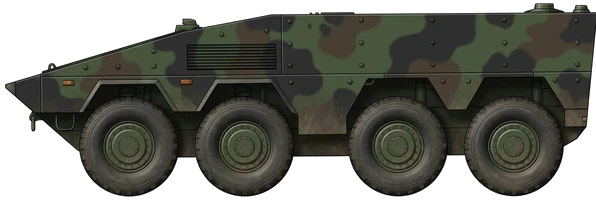
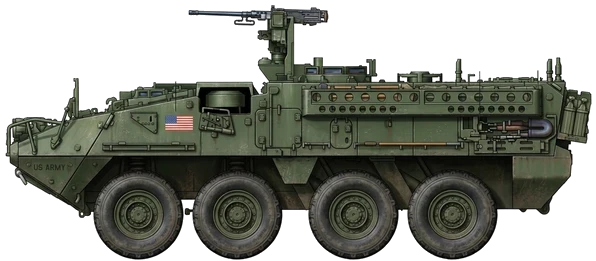
| GTK Boxer | IAV Stryker | |
|---|---|---|
| Origin country | 🇩🇪 Germany | 🇺🇸 United States |
| Category | Armored Personnel Carrier | Armored Personnel Carrier |
| Type | 8x8 Armored Personnel Carrier | 8x8 Armored Personnel Carrier |
| Manufacturer | ARTEC | General Motors |
| Number produced | 472 units | 1,000 units |
| Estimated unit price | $5 million | $4.9 million |
| Combat weight | 36.5 tons | 17.3 tons |
| Maximum speed | 103 km/h | 97 km/h |
| Operational range | 1,050 km | 500 km |
| Length | 7.93 m | 6.99 m |
| Width | 3.00 m | 2.72 m |
| Height | 2.37 m | 2.64 m |
| Crew | 2 | 2 |
| GTK Boxer | IAV Stryker | |
|---|---|---|
| Main armament | 1 Mk-19 40mm grenade launcher | 1 M-2 HB 12.7mm machine gun |
| Secondary weapon | 1 MAG 7.62mm machine gun | 1 Mk-19 40mm grenade launcher |
| Engine | Turbo-Diesel Engine with 710 hp | Diesel Engine with 350 hp |
Detailed Comparison
The GTK Boxer acts as a heavy-class, highly modular platform emphasizing maximum crew survivability and payload adaptability, while the IAV Stryker serves as a medium-weight interim force vehicle designed for rapid strategic deployability and C-130 transportability. The Boxer, weighing nearly double the Stryker in standard configuration, prioritizes protection and internal volume, whereas the Stryker prioritizes operational mobility and fleet commonality within U.S. Brigade Combat Teams.
Development and Design
The Boxer utilizes a unique modular architecture separating the "Drive Module" from interchangeable "Mission Modules." This allows reconfiguration for specific roles (ambulance, command, infantry) in under one hour, distinct from the Stryker's conventional monocoque hull. Originating from the U.S. Army's "Objective Force" initiative, the Stryker was built to bridge the gap between light and heavy units using a derivative of the LAV III. While the Boxer was designed from the outset with a focus on mine protection via a decoupled floor, the Stryker required retrofitting with the Double V-Hull (DVH) to effectively mitigate improvised explosive device (IED) threats encountered during the Global War on Terror.
Protection and Firepower
The Boxer’s 32-ton combat weight reflects its emphasis on heavy armor, utilizing rolled all-welded steel with AMAP appliqué modules and a triple-layered floor. The Stryker offers base protection against 14.5mm rounds and artillery fragments, augmented by bolt-on ceramic tiles or slat armor. Firepower is comparable in standard APC configurations, typically utilizing Remote Weapon Stations (RWS) with 12.7mm machine guns or 40mm grenade launchers. However, both platforms have evolved up-gunned variants; the Stryker Dragoon mounts a 30mm Mk44 Bushmaster II, while Boxer mission modules now include the Lance 30mm turret, Skyranger air defense, and the RCH 155 mobile artillery system.
Mobility and Logistics
The Boxer possesses superior raw kinematic performance, powered by a 710 hp turbo-diesel engine compared to the Stryker's 350 hp Caterpillar unit. This provides the heavier Boxer with a high power-to-weight ratio and an impressive operational range of 1050 km, more than double the Stryker's 500 km. While the Boxer achieves a top speed of 103 km/h against the Stryker's 97 km/h, the Stryker's significantly lower weight (17.2 tons vs 32 tons) offers distinct logistical advantages. The Stryker fits within a C-130 Hercules, whereas the Boxer requires larger transports like the A400M, limiting its strategic air mobility.
Deployment and Combat Record
The Stryker has an extensive combat lineage, serving as the backbone of U.S. medium brigades in Iraq since 2003 and later Afghanistan. Its readiness rates remained above 96% in combat theaters. The Boxer saw deployment with the ISAF in Afghanistan and is currently active in the Russo-Ukrainian War alongside the Stryker. While the Stryker has faced decades of asymmetric warfare necessitating armor upgrades, the Boxer entered service later, incorporating many lessons regarding mine survivability into its initial design.
Conclusion
The IAV Stryker remains a cost-effective solution for projecting force rapidly across strategic distances, ideal for air-mobile brigades requiring significant organic firepower. Conversely, the GTK Boxer represents a newer generation of wheeled APC design, trading strategic deployability for tactical superiority. Its modularity and heavy armor make it the preferred choice for high-intensity peer conflicts where crew survivability and payload capacity outweigh the logistical footprint.