Merkava vs Merkava 3
Merkava vs Merkava 3 at a glance — weight 61,000 vs 63,000 kg, top speed 55 vs 55 km/h, range 500 vs 500 km, crew 4 vs 4.
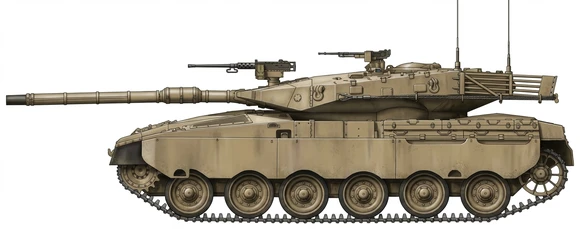
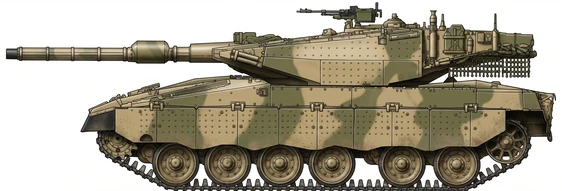
| Merkava | Merkava 3 | |
|---|---|---|
| Origin country | 🇮🇱 Israel | 🇮🇱 Israel |
| Category | Main Battle Tank | Main Battle Tank |
| Type | Heavy Main Battle Tank | Heavy Main Battle Tank |
| Manufacturer | Israeli Military Industries | Israeli Military Industries |
| Number produced | 2,270 units | 1,000 units |
| Estimated unit price | $3 million | $3.5 million |
| Combat weight | 61.0 tons | 63.0 tons |
| Maximum speed | 55 km/h | 55 km/h |
| Operational range | 500 km | 500 km |
| Length | 7.60 m | 8.80 m |
| Width | 3.70 m | 3.70 m |
| Height | 2.70 m | 2.80 m |
| Crew | 4 | 4 |
| Merkava | Merkava 3 | |
|---|---|---|
| Main armament | 1 M68 105mm rifled barrel (50 shells) gun | 1 IMI 120mm rifled barrel (50 shells) gun |
| Secondary weapon | 1 60mm mortar | 1 60mm mortar |
| Engine | Continental AVDS 1790-9AR V-12 Diesel Engine with 900 hp | Continental AVDS 1790 V-12 Diesel Engine with 1200 hp |
Detailed Comparison
The transition from the baseline Merkava to the Merkava 3 tracks the Israel Defense Forces' (IDF) operational shift from a heavy, defensively oriented tank to a modern main battle tank. The original 61-ton platform prioritized crew survivability following the 1973 Yom Kippur War. Ten years later, the 63-ton Mark 3 rebalanced the vehicle by upgrading lethality and mobility, while retaining the base front-engine architecture.
Development and Design
Brigadier General Israel Tal initiated the original Merkava program in 1970 following the cancellation of a British Chieftain procurement. Entering service in 1979, the baseline Merkava placed the engine at the front of the hull as a physical barrier against frontal penetrations, creating a rear compartment accessed via a clamshell door for infantry or casualty transport. The Mark 3, fielded in 1989, retained this architecture but replaced the baseline cast and spaced steel with the Kasag modular armor system. This modularity allowed the IDF to swap damaged sections in the field and integrate structural upgrades, culminating in the Mark 3D Dor-Dalet variant's removable composite turret blocks.
Protection and Firepower
The firepower delta between the two platforms defines their operational eras. The original Merkava utilizes the M68 105mm rifled gun, restricting its lethality against post-Cold War armor. The Mark 3 upgraded to the IMI 120mm smoothbore gun, enabling the use of standard Western APFSDS munitions and the LAHAT anti-tank guided missile.
Fire control system differences dictate engagement capabilities:
- The original Merkava lacked true fire-on-the-move capability and modern thermal optics.
- The Mark 3 BAZ integration introduced fully stabilized panoramic commander's sights and thermal imaging, establishing hunter-killer protocols and independent turret tracking.
Both platforms feature an internal 60mm mortar, but the Mark 3 mechanized the system for remote firing from under armor.
Mobility and Logistics
The original Merkava's 900-horsepower Continental AVDS 1790-9AR diesel engine struggled with the vehicle's 61-ton mass, yielding a power-to-weight ratio of 14.7 hp/ton. The Mark 3 integrated a 1,200-horsepower variant of the AVDS 1790. Despite a weight increase to 63 tons, the Mark 3 achieves 19 hp/ton. Both maintain a maximum speed of 55 km/h, but the Mark 3 generates higher torque for maneuvering in the basalt terrain of the Golan Heights and the mud of South Lebanon.
Deployment and Combat Record
The Mark 1 validated its survivability concept during the 1982 Lebanon War against Syrian armor, though its 105mm gun required multiple hits to defeat T-72s. The Mark 3 served as the IDF's numerical backbone from the First Intifada through the 2006 Lebanon War. In 2006, tandem-warhead weapons like the 9M133 Kornet and RPG-29 penetrated the Mark 3's passive modular armor, forcing the IDF to fast-track the Trophy active protection system for the subsequent Mark 4.
Conclusion
The Merkava 3 holds the definitive edge in any mechanized combat scenario. The baseline Merkava succeeded as a localized counter to 1970s Soviet export armor, but its underpowered drivetrain and 105mm armament relegate it to obsolescence. The Mark 3's 120mm smoothbore gun, 1,200-horsepower powerplant, and thermal hunter-killer optics provide the kinetic energy and acquisition speed required for modern armored warfare, justifying its retention in IDF reserve formations and viability for foreign military sales.