Continental AVDS 1790-9AR V-12 Diesel Engine with 900 hp
Detailed Comparison
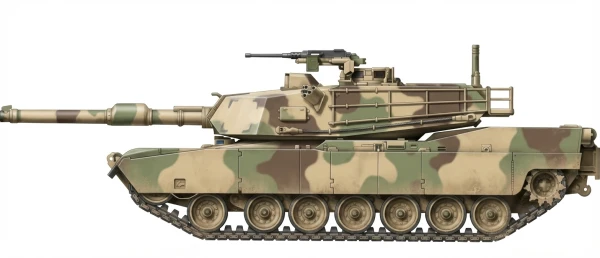
The General Dynamics M1A1 Abrams was engineered to engage Soviet mechanized formations across the European plain, prioritizing kinetic energy protection and mobility. The Israeli Military Industries Merkava was designed specifically for the confined, rocky terrain of the Levant and urban engagements, subordinating strategic mobility to maximum crew survivability.
Development and Design
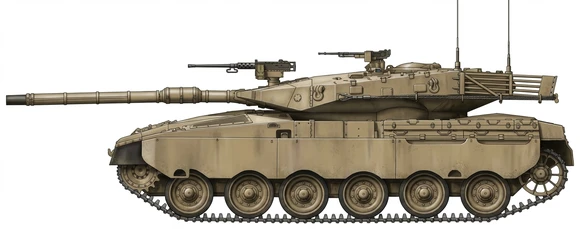
After the joint US-German MBT-70 program ended in 1970, the US Army initiated the XM1 project. The resulting M1 chassis centers on a gas turbine powerplant and isolated ammunition storage. Israel initiated the Merkava program in 1970 after the UK canceled a Chieftain procurement deal. Brigadier General Israel Tal inverted standard tank architecture by placing the Continental AVDS 1790-9AR diesel engine at the front. This created a physical barrier to protect the crew and enabled a rear clamshell door, allowing the vehicle to transport infantry, evacuate casualties, or carry additional ammunition under armor.
Protection and Firepower
The vehicles use divergent survivability architectures:
The M1A1 integrates Chobham composite armor with depleted uranium meshes, storing its 120mm M256 smoothbore ammunition in a turret bustle equipped with blowout panels.
The base Merkava relies on modular sloped steel and the forward engine block to shield the crew, arming early variants with a 105mm M68 rifled gun and an internal 60mm mortar for defilade fire.
While Israel upgraded the Mark 3 and 4 with 120mm guns and the Trophy active protection system (APS), the Mark 1 and 2 relied heavily on their spatial layout to absorb penetrators.
Mobility and Logistics
The Abrams' AGT-1500 gas turbine generates 1,500 hp, propelling the 63-ton vehicle to 66 km/h. This propulsion requires a heavy logistics tail due to high fuel consumption rates. The 61-ton early Merkava uses a 900 hp diesel engine, limiting its maximum speed to 55 km/h. The diesel powerplant offers a marginally better operational range of 500 km compared to the M1A1's 465 km and demands less maintenance infrastructure, aligning with Israel's short interior lines of communication.
Deployment and Combat Record
The M1A1 destroyed Iraqi T-72s in the 1991 Gulf War at ranges exceeding 2,500 meters. Deployments in Ukraine in 2023 and 2024 revealed vulnerabilities to top-attack munitions and FPV drones when operating without localized air defense. The Merkava first engaged Syrian T-62s during the 1982 Lebanon War. During the 2006 Lebanon War, concentrated ATGM strikes exposed vulnerabilities in the passive armor, prompting the IDF to mandate APS integration on subsequent models. The Merkava operates almost exclusively in asymmetric conflicts, while the M1A1 has seen extensive export to conventional mechanized forces globally.
Conclusion
The M1A1 Abrams holds the advantage in maneuver warfare across open terrain. Its higher power-to-weight ratio and 120mm main gun make it a more capable platform for destroying peer armor at extended ranges. The Merkava outperforms the Abrams in low-intensity, urban combat operations. Its front-engine layout, internal mortar, and rear escape hatch provide tactical options for infantry coordination and crew survival in environments where attacks occur at close range and from all axes.
The M1A1 Abrams is faster with a maximum road speed of 66 km/h compared to the Merkava's 55 km/h.
Which has longer operational range, the M1A1 Abrams or Merkava?
The Merkava has a longer operational range at 500 km compared to the M1A1 Abrams's 465 km.
Which is heavier, the M1A1 Abrams or Merkava?
The M1A1 Abrams is heavier at 63.0 tons combat weight compared to the Merkava's 61.0 tons.
Which is larger, the M1A1 Abrams or Merkava?
The M1A1 Abrams is longer at 9.83 meters compared to the Merkava's 7.60 meters.
How many crew members do the M1A1 Abrams and Merkava require?
Both the M1A1 Abrams and Merkava require a crew of 4.
Which is more expensive, the M1A1 Abrams or Merkava?
The M1A1 Abrams is more expensive at approximately $4.3 million per unit compared to the Merkava at $3.0 million.
Which has been built in greater numbers, the M1A1 Abrams or Merkava?
The M1A1 Abrams has been produced in greater numbers with 9,200 units compared to 2,270 units of the Merkava.
What are the main armaments of the M1A1 Abrams and Merkava?
The M1A1 Abrams is armed with 1 M256 120mm smoothbore barrel (40 shells) gun while the Merkava carries 1 M68 105mm rifled barrel (50 shells) gun as its main armament.