Merkava
Israeli main battle tank, incorporates engine-forward design, used extensively in the Yom Kippur War. Key figures: weight 61 t, top speed 55 km/h, range 500 km, unit cost $3M, built 2,270. In service with 2 armies — Israel, Philippines.
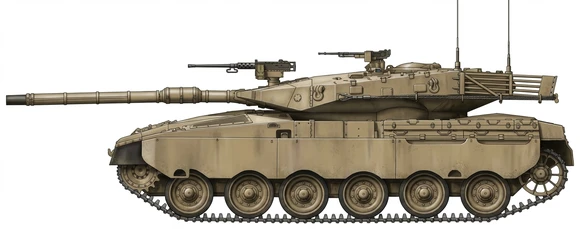
| Sub-type | Heavy Main Battle Tank |
| Crew | 4 personnels |
| Range | 500 km |
| Mass | 61.0 tons |
| Height | 2.7 m (8.9 ft) |
| Width | 3.7 m (12.1 ft) |
| Length | 7.6 m (24.9 ft) |
| Max. speed | 55 km/h (34 mph) |
| Engine | Continental AVDS 1790-9AR V-12 Diesel Engine with 900 hp |
| Weapon 1 | 1 M68 105mm rifled barrel (50 shells) gun |
| Weapon 2 | 1 60mm mortar |
| Weapon 3 | 3 7.62mm M-240 machine guns (10,000 rounds) |
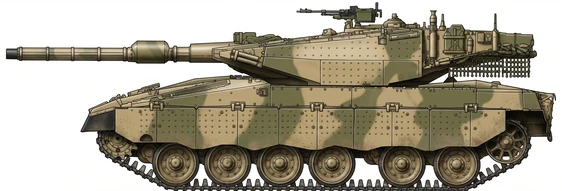
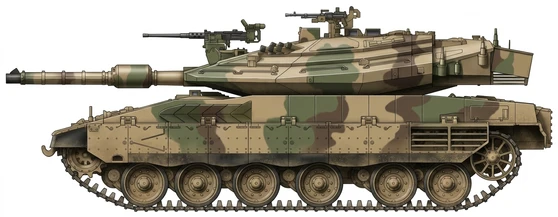
Description
Development of the Merkava main battle tank began in 1970 within the Israeli Ministry of Defense's Merkava and Armored Combat Vehicles Division. Following the cancellation of a proposed purchase and domestic production of the British Chieftain tank, Brigadier General Israel Tal initiated the program to produce an indigenous armored platform based on lessons from the 1973 Yom Kippur War. Initial designs were completed in 1974, and the first production variant, the Merkava Mark 1, entered official service with the Israel Defense Forces in 1979.
The Merkava design is configured for crew protection and survivability. The engine is positioned in the front of the hull to serve as additional shielding for the crew compartment against frontal attacks. This layout creates a space in the rear of the hull, accessed via a clamshell-style door, which allows the vehicle to carry infantry, casualties on stretchers, or additional ammunition. The armor consists of modular composite and sloped designs, allowing for the rapid replacement of damaged sections in the field.
The Mark 1 and 2 variants utilize a 105mm rifled main gun, while the Mark 3 and 4 versions incorporate a 120mm smoothbore gun capable of firing Western-standard ammunition and the LAHAT anti-tank guided missile. Secondary armament includes an internal 60mm mortar, 7.62mm machine guns, and a 12.7mm heavy machine gun. The Mark 4M variant is equipped with the Trophy active protection system, which uses radar sensors to detect and intercept incoming anti-tank projectiles. The Mark 4 Barak, entering service in 2023, integrates the Iron Vision helmet-mounted display to provide the crew with 360-degree situational awareness through external cameras.
The Merkava is produced in large numbers for the Israel Defense Forces and has been exported to the Philippines in an armored vehicle-launched bridge configuration. The tank first saw combat in the 1982 Lebanon War. It was subsequently deployed during the South Lebanon conflict, the First and Second Intifadas, and the 2006 Lebanon War. During the 2006 conflict, the vehicle faced various anti-tank guided missiles, leading to the further development of active protection systems. In 2011, a Merkava equipped with the Trophy system recorded the first successful operational interception of a rocket-propelled grenade. The platform has since been utilized in Operation Protective Edge and the 2023 Israel-Hamas War. Derivatives of the chassis include the Namer infantry fighting vehicle and the Nemmera armored recovery vehicle.
Frequently Asked Questions
What type of vehicle is the Merkava?
What is the weight of the Merkava?
What is the maximum speed of the Merkava?
What is the operational range of the Merkava?
How many crew members does the Merkava require?
How many Merkava have been built?
What weapons does the Merkava carry?
- SEP 42026 Verified Weight verified against the published specifications
- JUL 272026 Updated Service entry year added; number built added; service status added
- JUL 232026 Updated Sources and cross-references refreshed
- APR 72026 Updated Description added
- JAN 242026 Updated Cost added
- JAN 172026 Updated Description added