Type 100 vs Type 99
Type 100 vs Type 99 at a glance — top speed 80 vs 65 km/h, crew 3 (commander, driver, gunner) vs 3.
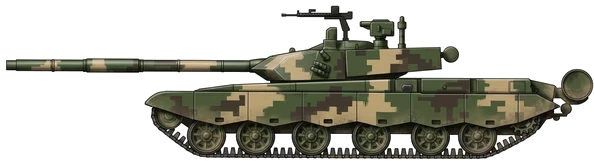
| Type 100 | Type 99 | |
|---|---|---|
| Origin country | 🇨🇳 China | 🇨🇳 China |
| Category | Main Battle Tank | Main Battle Tank |
| Type | Main Battle Tank | Medium Main Battle Tank |
| Manufacturer | Baotou Tank Plant | Norinco |
| Number produced | -- units | 1,300 units |
| Estimated unit price | $-- million | $2.5 million |
| Combat weight | 0.0 tons | 52.0 tons |
| Maximum speed | 80 km/h | 65 km/h |
| Operational range | -- km | 450 km |
| Length | -- m | 9.99 m |
| Width | -- m | 3.45 m |
| Height | -- m | 2.30 m |
| Crew | 3 (commander, driver, gunner) | 3 |
Detailed Comparison
China’s armored force transitions between two contrasting operational paradigms with the legacy Type 99 and the newly unveiled Type 100. The PLA's reliance on Soviet-derived manned turret architectures gives way to automated platforms prioritizing signature reduction and crew isolation.
Development and Design
The Type 99 evolved from the Soviet T-72 chassis. Entering service in 2001, its iterations—Type 99A (2011) and high-altitude Type 99B (2025)—focused on incremental armor and drivetrain upgrades. The 2025 Type 100 alters this trajectory by mimicking the Russian T-14 Armata’s architecture. It shifts the three-man crew into a reinforced armored hull cabin, utilizing an unmanned turret. The crew interacts via augmented reality and multi-band optical feeds, directly addressing the situational awareness deficits that limit closed-hatch operations in urban terrain.
Protection and Firepower
Type 99 protection relies on mass: modular composite blocks and Relikt-type explosive reactive armor (ERA), supplemented by the JD-3 blinding laser. The Type 100 pivots to active measures. It integrates two GL-6 hard-kill active protection systems (APS) guided by four phased-array radars, specifically calibrated to intercept top-attack munitions and FPV drones—vulnerabilities heavily exploited in Ukraine and the Middle East.
Firepower diverges sharply. The Type 99 employs a 125mm ZPT-98 smoothbore with a carousel autoloader, a system historically prone to catastrophic ammunition detonation. The Type 100 downsizes to an autoloaded 105mm gun. Advanced propellants maintain parity with heavier 120/125mm systems while reducing internal volume requirements and eliminating the carousel hazard. A 12.7mm RWS with thermal optics provides organic counter-UAS capability for the Type 100.
Mobility and Logistics
Both platforms utilize 1,500 hp powerplants, but the Type 100’s hybrid diesel-electric system enables an 80 km/h top speed compared to the Type 99’s 65 km/h. The hybrid drive introduces a full-electric mode, masking acoustic and infrared signatures against modern thermal imagers. The Type 99’s 52-ton mass requires heavy logistical tethering. The Type 100’s 105mm gun and unmanned turret likely reduce its overall combat weight, easing rail transport and bridging operations across Indo-Pacific infrastructure constraints.
Deployment and Combat Record
The Type 99 has equipped PLA heavy combined arms brigades in the Northern Theater Command for two decades, with the recent Type 99B deployed to the Himalayan border. Neither vehicle possesses a combat record. The Type 100’s design, however, explicitly integrates current battlefield feedback, incorporating drone-swarm command nodes and multi-spectrum signature management entirely absent in the Type 99’s Cold War-era framework.
Conclusion
The Type 100 holds a decisive edge in high-intensity, sensor-saturated environments. The Type 99's carousel autoloader and reliance on passive ERA make it structurally vulnerable to loitering munitions and top-attack ATGMs. By isolating the crew in the hull, prioritizing hard-kill APS for 360-degree drone defense, and utilizing hybrid-electric stealth, the Type 100 maximizes survivability. The shift to a 105mm gun is a calculated trade-off, favoring logistical footprint and platform weight over raw caliber.