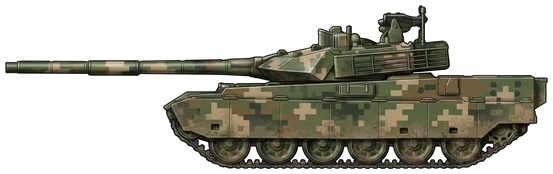
VT/E1 V12 diesel engine 1,200 hp (895 kW) at 2,300 rpm
Detailed Comparison
Beijing's armored warfare procurement divides sharply between domestic fielding and foreign military sales. The Type 100, entering service in 2025, integrates a hybrid-electric drive and an unmanned turret into a new architecture for the PLA. Conversely, Norinco’s VT-4 (MBT-3000) relies on a conventional 52.0-ton chassis and older Type 96B/99A subsystems to capture export market share among non-aligned states.
Development and Design
The VT-4 emerged from the 2009 MBT-3000 program, engineered specifically to eliminate China's reliance on Western-sourced powertrains. It repackages mature domestic components for export clients. The Type 100 discards the Soviet-legacy manned turret paradigm entirely. It places its three-man crew inside the hull, utilizing wearable augmented reality and multi-band optics to maintain situational awareness—a direct structural response to the high attrition rates of turret crews in recent conventional conflicts.
Protection and Firepower
The VT-4 mounts a traditional ZPT-98A 125mm smoothbore gun fed by a carousel autoloader, a configuration highly vulnerable to catastrophic ammunition detonations. Protection relies on composite armor and FY-4 explosive reactive armor, rated at 500mm RHA equivalent frontally. The Type 100 shifts to an autoloaded 105mm gun in an unmanned turret, using advanced propellants to match 120/125mm kinetic energy yields while reducing the vehicle's silhouette. For defense, the Type 100 prioritizes the GL-6 active protection system (APS). This system integrates phased-array radars to intercept top-attack munitions and suicide drones—threats that repeatedly defeated conventional armor in Nagorno-Karabakh and Ukraine. The base VT-4 lacks APS, though the VT-4A1 variant adds the older GL5 system.
Mobility and Logistics
Norinco powers the VT-4 with a 1,200 hp VT/E1 V12 diesel, achieving 70.0 km/h and a 500 km range. The Type 100 adopts a 1,500 hp hybrid diesel-electric powerplant. This allows an 80.0 km/h top speed and a full-electric mode, drastically lowering the tank's acoustic and thermal signatures against modern infrared targeting pods.
Deployment and Combat Record
The VT-4's combat record reveals systemic mechanical and survivability issues across its export users:
Nigerian forces deployed the tank during Operation Tura Takai Bango against Boko Haram, losing at least one unit to a rocket-propelled grenade and experiencing a main gun failure during a military display.
Thailand reported a VT-4 main gun barrel rupture during a December 2025 border clash with Cambodia.
During a dynamic display at the 2024 Zhuhai Airshow, a Pakistani-operated VT-4 experienced a mechanical stall while climbing an artificial incline.
The Type 100 remains untested in combat, having only debuted at the September 2025 Victory Day Parade.
Conclusion
The Type 100 holds a definitive edge in modern, high-intensity mechanized warfare. The conflict in Ukraine proved that heavy frontal composite armor cannot compensate for top-attack vulnerabilities and FPV drone strikes. By adopting an unmanned turret, hybrid-electric stealth, and integrated drone command systems, the Type 100 mitigates these precise threats. The VT-4 is obsolete for near-peer conflicts; its carousel autoloader and conventional layout make it a liability against modern anti-tank guided missiles, limiting it to a basic fire-support asset for developing nations engaged in low-intensity conflicts.