Type 10 vs Type 100
Type 10 vs Type 100 at a glance — top speed 70 vs 80 km/h, crew 3 (commander, gunner and driver) vs 3 (commander, driver, gunner).
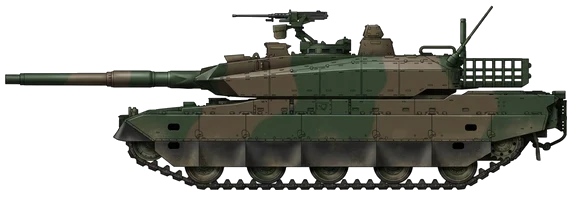
| Type 10 | Type 100 | |
|---|---|---|
| Origin country | 🇯🇵 Japan | 🇨🇳 China |
| Category | Main Battle Tank | Main Battle Tank |
| Type | Main battle tank | Main Battle Tank |
| Manufacturer | Mitsubishi Heavy Industries | Baotou Tank Plant |
| Number produced | 117 units | -- units |
| Estimated unit price | $11.3 million | $-- million |
| Combat weight | 48.0 tons | 0.0 tons |
| Maximum speed | 70 km/h | 80 km/h |
| Operational range | 500 km | -- km |
| Length | 9.49 m | -- m |
| Width | 3.24 m | -- m |
| Height | 2.30 m | -- m |
| Crew | 3 (commander, gunner and driver) | 3 (commander, driver, gunner) |
| Type 10 | Type 100 | |
|---|---|---|
| Main armament | Japan Steel Works 120 mm L/44 calibers-long smoothbore cannon with automatic loader | Autoloaded 105mm main gun |
| Secondary weapon | Type 90 12.7 mm machine gun | QJY-201 7.62mm coaxial machine gun |
| Engine | 4-stroke 22.6-litre diesel V8 MHI 8VA34WTK 1,200 hp/2,300 rpm | Hybrid diesel-electric, 1,500 hp |
Detailed Comparison
Japan's Type 10 prioritizes operational mobility within a restrictive domestic infrastructure, relying on a lightweight 48-ton chassis and localized C4I integration. Conversely, China’s Type 100 incorporates recent combat lessons regarding drone proliferation and top-attack munitions, utilizing an unmanned turret, a hybrid-electric drive, and dual active protection systems (APS).
Development and Design
Mitsubishi Heavy Industries designed the Type 10 to replace the Type 74 and supplement the Type 90. The Japanese Ministry of Defense required a tank lighter than the 50-ton Type 90 to cross 84% of Japan’s bridges, resulting in a modular design weighing 48 tons. The Type 100, produced by Baotou Tank Plant and debuted in 2025, follows an unmanned turret configuration. It places the three-man crew in a reinforced hull cabin to maximize survivability in the event of an ammunition detonation. The adoption of a hybrid diesel-electric powerplant allows the Type 100 to operate in full-electric mode, reducing acoustic and thermal signatures during stationary operations.
Protection and Firepower
The Type 10 relies on modular ceramic composite armor tailored against 120mm kinetic energy penetrators, supplemented by top-armor EFP protection. It lacks a hard-kill APS, a vulnerability exposed by FPV drones and ATGMs in Ukraine and the Middle East. The Type 100 addresses this threat vector directly:
- Dual GL-6 APS launchers use phased-array radars to intercept top-attack munitions and suicide drones.
- A 12.7mm RWS with thermal and optical tracking provides dedicated short-range drone defense.
- An integrated EW system functions alongside laser warning receivers.
Firepower diverges sharply. The Type 10 mounts a conventional Japan Steel Works 120mm L/44 smoothbore gun with a 3.5-second autoloader, firing standard NATO ammunition. The Type 100 downsizes to a 105mm autoloaded gun. Baotou claims kinetic parity with 120mm and 125mm systems through advanced propellants, which reduces recoil and ammunition volume requirements inside the unmanned turret. Fire control on the Type 10 utilizes the 10NW C4I system for platoon-level target synchronization. The Type 100 expands on this, using wearable augmented reality and multi-band imagery to manage the tank's armaments and external unmanned drones.
Mobility and Logistics
The Type 10 is powered by a 1,200 hp V8 diesel, but its continuously variable transmission (CVT) enables a 70 km/h top speed in both forward and reverse, allowing rapid withdrawal from firing positions. The 48-ton weight eliminates the transport bottlenecks that restrict 70-ton Western tanks. The Type 100 utilizes a 1,500 hp hybrid engine, generating an 80 km/h top speed. The unmanned turret and smaller gun caliber indicate a design focused on lowering ground pressure and simplifying railway logistics.
Deployment and Combat Record
Neither platform has sustained combat damage. The JGSDF operates 117 Type 10s strictly within Japan. Export attempts, notably a 2014 engine technology transfer for Turkey’s Altay project, failed over Japanese export laws. The Type 100 enters service in 2025 as a network node, giving its crew the hardware to command subordinate unmanned ground vehicles.
Conclusion
The Type 100 possesses a strict tactical advantage in high-intensity peer conflict. The proliferation of top-attack missiles and FPV drones renders the Type 10’s conventional composite armor and lack of APS inadequate for modern contested environments. The Type 100’s integration of drone-defeat mechanisms, crew isolation in a hull capsule, and thermal-reducing hybrid drive aligns directly with verified combat data from Eastern Europe. The Type 10 remains an optimized, closed-loop defensive platform for the Japanese home islands, but it requires an immediate APS retrofit to survive the current anti-armor threat landscape.