Eritrea Military Forces
Eritrea ranks #83 of 170 militaries worldwide in 2026, with 301,750 active troops. The Eritrean Army fields 488 ground vehicles, including 65 main battle tanks; the Air Force flies 20 aircraft, including 2 combat aircraft; the Navy operates 23 warships. Eritrea has no nuclear weapons.
Armed Forces in 2026
| Domain | Strength | Composition |
|---|---|---|
| Air Force | 20 aircraft | 2 combat 13 helicopters |
| Eritrean Navy | 23 warships | |
| Ground Forces | 488 vehicles | 65 main battle tanks |
| Personnel | 301,750 active |
ATLAS Index (Aggregate Total of Land, Air and Sea strength)
Full ranking →| Pillar | Weight | Score | Basis |
|---|---|---|---|
| Manpower | 10% | 52.6 | Active, reserve & paramilitary personnel |
| Ground forces | 20% | 24.0 | ARMS inventory power: armour & artillery by type and era, attack helicopters, armament |
| Naval power | 20% | 19.8 | SEAS inventory power: hulls by type, size and era, air wing, sustainment, armament |
| Air power | 25% | 14.7 | AIRS inventory power: aircraft by type and generation, enablers, armament |
| Nuclear deterrent | 10% | 0.0 | No declared nuclear capability |
| Defense budget | 15% | 11.9 | Annual spending, purchasing-power adjusted |
| Availability | modifier | ground ×0.80 · naval ×0.80 · air ×0.85 | Budget per point of each force, from the branch indexes |
Country File
| Population | 3.5M (2024) |
| GDP | $2.1 billion (2011) |
| GDP per capita | $584 |
| Military budget | $182M (2003) |
| Share of GDP | 20.9% (2003) |
| Share of govt spending | 46.4% (2003) |
| Military spending per capita | $75 (2003) |
| Capital | Asmara |
| Region | Africa |
| Land area | 125,000 km² |
| Coastline | 2,234 km |
| Land borders | 1,626 km |
| Bordering countries | 3 |
| Currency | ERN |
Strategic Overview in 2026
Strategic Position
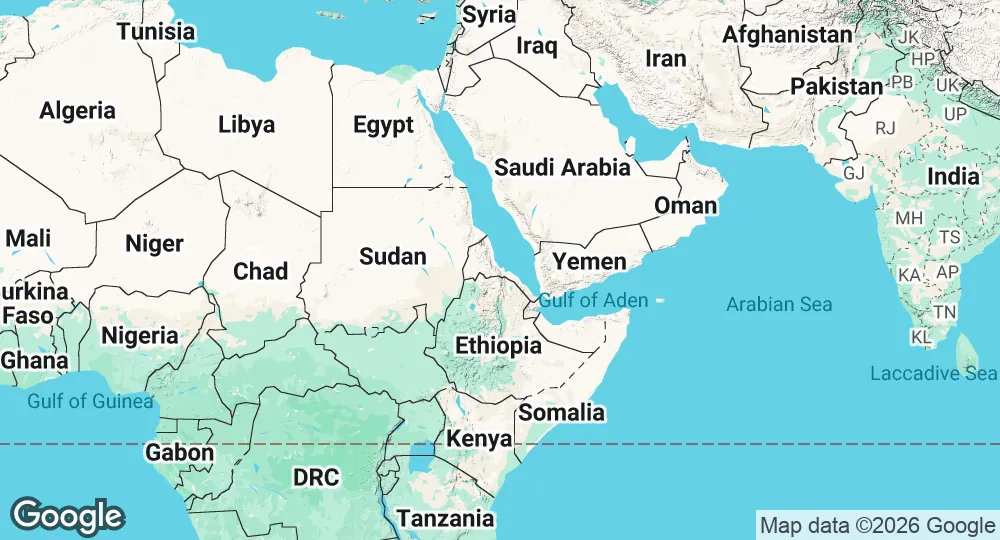
Eritrea occupies a coastal position on the Horn of Africa, bordering the Red Sea to the east, Ethiopia to the south, Sudan to the west, and Djibouti to the southeast. Its primary security concerns center on border integrity with Ethiopia and the maintenance of maritime control along its 1,150 km coastline and the Bab-el-Mandeb strait. Despite a 2018 peace agreement, the relationship with Ethiopia remains defined by militarized borders and shifting regional alignments following the 2020-2022 conflict in the Tigray region.
Eritrean defense doctrine is based on a policy of self-reliance and total national mobilization. The state maintains a high degree of militarization through the national service program, which provides the manpower for the Eritrean Defence Forces (EDF). Eritrea is not a member of any formal military alliances but has established bilateral security cooperation with Russia and China. In 2025, Eritrea expanded its technical cooperation with Russia, facilitating naval port calls at Massawa.
Regionally, Eritrea views the security of the Red Sea as its primary maritime priority. It remains wary of multilateral interventions in the Horn of Africa and generally opposes the presence of foreign military bases on its soil, though it has previously provided logistical facilities to the United Arab Emirates at Assab for operations in Yemen. Relations with Djibouti remain strained due to unresolved border disputes at Ras Doumeira.
Military Forces
The Eritrean Defence Forces (EDF) are organized into the Army, Air Force, and Navy. Command is centralized under the President, who serves as Commander-in-Chief, with the Ministry of Defence overseeing operational administration.
The EDF relies on a massive reserve system fueled by indefinite national service. Active-duty personnel numbers are estimated between 150,000 and 200,000, with a mobilized reserve capacity exceeding 300,000. All citizens are required to undergo military training at the Sawa Defence Training Centre.
Army The Army is the dominant branch, structured into corps and divisions that integrate both mechanized and infantry units.
-
Armor: The army operates Soviet-era main battle tanks, including T-54/55, T-62, and T-72 variants.
-
Infantry and Artillery: Maneuver units are equipped with BMP-1 and BTR-60 armored personnel carriers. Artillery support consists of 122mm and 152mm towed howitzers, alongside BM-21 Grad multiple rocket launchers and 2S1 Gvozdika self-propelled guns.
Air Force The Eritrean Air Force (ERAF) focuses on air defense and ground attack. It is headquartered at Asmara International Airport, with secondary bases at Massawa and Assab.
-
Combat Aircraft: The fleet includes Mikoyan MiG-29 and Sukhoi Su-27 fighters for air superiority, supplemented by Su-25 ground-attack aircraft.
-
Training and Transport: The ERAF utilizes Aermacchi MB-339 trainers and a small fleet of Antonov An-12 and An-24 transport aircraft.
-
Helicopters: Operations are supported by Mil Mi-8/17 transport helicopters and Mi-24/35 attack helicopters.
Navy The Navy is a coastal defense force tasked with patrolling the Exclusive Economic Zone (EEZ) and the Dahlak Archipelago.
- Vessels: The inventory consists of Osa-class missile boats, Swiftships patrol craft, and various small coastal interceptors. The navy lacks major surface combatants but maintains a presence in the ports of Massawa and Assab.
Defense Industry
Eritrea does not possess a large-scale domestic arms manufacturing sector and remains almost entirely dependent on foreign imports for advanced hardware. Domestic activity is restricted to the maintenance, repair, and overhaul (MRO) of existing Soviet-era equipment. The Gash Barka region hosts facilities for the repair of heavy vehicles and small arms. Eritrea relies on Russia and China for the procurement of spare parts, electronics, and ammunition. There are no known domestic aircraft or naval vessel production programs.
Strategic Trends
The primary trend in Eritrean defense as of 2026 is the consolidation of gains made during the Tigray conflict and the modernization of its aging inventory. Following the expiration of UN arms sanctions, the government has sought to formalize procurement channels with Moscow.
Modernization and Procurement Efforts are focused on upgrading the sensor suites of the Su-27 fleet and improving air defense networks. Procurement priorities include man-portable air-defense systems (MANPADS) and electronic warfare capabilities to counter regional drone proliferation.
Budget and Constraints Defense spending remains a high percentage of the national budget, though exact figures are not publicly disclosed by the government. The military’s capacity is constrained by long-term international isolation, which has led to a shortage of qualified technical personnel and modern logistics systems.
Force Structure Shifts There is an ongoing emphasis on the People's Militia, a secondary paramilitary force used for local security and border monitoring. This allows the regular EDF to maintain high-readiness units in strategic depth rather than dispersing them in static border positions. The military continues to prioritize internal security and the suppression of any perceived threats to the centralized administration.
Military Expenditure: information from the Stockholm International Peace Research Institute (SIPRI) Military Expenditure Database. Last updated on 4 August 2026. Suggest a change
Frequently Asked Questions
How large is Eritrea's military?
What is Eritrea's defense budget?
How does Eritrea rank militarily in the world?
Does Eritrea have nuclear weapons?
How many aircraft does Eritrea's air force have?
How large is Eritrea's navy?
How many tanks does Eritrea have?
What percentage of GDP does Eritrea spend on defense?
What is Eritrea's military personnel per capita?
- AUG 42026 Updated Global Military Index updated in a site-wide editorial pass
- JUL 242026 Updated Global Military Index updated
- JUL 162026 Updated Global Military Index updated in a site-wide editorial pass
- JUN 162026 Updated Economic and demographic series refreshed (3 yearly records)
- JAN 172026 Updated Main battle tank count and Global Military Index updated
- JAN 132026 Updated Description added
- JUN 172025 Updated Country data reviewed and updated