WZ-551
The WZ-551 is a Chinese 6x6 amphibious armored personnel carrier introduced in the 1980s, primarily used for troop transport and reconnaissance, distinguished by its modular design supporting multiple variant configurations. Key figures: weight 15.8 t, top speed 90 km/h, range 800 km, built 3,000. In service with 9 armies — China (1,850), Myanmar (450), Sri Lanka (200) and 6 others.
| Sub-type | Infantry Fighting Vehicle |
| Crew | 3 (commander, driver, gunner), plus 9 passengers personnels |
| Range | 800 km |
| Mass | 15.8 tons |
| Height | 2.8 m (9.2 ft) |
| Width | 2.8 m (9.2 ft) |
| Length | 6.63 m (21.8 ft) |
| Max. speed | 90 km/h (56 mph) |
| Engine | Deutz BF8L413F 8-cylinder, turbo-charged, air-cooled diesel, 320 hp |
| Weapon 1 | ZPT-99 30 mm stabilized autocannon |
| Weapon 2 | Type 86 7.62 mm coaxial machine gun |
| Weapon 3 | HJ-73C SACLOS anti-tank guided missile launch rail |
| Weapon 4 | Smoke grenade launchers (two clusters of three) |
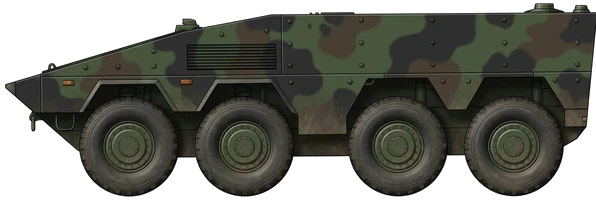
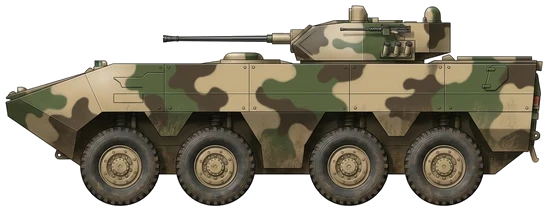
Description
The WZ-551 is a family of Chinese wheeled armoured vehicles produced by Norinco, covering two related generations designated Type 90 (ZSL-90) and Type 92 (ZSL-92) in People's Liberation Army service.
Development began in 1979, making it the first wheeled infantry fighting vehicle designed in China. It drew on experience from the WZ-521 armoured personnel carrier, which had been based on the Jiefang CA-30 truck. Proof-of-concept prototypes were completed in 1981 using an indigenous chassis derived from the imported Mercedes-Benz 2060 truck, with production licences for chassis and engine technology obtained from Mercedes-Benz and Deutz AG. Armament studies in 1982 considered 35 mm, 30 mm and 25 mm autocannon, a 12.7 mm machine gun, and a reverse-engineered 2A28 Grom; a 25 mm autocannon was selected for the IFV and a 12.7 mm machine gun for the APC. Subsystems were adapted from existing vehicles, including sights and the NBC overpressure system from the Type 86 IFV and the water-jettison system from the Type 63 amphibious tank. Cold- and hot-weather trials were conducted in northern China and on Hainan in 1986, the same year the Central Military Commission selected the WZ-551 over the competing WZ-523 as the PLA's future wheeled platform. A 1988 agreement with GIAT produced the NGV-1 prototype with a stabilised French 25 mm autocannon and fire-control system; the programme ended with the 1989 EU arms embargo. The vehicle was certified in 1990 with the domestic 25 mm gun.
Engine problems limited Type 90 production to fewer than a hundred vehicles. The revised WZ-551A substituted an air-cooled Deutz engine and equalised axle spacing, and was certified as the Type 92 in 1994, entering service in 1995 as the ZSL-92 IFV and ZSL-92A APC. It was shown publicly at the 1999 National Day parade. Planned 4×4 and 8×8 derivatives were realised as the WZ-550 and WZ-552.
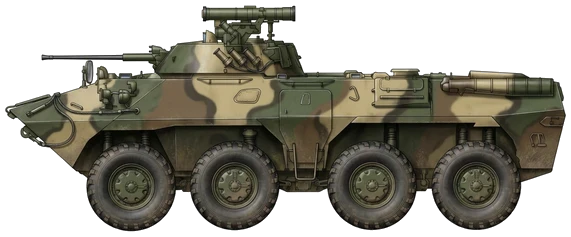
The hull is of fully welded steel, divided into three compartments, with driver and commander forward, engine amidships and turret basket and troop compartment at the rear. Protection is against small arms and shell splinters, with the frontal plate rated against 12.7 mm fire at 200 m. Steel-reinforced radial tyres permit continued travel after puncture, and ventilation and NBC systems are fitted. The automotive base is the Tiema XC2030 6×6 truck, a licence-built Mercedes-Benz 2026. The vehicle is amphibious, propelled in water by steerable propellers behind the rear wheels.
The ZSL-92 mounts the unstabilised ZPT-90 25 mm cannon, derived from the Type 87 anti-aircraft gun, with a Type 86 coaxial machine gun; the lack of stabilisation restricts accurate fire on the move. The ZSL-92A carries a QJC-88 12.7 mm machine gun and a larger troop compartment. The ZSL-92B introduced a stabilised ZPT-99 30 mm autocannon, HJ-73C missile rail, thermal sight, laser rangefinder and ballistic computer.
Derivatives include the PTL-02 100 mm assault gun, developed from the shelved PTL-87 and PTL-97 programmes after the Third Taiwan Strait Crisis; the PLL-05 120 mm gun-mortar; the ZSL-02B HJ-9 missile carrier; the XJZ-92 recovery vehicle; and the Type 92 Yitian air-defence system with TY-90 missiles, phased-array search radar and electro-optical fire control. Export variants comprise the VN2, mine-protected VN2C, CS/VN9, WMA301 with a 105 mm gun, and Tianlong 6.
The vehicle has been widely exported across Africa, Asia and South America, with operators including Algeria, Pakistan, Sri Lanka, Myanmar, Iran, Sudan and Venezuela; Sudan assembles it locally as the Shateef-2 and Ethiopia has converted APCs into D-30 howitzer carriers. Myanmar Army 105 mm gun variants have seen combat, with examples captured by the Arakan Army and Ta'ang National Liberation Army. Yitian systems used by Rwandan forces and the March 23 Movement downed FARDC aircraft, including CH-4 and Bayraktar TB2 drones, during the 2025 Goma offensive.
Frequently Asked Questions
What type of vehicle is the WZ-551?
What is the weight of the WZ-551?
What is the maximum speed of the WZ-551?
What is the operational range of the WZ-551?
How many crew members does the WZ-551 require?
How many WZ-551 have been built?
What weapons does the WZ-551 carry?
- SEP 42026 Verified Weight verified against the published specifications
- AUG 152026 Created WZ-551 page created (specifications, overview, 35 operators)