Mini-Uzi
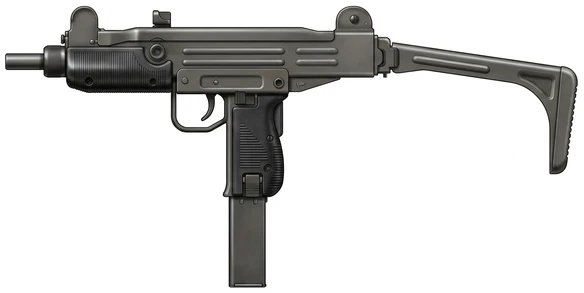
| Fire rate | 950 rounds/min. |
| Caliber | 9 x 19 mm Parabellum |
| Magazine | 32 rounds |
| Length | 600 mm (23.6 in) |
| Weight | 2.7 kg (6.0 lb) |
| Range | 100 m (328 ft) |
Description
The Mini Uzi was introduced by Israel Military Industries in 1980 as a scaled-down member of the Uzi family designed by Major Uziel Gal of the Israel Defense Forces. It derives directly from the original Uzi, whose prototype was completed in 1950 and which was officially adopted in 1951, and shares that weapon's layout and manufacturing approach. Over the service life of the family, production was undertaken by Israel Military Industries, FN Herstal and other manufacturers, with later designs handled by Israel Weapon Industries, formerly the small arms division of IMI.
The Mini Uzi retains the open-bolt, blowback operation of the parent design. It uses a telescoping bolt that wraps around the breech end of the barrel, permitting the barrel to sit well back within the receiver and the magazine to be housed in the pistol grip. The shorter bolt raises the cyclic rate compared with the full-size weapon. Construction is primarily of stamped sheet metal, which lowers unit cost relative to designs machined from forgings, and the small number of moving parts allows stripping for maintenance without special tools. Magazine housing within the grip supports reloading by feel in darkness, and the paddle-type magazine release lies flush with the grip to prevent inadvertent release. A non-reciprocating charging handle sits on the top of the receiver cover; the cover remains forward during firing. Two external safeties are fitted: a three-position selector lever at the top of the grip behind the trigger group, and a grip safety at the rear of the grip. When the weapon is de-cocked the ejection port closes against dust and dirt, though heavy accumulations of sand can still cause stoppages if the weapon is not cleaned regularly. The Mini Uzi is fitted with a forward-folding single-strut metal stock, which is longer than the folding stock of the full-size Uzi; the buttplate can be used as a foregrip when the stock is stowed. Magazine capacity is reduced relative to the standard Uzi, with extended magazines and aftermarket drums available.
Sri Lanka ordered several thousand Mini Uzis and Uzi carbines during the 1990s. These remain in service with the Sri Lanka Army, the Sri Lanka Navy elite forces and the Special Task Force of the Sri Lanka Police, which employ them for VIP protection duties. A semi-automatic Mini Uzi carbine was produced for the United States civilian market, fitted with a longer barrel to meet minimum overall length requirements and firing from a closed bolt. Vektor Arms, formed from the assets of Group Industries, built and marketed versions of both the Uzi carbine and the Mini Uzi in the United States. Foreign copies include the Mini-Ero, produced by Končar Arma Grupa d.o.o. of Zagreb, which adopted dimensions between those of the Mini Uzi and Micro Uzi, a stock taken from the vz. 61 Škorpion, and a closed-bolt action. The Zastava M97 is a Serbian clone of the Mini Uzi, offered as the M97 and as the M97K, the latter without a folding stock and with a permanently attached vertical foregrip.
Frequently Asked Questions
What type of firearm is the Mini-Uzi?
What caliber is the Mini-Uzi?
What is the effective range of the Mini-Uzi?
What is the rate of fire of the Mini-Uzi?
What magazine does the Mini-Uzi use?
How heavy is the Mini-Uzi?
- AUG 302026 Updated Description updated
- JUL 232026 Updated Service entry year updated in a site-wide editorial pass
- APR 82026 Updated Sources and cross-references refreshed