Forrestal-class
Summary
| Origin country | 🇺🇸 United States |
| Category | Aircraft carrier |
| Subtype | Aircraft carrier |
| Manufacturer | New York Navy Yard |
| Year commissioned | 1955 |
| Units | Forrestal, Saratoga, Ranger, Independence |
Operators
Technical specifications
| Displacement | 82000 tons |
| Crew | 4378 members |
| Width | 73.0 m (239.5 ft) |
| Length | 326.1 m (1069.9 ft) |
| Air Park |
|
| Propulsion | 8 Steam turbines, 280,000 shp (210,000 kW) |
| Armament |
|
| Maximum speed | 34 knots |
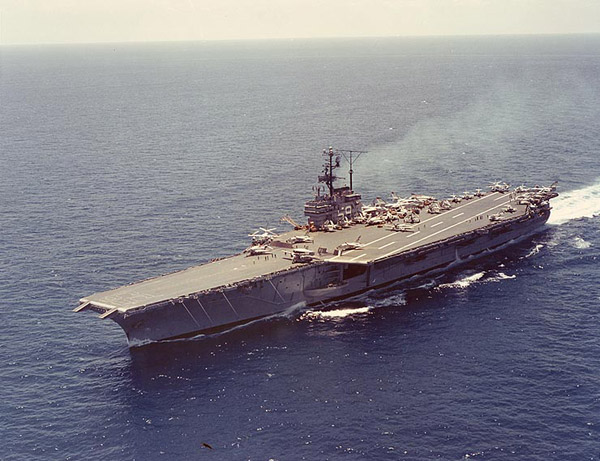
Description
The Forrestal-class aircraft carriers were a group of four vessels built for the United States Navy during the 1950s. Named for James Forrestal, the first U.S. Secretary of Defense, these were the first vessels designated as supercarriers. The class succeeded the Midway class and preceded the Kitty Hawk and Enterprise classes.
The design incorporated an angled flight deck, deck-edge elevators, and a deep hull. Engineers integrated the armored flight deck into the hull as the strength deck, a departure from earlier American practice where the flight deck functioned as superstructure. This construction provided increased freeboard and improved stability in rough sea conditions. The ships utilized four steam catapults and four deck-edge elevators. While initial plans featured a retractable island, the ships were completed with a fixed island to facilitate air operations and exhaust venting.
Internal design differences existed between the ships. Forrestal and Saratoga were initiated as axial deck carriers and converted to an angled deck configuration during construction. These two vessels featured two island masts and an open fantail. Ranger and Independence were laid down as angled deck ships and featured a single island mast and a closed fantail.
The class exhibited specific limitations regarding aircraft handling. The portside elevator was located at the forward end of the angled deck, which placed it in the path of both aircraft recovery and launches from the waist catapults. Additionally, the original sponson-mounted guns were positioned in areas susceptible to sea spray. These were later removed and replaced by missile launchers and close-in weapon systems.
The vessels entered service between 1955 and 1959. During its operational history, Forrestal sustained damage during a flight deck fire in 1967. In the late 1990s, the United States offered a Forrestal-class carrier to Brazil, but the proposal was declined due to operating costs. The Navy decommissioned the final member of the class in 1998. All four vessels were struck from the Naval Vessel Register and scrapped in Brownsville, Texas, between 2014 and 2017.