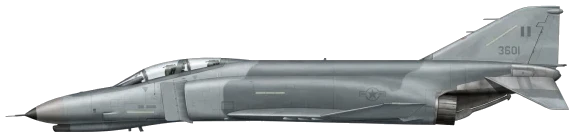
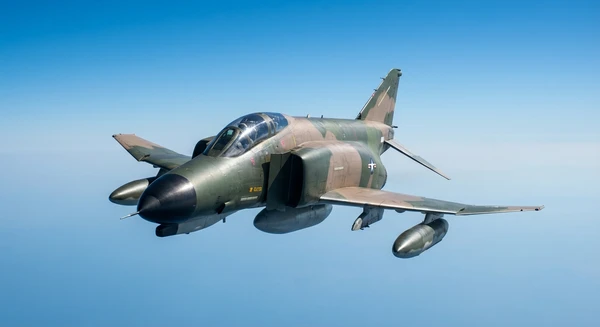
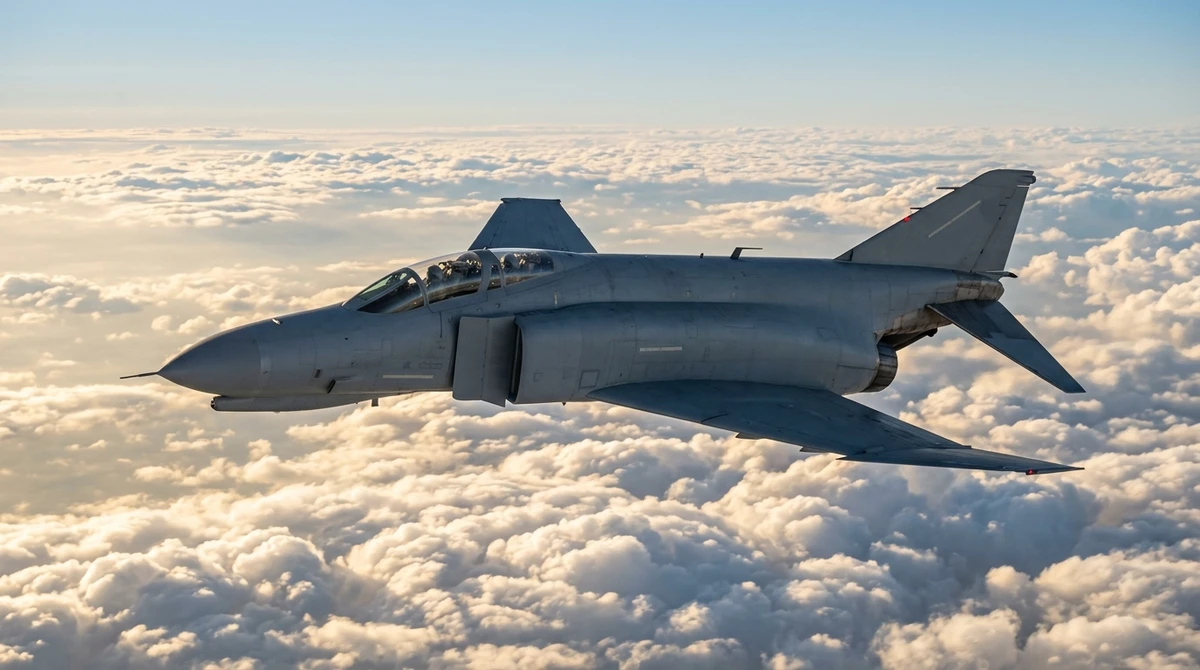
The McDonnell Douglas F-4 Phantom II is an American tandem two-seat, twin-engine, all-weather supersonic interceptor and fighter-bomber developed by McDonnell Aircraft for the United States Navy. It entered service with the U.S. Navy in 1961 and was subsequently adopted by the U.S. Marine Corps and U.S. Air Force. The aircraft set 16 world performance records and became the most-produced American supersonic military aircraft, seeing combat during the Vietnam War and the 1991 Gulf War.
Development
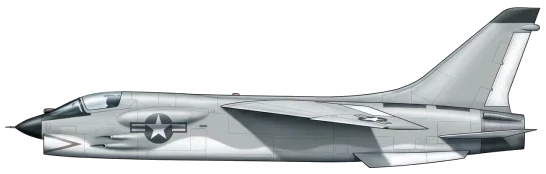
McDonnell Aircraft began design work in 1953 to revise the F3H Demon, which evolved into an all-weather fleet defense interceptor concept following revised U.S. Navy requirements in 1955. The XF4H-1 prototype made its maiden flight on 27 May 1958 and was selected over the competing XF8U-3 Crusader III in December 1958. Total production reached 5,195 airframes between 1958 and 1981, consisting of 5,057 built by McDonnell Douglas and 138 license-built by Mitsubishi in Japan.
Design
The F-4 airframe features a 45-degree swept wing with outer sections angled up by 12 degrees and a tailplane set at 23 degrees of anhedral. Powered by two General Electric J79 afterburning turbojets fed through variable-geometry air intakes, the aircraft achieves a maximum speed of Mach 2.23. Radar systems progressed from the AN/APQ-50 to the Westinghouse AN/AWG-10 fire control system, which introduced look-down/shoot-down capability.
Armament
The aircraft features nine external hardpoints capable of carrying up to 18,650 pounds (8,480 kg) of weapons, including air-to-air missiles, air-to-ground missiles, guided bombs, and nuclear ordnance. Four semi-recessed stations beneath the fuselage hold AIM-7 Sparrow radar-guided missiles, while wing pylons carry AIM-9 Sidewinder missiles. Although initial variants lacked an internal gun, the F-4E introduced an integrated 20 mm M61A1 Vulcan rotary cannon under the nose.
Operational History
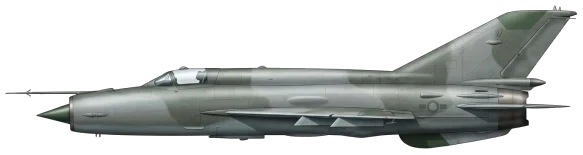
During the Vietnam War, U.S. Air Force, Navy, and Marine Corps aircrews flying the F-4 were credited with 150.5 air-to-air victories against enemy MiGs. The aircraft was exported to 11 nations, with Israeli Phantoms seeing combat in several Arab–Israeli conflicts and Iranian F-4s operating throughout the Iran–Iraq War. U.S. Air Force F-4G Wild Weasel variants flew defense suppression missions during the 1991 Gulf War before the type left U.S. combat service in 1996.
Variants
- F-4B: Definitive initial production model for the U.S. Navy and Marine Corps equipped with J79-GE-8 engines and Westinghouse AN/APQ-72 radar.
- F-4C: Initial production variant for the U.S. Air Force modified to fulfill dual air-to-air and ground-attack roles.
- F-4E: Upgraded variant featuring an internally mounted 20 mm M61A1 Vulcan cannon, J79-GE-17 engines, and wing leading-edge slats.
- F-4G Wild Weasel: Dedicated U.S. Air Force Suppression of Enemy Air Defenses aircraft converted from F-4E airframes.
- F-4J: U.S. Navy and Marine Corps variant fitted with AN/AWG-10 fire control radar providing look-down/shoot-down capability.