A-4 Skyhawk
American light attack jet, extensively deployed in the Vietnam War, notable for carrier-based operations and close air support roles. Key figures: top speed 1,077 km/h, range 4,063 km, service ceiling 12,880 m, max takeoff weight 11,136 kg, unit price $2M, built 2,960. In service with 2 air forces as of 2026 — Argentina (26), Brazil (6).
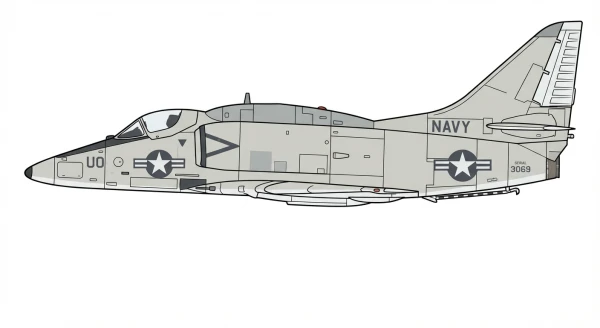
| Crew | 1 |
| Length | 12.2 m (40.1 ft) |
| Wingspan | 8.4 m (27.5 ft) |
| Height | 4.6 m (15.0 ft) |
| Wing area | 24.2 m² (259.9 sqft) |
| Empty weight | 4,750 kg (10,472 lbs) |
| Max. takeoff weight | 11,136 kg (24,551 lbs) |
| Powerplant | 1 × turbojet Pratt & Whitney J52-P8A 4,100 kgf each |
| Ejection seat | Escapac IC-3 |
| Maximum speed | 1077 km/h (Mach 1.08) |
| Operational range | 4,063 km (2,525 mi) |
| Service ceiling | 12,880 m (42,257 ft) |
| Climb rate | 43.0 m/s (141.1 ft/s) |


- Air-to-Surface AGM-12 Bullpup
- Anti-Radiation AGM-45 Shrike
- Air-to-Surface AGM-65 Maverick
- Air-to-Air Short-Range Raytheon AIM-9 Sidewinder
- Thermonuclear B57 Mod 1
- Thermonuclear B61
- Cluster CBU-59/B Rockeye II
- Cluster Mk 20 Mod 0 Rockeye
Recent Events — A-4 Skyhawk
3 events →-
MAY 142026
 Argentina
×3
Three OA-4AR two-seat trainers retired alongside the single-seat A-4AR fleet at Villa Reynolds Air Base on May 14, 2026.
Retired
Argentina
×3
Three OA-4AR two-seat trainers retired alongside the single-seat A-4AR fleet at Villa Reynolds Air Base on May 14, 2026.
Retired
-
MAY 142026
Argentina
×23
Argentine Air Force officially retires remaining 23 A-4AR Fightinghawks at Villa Reynolds Air Base; 60 years of Skyhawk operations in Argentina end.
Retired

Description
The Douglas A-4 Skyhawk is an American single-seat, subsonic, carrier-capable light attack aircraft produced by the Douglas Aircraft Company and later McDonnell Douglas. Entering service with the United States Navy on 1 October 1956, it was developed as a lightweight replacement for the propeller-driven Douglas A-1 Skyraider. The aircraft is known for its compact delta-wing design, low production and operating costs, and pioneering implementation of "buddy" air-to-air refueling.
Development
Designed in the early 1950s by Ed Heinemann, the Skyhawk originated from a United States Navy requirement for a jet-powered attack aircraft. The U.S. Navy issued a contract on 12 June 1952, and the XA4D-1 prototype conducted its maiden flight on 22 June 1954. The prototype set a world speed record of 695.163 mph on 15 October 1955. Production continued through February 1979, totaling 2,960 aircraft, which included 555 two-seat trainer variants.
Design
The aircraft features a low-mounted delta wing, a cruciform tail, and side-fuselage engine air intakes. The wing spars were machined from a single forging spanning both wingtips, while automatic gravity-operated leading-edge slats eliminated mechanical actuators to save weight. Early variants were powered by a single Wright J65 turbojet engine, which was replaced by the Pratt & Whitney J52 starting with the A-4E. The aft fuselage detaches to provide direct engine access, and the airframe is designed to perform emergency gear-up landings directly on its external fuel tanks.
Armament
Standard internal armament consists of two wing-root 20 mm Colt Mark 12 cannons, though some export models substituted 30 mm DEFA cannons. Five external hardpoints accommodate a maximum payload of 8,500 lb (3,900 kg). Munitions options include Mark 80 series unguided bombs, Rockeye cluster bombs, Zuni rockets, AIM-9 Sidewinder missiles, AGM-12 Bullpup, AGM-45 Shrike, and AGM-65 Maverick missiles, as well as B43, B57, and B61 nuclear weapons.
Operational History
The U.S. Navy used the A-4 as its primary light-attack aircraft during the early years of the Vietnam War and later operated it in an adversary training role at TOPGUN until 1999. The Israeli Air Force deployed the Skyhawk as its main ground-attack platform during the War of Attrition and the Yom Kippur War. In the 1982 Falklands War, Argentine Skyhawks sank HMS Coventry and HMS Ardent. The type also saw combat in Indonesian counterinsurgency strikes in East Timor and Kuwaiti operations during Operation Desert Storm. By 2026, Brazil was the sole military operator of the type.
Variants
-
A-4A: The initial production version powered by a Wright J65 turbojet, with 166 aircraft built.
-
A-4E: An upgraded version incorporating a Pratt & Whitney J52 engine, two additional hardpoints, and Doppler navigation radar.
-
A-4F: A refined variant featuring a dorsal avionics hump, wing-top spoilers, nose-wheel steering, and an uprated engine.
-
A-4M Skyhawk II: A dedicated U.S. Marine Corps attack version fitted with an enlarged canopy, an Angle Rate Bombing System, and a J52-P-408 engine.
-
TA-4J: A dedicated two-seat trainer configuration based on the A-4F that omitted combat equipment and served in U.S. Navy pilot instruction.
Frequently Asked Questions
What type of aircraft is the A-4 Skyhawk?
What is the maximum speed of the A-4 Skyhawk?
What is the range of the A-4 Skyhawk?
When did the A-4 Skyhawk first fly?
How many A-4 Skyhawk have been built?
Which countries operate the A-4 Skyhawk?
How much does a A-4 Skyhawk cost?
What is the service ceiling of the A-4 Skyhawk?
- AUG 122026 Updated Range corrected to the ferry range
- AUG 62026 Updated Description updated
- APR 72026 Updated Picture credits updated in a site-wide editorial pass
- JAN 122026 Updated Range updated in a site-wide editorial pass