EA-6B Prowler
American electronic warfare aircraft, vital during the Cold War, widely deployed in Iraq and Afghanistan conflicts. Key figures: top speed 1,048 km/h, range 3,745 km, service ceiling 11,460 m, max takeoff weight 27,896 kg, unit price $52M, built 170.
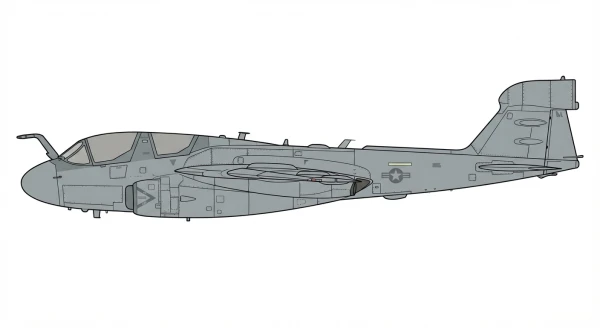
| Crew | 4 (pilot, 3 electronic countermeasures officers) |
| Length | 18.0 m (59.1 ft) |
| Wingspan | 16 m (52.5 ft) |
| Height | 5.1 m (16.8 ft) |
| Wing area | 49.2 m² (529.8 sqft) |
| Empty weight | 14,134 kg (31,160 lbs) |
| Max. takeoff weight | 27,896 kg (61,500 lbs) |
| Powerplant | 2 × turbojets Pratt & Whitney J52-P408A 4,717 kgf each |
| Maximum speed | 1048 km/h (Mach 1.05) |
| Operational range | 3,745 km (2,327 mi) |
| Service ceiling | 11,460 m (37,598 ft) |
| Climb rate | 65.0 m/s (213.3 ft/s) |
Description
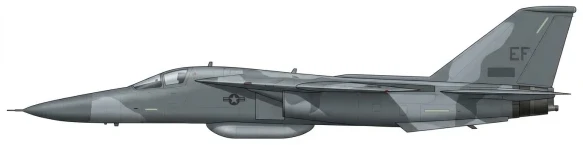
The Grumman (later Northrop Grumman) EA-6B Prowler is a twin-engined, four-seat, mid-wing electronic-warfare aircraft derived from the A-6 Intruder, operated by the United States Navy and United States Marine Corps from 1971 to 2019. It entered operational service with VAQ-132 in July 1971 and served as the sole dedicated radar-jamming aircraft of the U.S. armed forces between the EF-111A Raven's retirement in 1998 and the EA-18G Growler's introduction in 2009.
Development
The EA-6A "Electric Intruder", a twin-seat A-6 conversion, entered USMC service in December 1965 and flew in Operation Rolling Thunder; 27 were produced, 15 newly built. Development of the more capable EA-6B began in 1966 as a replacement for the Navy's EKA-3B Skywarrior. The forward fuselage was lengthened to accommodate a four-seat cockpit and an antenna fairing was added to the vertical stabilizer tip. Grumman received a $12.7 million prototype contract on 14 November 1966, and the type first flew on 25 May 1968. Three prototypes were converted from A-6As and five aircraft supported development; 170 production airframes were built between 1966 and 1991. Upgrade programmes comprised EXCAP (1973), ICAP (1976), ICAP II (1980, adding Shrike and AGM-88 HARM capability), the cancelled ADVCAP effort removed from the FY1995 budget, and ICAP III with the ALQ-218 receiver and Link 16.
Design
The EA-6B combined long-range, all-weather carrier and land-based operation with an integrated electronic-warfare suite housed in a forward equipment bay and the vertical-fin pod. The crew consisted of a pilot and three electronic countermeasures officers; the two rear ECMOs operated the jamming equipment while the right front ECMO handled navigation, communications, and defensive countermeasures. Two non-afterburning Pratt & Whitney J52-P-408A turbojets of 10,400 lbf each gave a maximum speed of 566 kn and a range of 2,022 nmi. The refuelling probe was bent to the right for pilot visibility and contained an antenna near its root; the canopy was gold-shaded to shield the crew from the aircraft's own emissions.
Armament
Five hardpoints — one centreline and four underwing — carried up to 18,000 lb. Typical loads included two to four AGM-88 HARM anti-radiation missiles, up to five AN/ALQ-99 Tactical Jamming System pods, up to five 300 US gal drop tanks, the AN/ALE-43 bulk chaff dispenser, and the AN/AAQ-28 Litening targeting pod on USMC aircraft.
Operational History
VAQ-132 deployed to Vietnam aboard America in June 1972, followed by VAQ-131 and VAQ-134; two squadrons flew 720 sorties supporting Navy attack aircraft and USAF B-52s. Prowlers operated over Grenada in 1983, during El Dorado Canyon in 1986, and Praying Mantis in 1988. In Desert Storm, 39 aircraft flew 1,648 sorties over 4,600 flight hours and fired more than 150 HARMs without loss. Later use included counter-IED jamming in Afghanistan, Operation Inherent Resolve from June 2014, and a 2016 VMAQ-4 deployment to Incirlik. Navy operations ended 27 May 2015; VMAQ-2 disbanded on 8 March 2019.
Variants
Frequently Asked Questions
What type of aircraft is the EA-6B Prowler?
What is the maximum speed of the EA-6B Prowler?
What is the range of the EA-6B Prowler?
When did the EA-6B Prowler first fly?
How many EA-6B Prowler have been built?
How much does a EA-6B Prowler cost?
What is the service ceiling of the EA-6B Prowler?
- AUG 302026 Updated Description updated
- JUL 232026 Updated Sources and cross-references refreshed
- APR 72026 Updated Sources and cross-references refreshed
- JAN 122026 Updated Range updated in a site-wide editorial pass