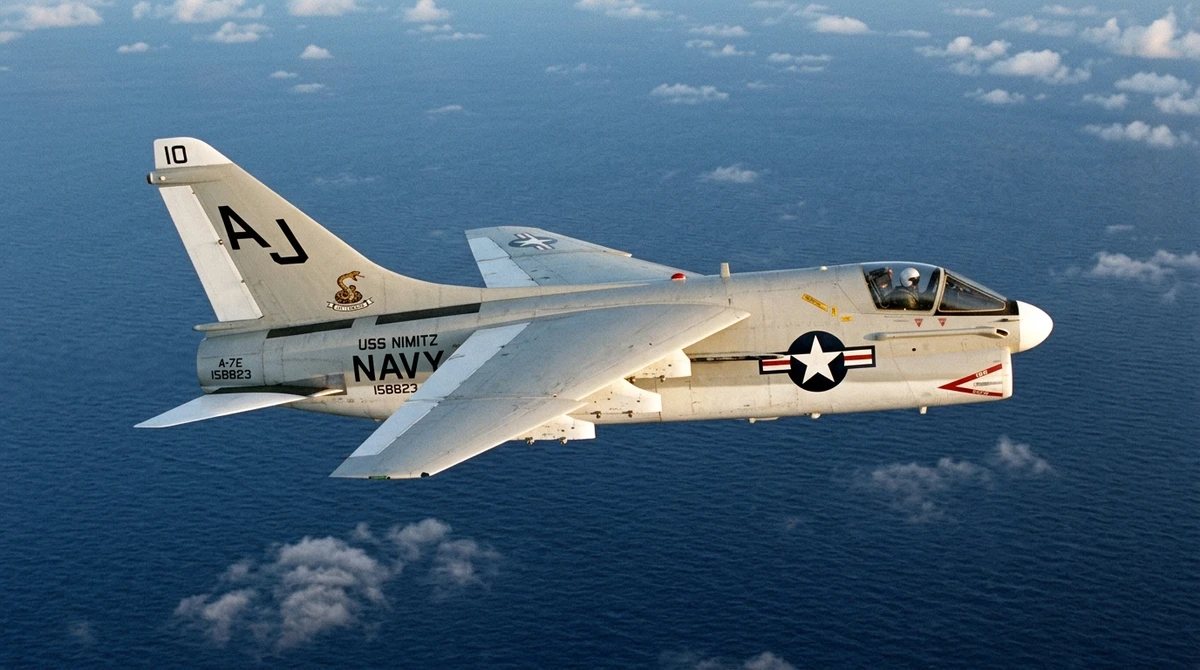
The LTV A-7 Corsair II is an American carrier-capable subsonic light attack aircraft designed and built by Ling-Temco-Vought. Derived from the Vought F-8 Crusader, it entered US Navy squadron service on 1 February 1967 and was deployed to the Vietnam War by December of that year. It is known for its bombing and navigation system, which allowed accurate weapons delivery from stand-off distances, and for its long service with the US Navy, US Air Force, Air National Guard, Greece and Portugal.
Development
In 1960 the Navy began studying a replacement for the Douglas A-4 Skyhawk. The Sea-Based Air Strike Forces study group examined 144 hypothetical designs from December 1962 and concluded that a subsonic aircraft would offer better performance per unit cost than a supersonic one. The VAL requirement was drafted on 17 May 1963 and the RFP issued on 29 May 1963, requiring proposals based on existing designs; Vought, Douglas, Grumman and North American responded. Vought's F-8-derived submission was selected on 11 February 1964, with a production contract following on 19 March 1964. The first A-7A flew on 27 September 1965. The USAF ordered the A-7D in November 1965, powered by the Allison TF41-A-1, a licence-built Rolls-Royce Spey; the first Spey-powered A-7D flew on 26 September 1968. The A-7E first flew on 25 November 1968. Production totals included 199 A-7A, 196 A-7B, 459 A-7D and 529 A-7E, with the final new-build aircraft delivered in 1983.
Design
Compared with the F-8, the A-7 has a shorter, broader fuselage and a longer-span wing with reduced sweepback and no variable-incidence mechanism. It uses outboard ailerons, inboard slotted flaps, a fixed dog-toothed leading edge and a ventral airbrake. Early aircraft used the Pratt & Whitney TF30-P-6 of 11,350 lbf; later models used the TF30-P-8 and the Allison TF41, which cured compressor stalls and low thrust. Flight control hydraulics were triplicated and much of the fuselage was armoured. Avionics included AN/APQ-116 and later AN/APQ-126 radar, an IBM navigation and weapons delivery computer, a Marconi-Elliott head-up display, and a projected map display slaved to the inertial navigation system, which could fly the aircraft to nine waypoints.
Armament
The A-7A carried two 20 mm Colt Mk 12 cannon; the A-7D and A-7E substituted a single M61A1 with 1,030 rounds. Six underwing pylons and two fuselage stations, the latter for AIM-9 Sidewinders only, carry up to 15,000 lb. Typical loads include Mark 80 series bombs, Paveway laser-guided bombs, LAU-10 Zuni pods, AGM-45 Shrike, AGM-62 Walleye, AGM-65 Maverick, AGM-88 HARM, GBU-8 HOBOS and B28, B43, B57, B61 or B83 nuclear bombs.
Operational History
USN A-7 squadrons were based at NAS Cecil Field and NAS Lemoore; 27 squadrons took delivery between 1967 and 1971. USAF A-7Ds deployed to Korat RTAFB in September 1972, flying Sandy combat search and rescue escort; on 18 November 1972 Major Colin A. Clarke led a rescue near Thanh Hoa and received the Air Force Cross. USAF A-7Ds flew 12,928 combat sorties for six losses; 98 Navy A-7s were lost in the war. On 6 October 1972 four VA-82 A-7Cs dropped the Thanh Hoa Bridge span using Walleyes and Mk 84 bombs. A-7Es supported Operation Eagle Claw, the 1983 Grenada invasion with VA-15 and VA-87, and Lebanon, where one was downed by a Syrian SAM on 4 December 1983. A-7s fired the first combat AGM-88 HARMs over the Gulf of Sidra in March 1986 and flew in Operation El Dorado Canyon. VA-22 and VA-94 sank the Iranian frigate Sahand during Operation Praying Mantis. VA-46 and VA-72 flew the type's last combat sorties in Desert Storm from USS John F. Kennedy. The 4450th Tactical Group used A-7Ds and A-7Ks from 1981 to 1989 as F-117 trainers and cover aircraft. Greece ordered 60 A-7H and five TA-7H in 1974 and received 62 A-7E and 19 TA-7C in 1993, retiring the type in October 2014; Portugal operated A-7Ps from 1981 to 1999. US Navy retirement came in May 1991, the ANG in 1993.
Variants
- A-7A: First production version with two 20 mm Mk 12 cannon and TF30-P-6 engine; 199 built.
- A-7B: TF30-P-8 engine of 12,190 lbf, later upgraded to the TF30-P-408; 196 built.
- A-7D: USAF version with Allison TF41-A-1, M61 Vulcan, AN/APQ-126 radar and boom refuelling receptacle; 459 built.
- A-7E: Definitive naval model with TF41-A-2, M61 Vulcan, AN/APN-190 and AN/APQ-128; 529 built.
- A-7P: US Navy A-7As rebuilt for Portugal with TF30-P-408 engines and A-7E-type avionics; 44 refurbished.