F-8 Crusader
American fighter aircraft, notable for its Cold War-era use, largely deployed in the Vietnam War and the Cuban Missile Crisis. Key figures: top speed 1,971 km/h, range 2,791 km, service ceiling 17,678 m, max takeoff weight 13,000 kg, unit price $2.5M, built 1,219.
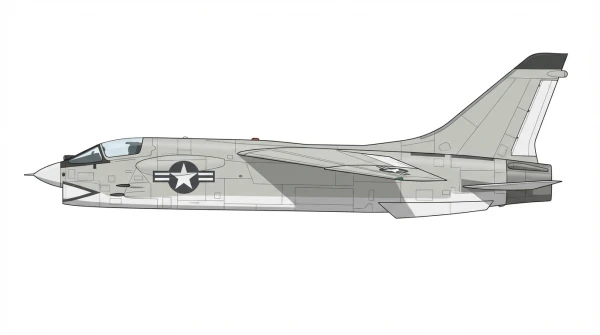
| Crew | 1 |
| Length | 16.5 m (54.2 ft) |
| Wingspan | 10.9 m (35.7 ft) |
| Height | 4.8 m (15.7 ft) |
| Wing area | 34.8 m² (374.6 sqft) |
| Empty weight | 7,956 kg (17,540 lbs) |
| Max. takeoff weight | 13,000 kg (28,660 lbs) |
| Powerplant | 1 × turbojet Pratt & Whitney J57-P-20A 8,165 kgf each |
| Ejection seat | Martin-Baker Mk 5 |
| Maximum speed | 1971 km/h (Mach 1.97) |
| Operational range | 2,791 km (1,734 mi) |
| Service ceiling | 17,678 m (57,999 ft) |
| Climb rate | 162.3 m/s (532.5 ft/s) |
Description
The Vought F-8 Crusader (originally designated F8U) was a single-engine, supersonic, carrier-based air superiority fighter built by the American manufacturer Vought. It entered US Navy service in March 1957 and also served with the US Marine Corps, the French Aéronavale and the Philippine Air Force. It was the last American fighter designed with guns as its primary weapon, giving rise to the nickname "The Last of the Gunfighters".
Development
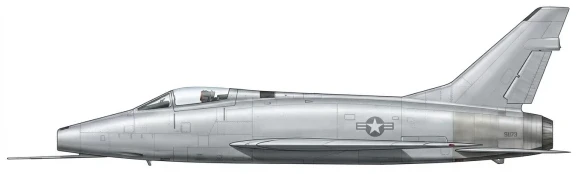
The US Navy issued a requirement in September 1952 for a fighter capable of Mach 1.2 at 30,000 ft, a 25,000 ft/min climb rate, a landing speed under 100 mph, and 20 mm cannon armament. Vought's V-383, designed by a team led by John Russell Clark, beat the Grumman F-11 Tiger, the twin-engine McDonnell F3H-H and a carrier-adapted North American F-100. Three XF8U-1 prototypes were ordered in June 1953, and the first flew on 25 March 1955 with John Konrad at the controls, exceeding Mach 1 on the maiden flight. The second prototype and the first production F8U-1 both flew on 30 September 1955, and the first catapult launch from Forrestal followed on 4 April 1956. On 21 August 1956, Commander R.W. "Duke" Windsor set a US national speed record of 1,015.428 mph. A total of 1,261 aircraft were built, the last delivered to VF-124 at NAS Miramar on 3 September 1964.
Design
The variable-incidence wing pivoted 7° out of the fuselage for takeoff and landing, raising the wing's angle of attack without a nose-high fuselage attitude and permitting short, fuselage-mounted landing gear; leading-edge flaps drooped 25° and inboard flaps extended 30°. The airframe used an area-ruled fuselage, all-moving stabilators, dog-tooth notching at the wing folds for yaw stability and titanium in the structure. Power came from a single afterburning Pratt & Whitney J57 turbojet. Early aircraft carried only a gun-ranging radar; air-intercept radar appeared from the F-8B, progressing through the AN/APQ-83, -94, -104, -124, -125 and -149 sets, with an IRST blister added ahead of the canopy on the F-8E.
Armament
Primary armament was four 20 mm Colt Mk 12 cannon in the lower fuselage with 125 rounds per gun, supplemented by a retractable tray of 32 Mk 4/Mk 40 Mighty Mouse FFAR rockets, later sealed shut. Two fuselage Y-pylons carried up to four AIM-9 Sidewinders or Zuni rockets, and two underwing pylons held 4,000 lb of stores including AGM-12 Bullpup missiles and Mk 81 through Mk 84 bombs. The Crusader was the only aircraft to employ the radar-guided AIM-9C, shelved in 1969. French aircraft carried Matra R.530 and later R550 Magic missiles.
Operational History
The first combat action came during the 1958 Lebanon crisis with VF-32 aboard Saratoga. From 23 October 1962, unarmed RF-8As of VFP-62, VFP-63 and VMCJ-2 flew low-level reconnaissance over Cuba, returning 160,000 images confirming Soviet MRBM deployments. US Navy F-8s from Hancock engaged VPAF MiG-17s on 3 April 1965; Crusaders claimed 19 kills for three air-combat losses, only four scored with cannon, and 170 were lost to all causes in Vietnam. France ordered 42 F-8E(FN) from October 1964, flying over Djibouti, Lebanon in 1983, Libya in 1984 and the former Yugoslavia from 1993 until 1999. The Philippines bought 35 F-8Hs in 1977, grounded in 1988. NASA used modified F-8s for digital fly-by-wire and supercritical wing testing. The last US RF-8G retired on 29 March 1987; French F-8Ps were replaced by the Rafale M in 2000.
Variants
- F-8A (F8U-1): First production version with J57-P-4A engine from the 31st aircraft; 318 built.
- F-8C (F8U-2): J57-P-16 engine, ventral fins and Y-shaped cheek pylons for four Sidewinders; 187 built.
- F-8D (F8U-2N): All-weather version with the rocket pack replaced by fuel, J57-P-20 engine and AN/APQ-83 radar; 152 built.
- F-8E (F8U-2NE): AN/APQ-94 radar in an enlarged nose, Bullpup electronics hump, 5,000 lb payload and Martin-Baker seat; 286 built.
- RF-8A (F8U-1P): Unarmed photo-reconnaissance version with cameras in place of guns; 144 built, later modernized as RF-8G.
Frequently Asked Questions
What type of aircraft is the F-8 Crusader?
What is the maximum speed of the F-8 Crusader?
What is the range of the F-8 Crusader?
When did the F-8 Crusader first fly?
How many F-8 Crusader have been built?
How much does a F-8 Crusader cost?
What is the service ceiling of the F-8 Crusader?
- AUG 302026 Updated Description updated
- AUG 122026 Updated Range corrected to the ferry range with external fuel
- AUG 52026 Updated Thrust updated
- JUL 232026 Updated Sources and cross-references refreshed
- JUN 262026 Updated Missiles updated
- APR 72026 Updated Sources and cross-references refreshed
- APR 52026 Updated Ejection seat added