Kalvari-class (Project 75)
The Kalvari class is a series of diesel-electric attack submarines built for the Indian Navy under license from France, based on the Scorpène design; lead boat commissioned 2017. Key figures: displacement 1,615 tons, length 68 m, top speed 11 knots, crew 43, built 6. In service with 1 navy — India (6).
| Subtype | Diesel-electric attack submarine |
| Displacement | 1615 tons |
| Displacement submerged | 1775 tons |
| Crew | 43 members |
| Width | 6.2 m (20.3 ft) |
| Length | 67.5 m (221.5 ft) |
| Max. depth | 350 m (1148.3 ft) |
| Propulsion | 4 x MTU 12V 396 SE84 diesel generators, battery-electric drive; DRDO AIP planned |
| Range | 6,500 nm at 8 knots |
| Endurance | 50 days |
| Maximum speed | 11 knots |
| Max. speed submerged | 20 knots |
- 6 x 533 mm weapon launching tubes
- 18 x SUT heavyweight torpedoes or SM39 Exocet anti-ship missiles
- OR 30 naval mines
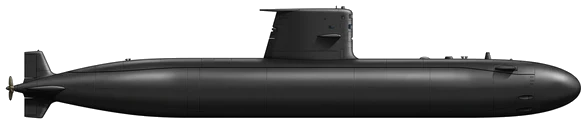
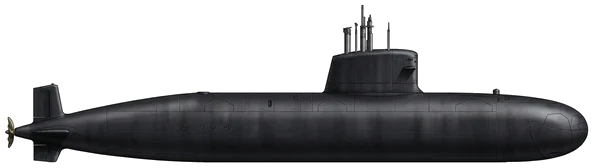
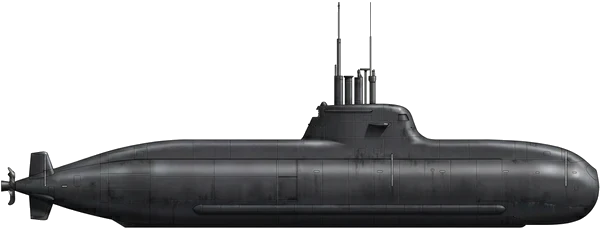
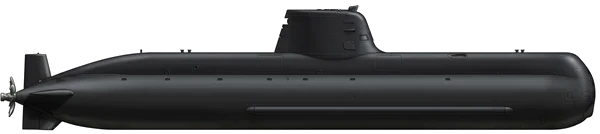
Description
The Kalvari class, formally designated Project-75 (P-75), is a group of six diesel-electric attack submarines built for the Indian Navy by Mazagon Dock Limited (MDL) in Mumbai under licence from France's Naval Group. The class is an export derivative of the Scorpène design. Its origins lie in a 1997 Cabinet Committee on Security approval for two Type 209/1500 boats from Howaldtswerke-Deutsche Werft; in 1999 the Ministry of Defence adopted a two-phase plan for 24 submarines over 30 years, and the Indian Navy selected the Scorpène over the Type 209/1500 because it came with technology transfer and could fire the SM39 Exocet, the Harpoon being unavailable and the Kalibr incompatible with the German design's tubes. Contracts were signed on 6 October 2005 with Armaris for six boats at €2.4 billion, with DCN International as prime contractor in partnership with Navantia and MBDA supplying the Exocets. The name revives that of the Foxtrot-class boats operated between 1967 and 2010; the class replaces the Sindhughosh and Shishumar classes.
The hull, fin and hydroplanes are shaped for low underwater resistance, and equipment within the pressure hull sits on shock-absorbing cradles. Construction uses high-tensile special steel; each boat contains 60 km of cabling and 11 km of piping. Propulsion combines diesel generators, a battery of 360 cells weighing 750 kg each and a permanent-magnet propulsion motor. Armament comprises six 533 mm weapon launching tubes with 18 weapons carried, combining SUT torpedoes and SM39 Exocet anti-ship missiles, or 30 mines in their place. Sensors and weapons are tied into the Submarine Tactical Integrated Combat System (SUBTICS), with a sonar suite offering Low Frequency Analysis and Ranging. C303/S mobile anti-torpedo decoys provide self-defence. DRDO's High Energy Materials Research Laboratory in Pune developed the Signal Star Naval Flare, an underwater signalling round launched from the signal ejector, handed over in August 2025.
Steel was cut for Kalvari on 14 December 2006. Omissions in the 2005 contract covering engines, generators and raw materials stalled work, prompting creation of the Mazagaon Procured Materials entity and an additional ₹4,764 crore sanction. Dockyard flooding in 2011 and Navantia's withdrawal added further delay. Kalvari was launched in October 2015, began sea trials on 1 May 2016 and commissioned in December 2017; Khanderi followed in September 2019, Karanj in March 2021, Vela in November 2021, Vagir in January 2023 and Vagsheer on 15 January 2025. A 2016 plan for 98 Black Shark torpedoes from Whitehead Alenia Sistemi Subacquei was cancelled over the AgustaWestland corruption case, leaving older AEG SUT 264 torpedoes as a stopgap; 48 Black Sharks were finally ordered from WASS Submarine Systems on 30 December 2025 for delivery between April 2028 and 2030.
Vagir made the class's first long-range deployment in 2023, calling at Colombo on 19 June and Fremantle on 20 August. Three Kalvari boats operated with INS Vikrant on 7 November 2024. On 22 November 2024 one of the submarines collided with a fishing boat 70 nautical miles off Goa; 11 fishermen were rescued and two reported missing. Retrofitting of DRDO phosphoric acid fuel cell AIP modules, beginning with Khanderi, is scheduled from July 2026.
Frequently Asked Questions
What type of ship is the Kalvari-class?
What is the displacement of the Kalvari-class?
What is the maximum speed of the Kalvari-class?
What is the range of the Kalvari-class?
How many crew members serve on the Kalvari-class?
How many Kalvari-class ships have been built?
Which countries operate the Kalvari-class?
- SEP 52026 Created Kalvari-class submarine page created (specs, description, Indian Navy inventory and events linked)