Type 214-class
German export attack submarine with fuel cell AIP, serving Greece, South Korea, Portugal and Turkey. Key figures: displacement 1,690 tons, length 65 m, top speed 12 knots, crew 27, unit cost $330M, built 16. In service with 2 navies — Greece (4), Portugal (2).
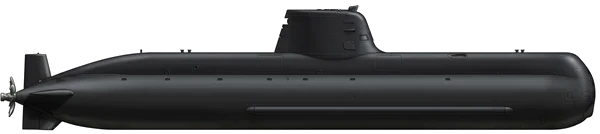
| Subtype | Diesel-electric attack submarine |
| Displacement | 1690 tons |
| Displacement submerged | 1860 tons |
| Crew | 27 members |
| Width | 6.3 m (20.7 ft) |
| Length | 65.0 m (213.3 ft) |
| Max. depth | 400 m (1312.3 ft) |
| Propulsion | Diesel-electric with fuel cell air-independent propulsion (AIP) |
| Range | 12,000 nm |
| Endurance | 84 days |
| Maximum speed | 12 knots |
| Max. speed submerged | 20 knots |
- 8 × 533 mm torpedo tubes (4 capable of firing Sub-Harpoon missiles)
- Heavyweight torpedoes and naval mines
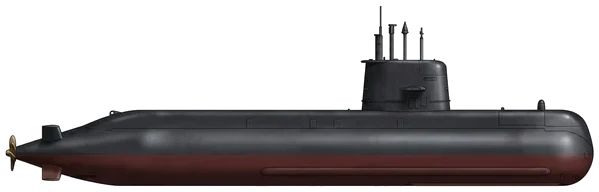
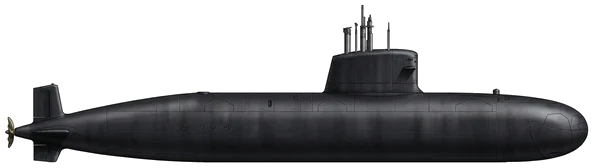
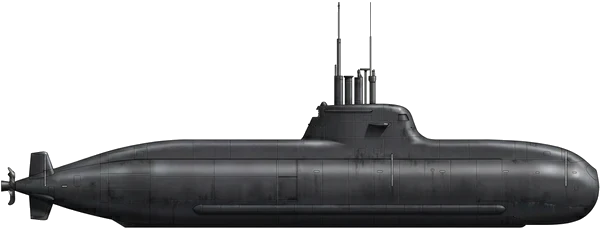
Description
The Type 214 is an export diesel-electric attack submarine developed by Germany's Howaldtswerke-Deutsche Werft (HDW), combining the proven hull design principles of the Type 209 family with the fuel cell air-independent propulsion (AIP) of the Type 212A. The AIP system allows the boat to remain submerged for up to three weeks without snorkeling, and the design dives to nearly 400 meters thanks to improved pressure hull steel.
At 65 meters and 1,690 tons surfaced, the Type 214 carries eight 533 mm torpedo tubes, four of which are capable of launching anti-ship missiles such as the Sub-Harpoon, with an endurance of 84 days and a crew of 27. Low-noise skewed propellers and a flank sonar array complete a design pitched squarely at navies seeking near-nuclear submarine endurance at conventional cost — around $330 million per boat.
Sixteen boats have been completed for four navies. Greece ordered four as the Papanikolis class, the first built in Kiel and the rest at Hellenic Shipyards in Skaramangas — a program initially marred by acceptance disputes over rolling and AIP performance that were eventually resolved. South Korea built nine under license as the Son Won-il class with Hyundai and Daewoo. Portugal operates two as the Tridente class, and Turkey assembles six boats of the improved Reis class (Type 214TN) at Gölcük Naval Shipyard. The type competes directly with the French Scorpène across export markets, and its success cemented German dominance of the conventional submarine market in the 2000s and 2010s.
Frequently Asked Questions
What type of ship is the Type 214-class?
What is the displacement of the Type 214-class?
What is the maximum speed of the Type 214-class?
What is the range of the Type 214-class?
How many crew members serve on the Type 214-class?
How many Type 214-class ships have been built?
Which countries operate the Type 214-class?
How much does a Type 214-class cost?
- JUL 272026 Updated Endurance updated
- JUL 242026 Created Page created: Type 214