Todaro-class (Type 212A)
German diesel-electric submarine, introduced in 2005, utilizes air-independent propulsion. Key figures: displacement 1,524 tons, length 56 m, top speed 12 knots, crew 27, built 10. In service with 2 navies — Germany (6), Italy (4).
| Subtype | Diesel-electric attack submarine |
| Displacement | 1524 tons |
| Displacement submerged | 1830 tons |
| Crew | 27 members |
| Width | 6.8 m (22.3 ft) |
| Length | 56.0 m (183.7 ft) |
| Max. depth | 200 m (656.2 ft) |
| Propulsion | 1 × MTU-396 16V (2,150 kW) diesel engine; 9 × HDW/Siemens PEM fuel cells (30–40 kW each) or 2 × 120 kW fuel cells; 1 × Siemens Permasyn electric motor (2,850 kW) driving a single seven-bladed skewback propeller |
| Range | 8,000 nm at 8 knots |
| Endurance | 84 days |
| Maximum speed | 12 knots |
| Max. speed submerged | 20 knots |
- 6 × 533 mm torpedo tubes
- 13 DM2A4 or Black Shark torpedoes
- IDAS missiles
- 24 external naval mines (optional)
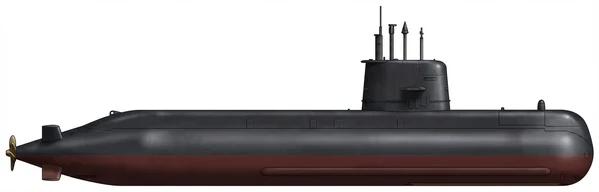
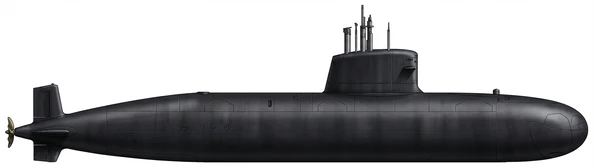
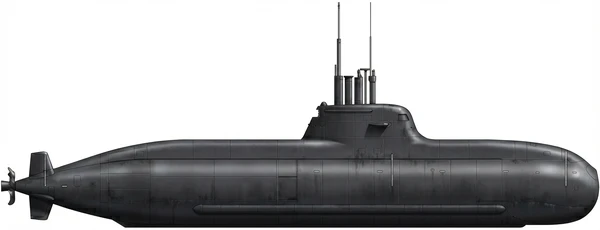
Description
The Todaro class is a series of diesel-electric attack submarines operated by the Italian Navy (Marina Militare), developed in cooperation with Germany where the design is designated as the Type 212A. The bilateral program originated in 1994 when the Italian Navy and the German Navy merged their requirements for a conventional submarine capable of operating in both the deep Mediterranean Sea and shallow Baltic Sea. In 1998, the Italian government ordered the first two submarines from Fincantieri, which built the boats at the Muggiano shipyard. The Italian Navy ordered a second batch of two submarines in April 2008, followed by a contract amendment in December 2022 to construct a third Near Future Submarine (NFS) variant based on this design, with a fourth planned.
The Todaro class utilizes a hybrid propulsion system combining a conventional MTU 16V 396 diesel engine with an air-independent propulsion (AIP) system. This AIP system uses Siemens Energy proton-exchange membrane compressed hydrogen fuel cells, storing fuel and oxidizer tanks outside the pressure hull to mitigate fire risks. The submarines utilize a 1700 kW Siemens Energy Permasyn electric motor driving a single seven-bladed skewback propeller. For steering and shallow-water operations, the boats employ an "X" arrangement of the stern planes, allowing operation in depths as shallow as 17 meters. The hull features a prismatic cross-section with smoothly faired transitions to the sail to reduce the acoustic signature.
Sensor and combat systems on the Todaro class include the Kongsberg MSI-91 combat system, the STN Atlas DBQS40 sonar suite—which incorporates a TAS-3 passive towed array, a FAS-3 flank array, and a MOA 3070 mine detection sonar—and WASS hydrophones. The submarines carry Carl Zeiss SERO 14 and SERO 15 periscopes, Riva Calzoni periscope masts, a Kelvin Hughes Type 1007 I-band navigation radar, and an EADS FL 1800U electronic support measures suite. The primary armament consists of six 533 mm water-ram expulsion torpedo tubes. These tubes launch fiber-optic guided DM2A4 Seehecht heavyweight torpedoes, WASS BlackShark torpedoes, and IDAS short-range missiles, and can optionally deploy 24 external naval mines. Defensively, the submarines utilize the Tau torpedo defence system with four launchers.
In operational service, the Italian Navy deployed S 526 Todaro to the United States for six months in 2008 to participate in the CONUS 2008 exercise with the United States Navy. The second submarine of the class, S 527 Scirè, completed a five-month deployment to the United States for the CONUS 2009 exercise. S 526 Todaro subsequently deployed to the Gulf of Aden, the Arabian Sea, the Gulf of Oman, and the Indian Ocean between September 2012 and February 2013.
Frequently Asked Questions
What type of ship is the Todaro-class?
What is the displacement of the Todaro-class?
What is the maximum speed of the Todaro-class?
What is the range of the Todaro-class?
How many crew members serve on the Todaro-class?
How many Todaro-class ships have been built?
Which countries operate the Todaro-class?
- JUL 292026 Updated Description updated
- JAN 242026 Updated Max depth updated
- JAN 182026 Created Page created: Todaro