Ocean-class (L12)
Summary
| Origin country | 🇬🇧 United Kingdom |
| Category | Aircraft carrier |
| Subtype | Landing Platform Helicopter |
| Manufacturer | Vickers Shipbuilding and Engineering Ltd |
| Year commissioned | 1998 |
| Approx. unit cost | $197 million |
| Units | HMS Ocean (L12) / NAM Atlântico (A140) |
Operators
Technical specifications
| Displacement | 21500 tons |
| Range | 8000 km at 15 knots |
| Crew | 465 members |
| Width | 35.0 m (114.8 ft) |
| Length | 203.4 m (667.3 ft) |
| Air Park | |
| Propulsion | 2 × Crossley Pielstick 12 cylinder |
| Thrust | 11000 hp |
| Armament |
|
| Maximum speed | 21 knots |
Description
The Royal Navy issued an invitation to tender for a new helicopter carrier in February 1992. The requirement followed the use of the aviation training ship RFA Argus as an amphibious transport during operations in the Balkans, which identified the need for a dedicated platform for embarked military forces. VSEL was awarded the contract in May 1993 and sub-contracted the construction to the Kværner Govan yard. The vessel was built to commercial standards to reduce costs. It was launched in October 1995 and commissioned in September 1998.
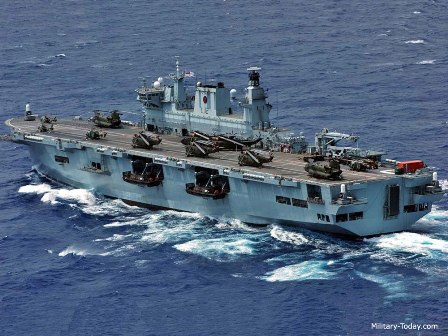
The vessel was designed as a Landing Platform Helicopter (LPH) to support amphibious operations and command staff. It transports a Royal Marines Commando Group and is equipped with a flight deck, hangar, and helicopter lifts. The ship carries four Landing Craft Vehicle and Personnel (LCVP) operated by 9 Assault Squadron. Aviation capabilities include up to 18 helicopters, such as the Chinook, Merlin, and Apache. It can also transport fixed-wing Harrier aircraft in a ferry capacity. Facilities include a vehicle deck and a stern ramp for deploying landing craft. In 2020, the Brazilian Navy reclassified the vessel as a Multipurpose Aircraft Carrier (NAM) to reflect its capability to host unmanned aerial vehicles.
Initial deployments included humanitarian relief in Honduras and Nicaragua following Hurricane Mitch in 1998 and support for Operation Palliser in Sierra Leone in 2000. In 2003, the vessel served as the flagship for the UK contribution to the Iraq War. Between 2011 and 2012, it participated in military intervention in Libya, marking the first operational use of Apache helicopters from a Royal Navy ship, and provided security for the London 2012 Olympic Games.
The vessel became the Royal Navy Fleet Flagship in June 2015. During a 2016 deployment, its commander assumed control of United States Task Force 50 in the Persian Gulf, the first instance of a Royal Navy vessel commanding this US formation. Following disaster relief operations in the Caribbean in 2017, the ship was decommissioned on 27 March 2018. It was purchased by Brazil for £84.6 million and commissioned as the Atlântico in June 2018. It currently serves as the flagship of the Brazilian Navy.