H225M / EC725 Caracal
European long-range tactical transport military helicopter, featuring advanced avionics and systems, used for roles including troop transport and special operations. Key figures: top speed 324 km/h, range 1,253 km, service ceiling 6,100 m, max takeoff weight 11,200 kg, unit price $70M, built 90. In service with 15 air forces as of 2026 — Brazil (40), Kuwait (30), France (23) and 12 others.
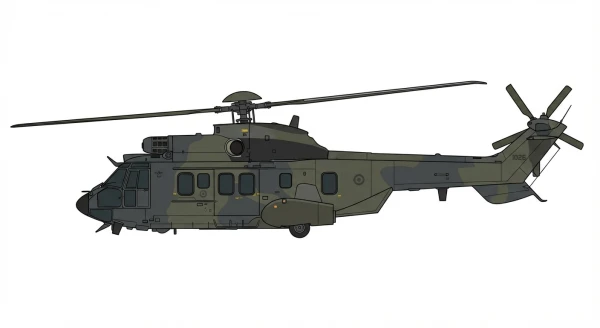
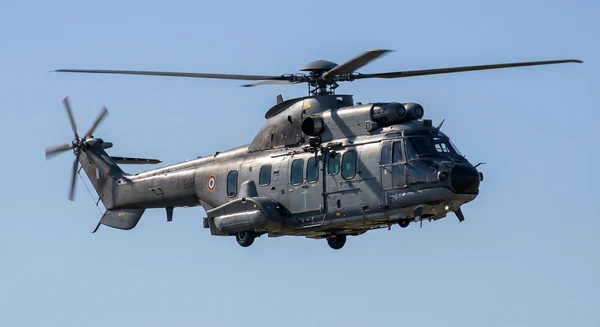
| Crew | 2 (pilot, co-pilot) |
| Length | 19.5 m (64.0 ft) |
| Wingspan | 16.2 m (53.1 ft) |
| Height | 4.6 m (15.1 ft) |
| Empty weight | 5,330 kg (11,751 lbs) |
| Max. takeoff weight | 11,200 kg (24,692 lbs) |
| Powerplant | 2 × Turboméca Makila 2A1 turboshaft 1,776 kW each |
| Maximum speed | 324 km/h (201 mph) |
| Operational range | 1,253 km (779 mi) |
| Service ceiling | 6,100 m (20,013 ft) |
| Climb rate | 7.4 m/s (24.3 ft/s) |
-
 Brazil
40 +6
Brazil
40 +6
-
 Kuwait
30
Kuwait
30
-
 France
23 +4
France
23 +4
-
 Hungary
16
Hungary
16
-
 Mexico
15 +4
Mexico
15 +4
-
 Indonesia
14 +2
Indonesia
14 +2
-
 Singapore
13 +3
Singapore
13 +3
-
 Malaysia
12
Malaysia
12
-
 Thailand
12
Thailand
12
-
 China
3
China
3
-
 Taiwan
3
Taiwan
3
-
 Iraq
2 +10
Iraq
2 +10
-
 Ecuador
2
Ecuador
2
-
 Tanzania
2
Tanzania
2
-
 Vietnam
2
Vietnam
2
-
 Kazakhstan
0 +20
Kazakhstan
0 +20
-
 Netherlands
0 +12
Netherlands
0 +12
Recent Events — H225M / EC725 Caracal
8 events →-
JUN 82026
 France
×4
DGA hands over the last of eight H225M Caracal ordered in 2021, completing the overseas batch and taking the fleet to 19.
Delivered
France
×4
DGA hands over the last of eight H225M Caracal ordered in 2021, completing the overseas batch and taking the fleet to 19.
Delivered
-
NOV 182025
 Morocco
×10
Morocco orders 10 Airbus H225M Caracal helicopters.
Ordered
Morocco
×10
Morocco orders 10 Airbus H225M Caracal helicopters.
Ordered
-
SEP 262025
 Thailand
×2
Royal Thai Air Force ordered two extra H225 helicopters for search and rescue and medical missions.
Ordered
Thailand
×2
Royal Thai Air Force ordered two extra H225 helicopters for search and rescue and medical missions.
Ordered
Description
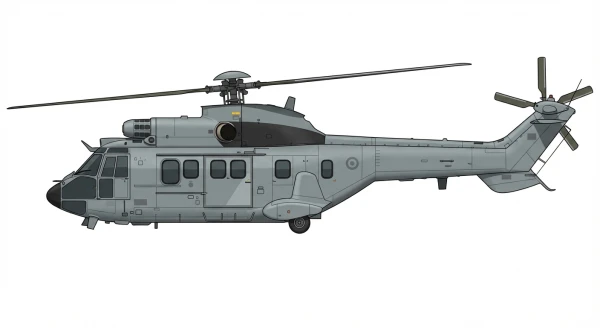
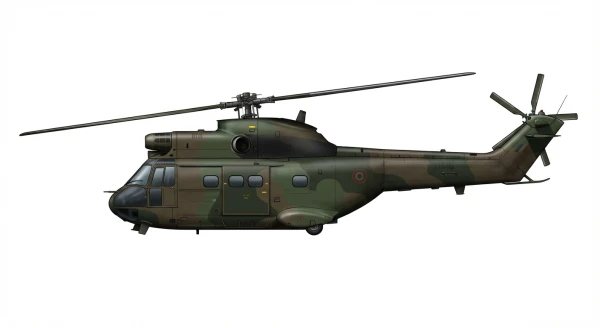
The Airbus Helicopters H225M, formerly the Eurocopter EC725 Caracal, is a twin-engined long-range tactical transport helicopter developed in France from the AS532 Cougar. It entered French Air Force service in 2005 and is used for combat search and rescue, troop transport, casualty evacuation, logistic support and shipboard maritime operations, carrying up to 28 seated troops plus two crew.
Development
The EC725 originated in a French Air Force requirement for a dedicated combat search and rescue helicopter. The AS 532 A2 Cougar was trialled between 1996 and 1999 and rejected; the service sought more powerful engines, greater endurance and improved combat durability. Eurocopter developed a more ambitious AS 532 derivative, initially named Cougar Mk II+ for treaty reasons, with new mission equipment and autonomous avionics. The first prototype flew at Marignane on 27 November 2000 and was publicly presented on 15 January 2001. A civil counterpart, the EC225, was developed in parallel. France ordered six aircraft for the CSAR mission, the first delivered in February 2005, followed by eight more in November 2002, with a fleet of 20 envisaged in 2004. By 2015 the type, redesignated H225M, was built on two production lines in France and Brazil, with a third line in India considered in July 2015.
Design
The EC725 uses a five-blade composite main rotor with a new airfoil shape to reduce vibration, and a reinforced main rotor gearbox. Power comes from two Turbomeca Makila 1A4 turboshafts mounted over the cabin with dual-channel FADEC and an optional anti-icing system. The glass cockpit has an integrated display system with digital map and active-matrix LCDs. Removable armour plating can be fitted. Search radar and forward-looking infrared permit day and night SAR under visual and instrument flight rules. Four cabin configurations were developed: troop transport for up to 29 troops, VIP transport for 8–12 passengers, casualty evacuation with 12 stretchers and four medical staff, and combat SAR.
Armament
Armament options include two 7.62 mm FN MAG machine guns in the forward left and right windows, two side-mounted 68 mm Thales Brandt or Forges de Zeebrugge rocket launchers with 19 rockets each, and the MU90 Impact torpedo. Gun pods, rocket pods and Hellfire missiles can be carried externally through the HForce Generic Weapon System, cued by a Thales Scorpion helmet-mounted sight and Wescam electro-optical sensor. Brazilian Navy aircraft have been fitted with the Exocet anti-ship missile and a Helibras-built chaff and flare countermeasures suite; Thales supplies self-protection systems for French aircraft. Payload is 5,670 kg.
Operational History
Three French EC725s deployed to Cyprus in summer 2006 during Opération Baliste to evacuate civilians from Lebanon, weeks after entering service. From December 2006 French aircraft operated in Afghanistan from Kabul International Airport. In 2013 French machines received a SAGEM FLIR, Nexter door guns and cold-weather FADEC changes. Brazil ordered 50 aircraft in 2008 for $1 billion, built by Helibras at Itajubá; the Navy accepted its first on 19 June 2014, and the fleet passed 10,000 flight hours by 1 October 2015. Mexico ordered six in March 2009 and six more in September 2010; one made an emergency landing on 30 April 2015 after an RPG struck its tail rotor during Operation Jalisco, killing six soldiers. Malaysia ordered 12 in April 2009 and used them in the 2014 MH370 search and the 2015 Sabah earthquake rescue at Mount Kinabalu. Indonesia received the first of six in November 2014. Kuwait signed for 30 in August 2016, Singapore selected the type in November 2016, the UAE ordered 12 in December 2021, and the Netherlands formalised an order for 12 SOF aircraft in November 2024. Poland announced an order for 50 in April 2015 but withdrew from offset negotiations in October 2016.
Variants
- HM-4: Brazilian Army designation for the EC725.
- AH-15: Brazilian Navy designation for an attack variant.
- UH-15/UH-15A: Brazilian Navy designations for utility variants.
- H-36 / VH-36: Brazilian Air Force designations for the standard and VIP transport variants.
- H.11: Royal Thai Armed Forces designation for the H225M.
Frequently Asked Questions
What type of aircraft is the H225M / EC725 Caracal?
What is the maximum speed of the H225M / EC725 Caracal?
What is the range of the H225M / EC725 Caracal?
When did the H225M / EC725 Caracal first fly?
How many H225M / EC725 Caracal have been built?
Which countries operate the H225M / EC725 Caracal?
How much does a H225M / EC725 Caracal cost?
What is the service ceiling of the H225M / EC725 Caracal?
- SEP 82026 Updated Alternate designations Super Cougar and UH-15 added
- AUG 302026 Updated Description updated
- AUG 302026 Updated Range corrected to the ferry range with extended tanks
- AUG 262026 Updated French overseas batch completion added to the operational history
- AUG 62026 Updated Description updated
- AUG 52026 Updated Powerplant updated in a site-wide editorial pass
- JUL 232026 Updated Sources and cross-references refreshed