BM-27 Uragan
Summary
| Origin country | 🇷🇺 Russia |
| Category | Multiple Launch Rocket System |
| Sub-type | Multiple Launch Rocket System |
| Manufacturer | Splav State Research and Production Enterprise |
| Number built | 700 units |
Technical specifications
| Crew | 6 (commander, driver, 4 crew) personnels |
| Range | 500 km |
| Mass | 20.0 tons |
| Max. speed | 65 km/h (40 mph) |
| Engine | ZIL-375 V8 gasoline, 180 hp |
| Weapon 1 | 16 × 220mm rocket tubes |
Historical operators
Profile of BM-27 Uragan
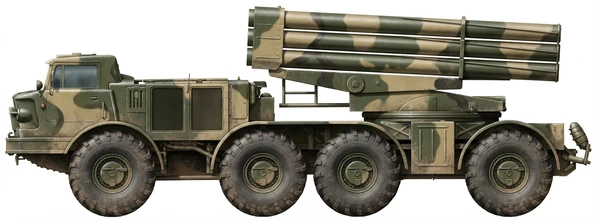
Description
The BM-27 Uragan is a self-propelled multiple rocket launcher developed in the Soviet Union to deliver cluster munitions. It entered service in the late 1970s as the first Soviet heavy rocket system to utilize spin and fin stabilization. A modernized variant, the Uragan-1M, was commissioned in 2008.
The standard 9P140 variant utilizes a chassis powered by two gasoline engines. One engine drives the wheels on the left side, while the other drives the wheels on the right. Steering is performed by the front and rear axles. The cab is NBC protected, allowing the six-man crew to operate the system without exposure to contaminants. Deployment requires lowering stabilizing jacks and raising a blast shield to protect the cab during firing. Indirect fire is directed using a PG-1 panoramic telescope, and the driver is provided with a night vision device.
The launcher is equipped with 16 tubes and can fire a full salvo in 20 seconds. It utilizes HE-FRAG, incendiary, and scatterable mine rockets, such as the PTM-3 and PFM-1. These munitions are detonated by electric timing fuses. Although originally designed to deploy chemical munitions, Russia officially decommissioned this capability in 2017. The system is used for mine-laying operations, a tactic employed by Soviet forces in Afghanistan to encircle or obstruct retreating units. Reloading is conducted via the 9T452 transloader vehicle, which uses a crane to transfer rockets from the loader to the launcher, a process taking approximately 20 minutes.
The Uragan-1M variant, introduced to the Russian Army in 2016, features automated systems and a modular design that allows for the firing of multiple rocket calibers by substituting launch tubes. Ukrainian developments include the Bastion-03 and the Bureviy, which is mounted on a Tatra chassis and features a digital fire control system for target sharing.
The system is operated in several countries, including Russia, Ukraine, Belarus, Turkmenistan, Uzbekistan, Kyrgyzstan, and Moldova. It is also found in the inventories of Angola, Eritrea, Guinea, and Syria. Former operators include Afghanistan, Georgia, Kazakhstan, and Yemen. The BM-27 saw combat during the Abkhazia War and the civil war in Yemen. In 2022, it was used in engagements in Mykolayv and Chasiv Yar.