Chieftain / Shir
Summary
| Origin country | 🇬🇧 United Kingdom |
| Category | Main Battle Tank |
| Sub-type | Heavy Main Battle Tank |
| Manufacturer | Royal Ordnance Factory |
| Number built | 1056 units |
Technical specifications
| Crew | 4 personnels |
| Range | 500 km |
| Mass | 55.0 tons |
| Height | 2.9 m (9.5 ft) |
| Width | 3.5 m (11.5 ft) |
| Length | 9.99 m (32.8 ft) |
| Max. speed | 48 km/h (30 mph) |
| Engine | Leyland L60 Diesel Engine with 750 hp |
| Weapon 1 | 1 L11A5 120mm rifled barrel gun |
| Weapon 2 | 1 L8A1 7.62mm coaxial machine gun |
| Weapon 3 | 1 7.62mm L8A1 machine gun |
Historical operators
Profile of Chieftain / Shir
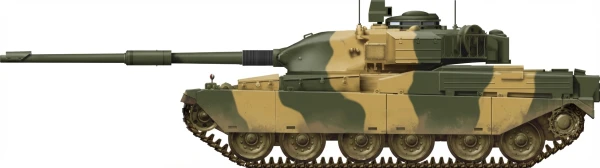
Description
The FV4201 Chieftain was developed by Leyland Motors to succeed the Centurion as the primary main battle tank of the United Kingdom. Concept research studies began in 1950 with the objective of combining the firepower of the 120 mm gun used on the Conqueror heavy tank with the mobility of the Centurion. Development was informed by experiences from the Korean War, emphasizing long-range engagement capabilities and protection against artillery. Troop trials for early prototypes commenced in 1959, and the vehicle entered service in 1967.
The Chieftain features a heavily sloped cast turret and hull designed to increase effective protection. The driver occupies a supine position, allowing for a reduced hull height and a steeply angled glacis plate. The primary armament is the L11A5 120 mm rifled gun. This weapon uses a bagged charge system with separate projectiles and combustible charges rather than fixed rounds. To prevent propellant explosions, the charges are stored in "wet-stowage" recesses surrounded by a water-glycol mixture. Secondary armament includes a coaxial 7.62 mm machine gun and a second 7.62 mm machine gun mounted on the commander's cupola.
Early marks used a .50-inch ranging machine gun for fire control, which was later replaced by the LF-2 laser rangefinder. Subsequent upgrades introduced the Marconi Improved Fire Control System and the Thermal Observation Gunnery Sight. Later British variants, such as the Mark 10 and 11, were fitted with Stillbrew armor to improve protection against kinetic energy rounds. The Shir 2 variant, intended for export, was among the first designs to incorporate Chobham armor. The tank is powered by the Leyland L60, a two-stroke opposed-piston multi-fuel engine, and utilizes Horstmann bogie suspension.
The Chieftain was deployed with the British Army of the Rhine in West Germany during the Cold War. It was widely exported to Middle Eastern nations, including Iran, Jordan, Kuwait, and Oman. Iran operated the tank extensively during the Iran–Iraq War, where it participated in large-scale armored engagements. During this conflict, the vehicle’s mechanical reliability and power-to-weight ratio were challenged by harsh terrain. Iraqi forces captured and evaluated several units during the war. Kuwaiti Chieftains saw action during the 1990 Iraqi invasion, notably at the Battle of the Bridges.
The Chieftain remained in British front-line service until 1996, when it was fully replaced by the Challenger series. The vehicle continues to be operated in several countries, and Iran utilizes a locally upgraded version known as the Mobarez.