Iraq Military Forces
Open-source order of battle for 2026: 193,000 active troops, 396 aircraft, 62 warships, 6,505 ground vehicles.
Armed Forces in 2026
| Domain | Strength | Composition |
|---|---|---|
| Air Force | 396 aircraft | 53 combat 213 helicopters 12 air bases +18 on order |
| Iraqi Navy | 62 warships | |
| Ground Forces | 6,505 vehicles | 1,025 main battle tanks |
| Personnel | 193,000 active | 266,000 paramilitary |
ARMS Index (Aggregate Rating of Military Strength)
Full ranking →| Pillar | Weight | Score | Basis |
|---|---|---|---|
| Manpower | 15% | 75.3 | Active, reserve & paramilitary personnel |
| Ground forces | 20% | 70.1 | Tanks, armor & artillery weighted by type |
| Naval power | 20% | 26.4 | Weighted by hull type: carrier tiers, nuclear vs conventional submarines |
| Air power | 25% | 49.1 | Weighted by aircraft type and fleet age |
| Nuclear deterrent | 10% | 0.0 | No declared nuclear capability |
| Defense budget | 10% | 49.5 | Annual spending, purchasing-power adjusted |
| Readiness | modifier | ×1.00 | Budget per soldier: proxy for training, maintenance & technology |
Country File
| Population | 46M (2024) |
| GDP | $279.6 billion (2024) |
| GDP per capita | $6,074 |
| Military budget | $7B (2024) |
| Share of GDP | 2.5% (2024) |
| Military spending per capita | $152 (2024) |
| Inflation rate | -12.3% (2024) |
| Capital | Baghdad |
| Region | Asia |
| Land area | 437,367 km² |
| Coastline | 58 km |
| Land borders | 3,650 km |
| Bordering countries | 6 |
| Currency | IQD |
Strategic Overview in 2026
Strategic Position
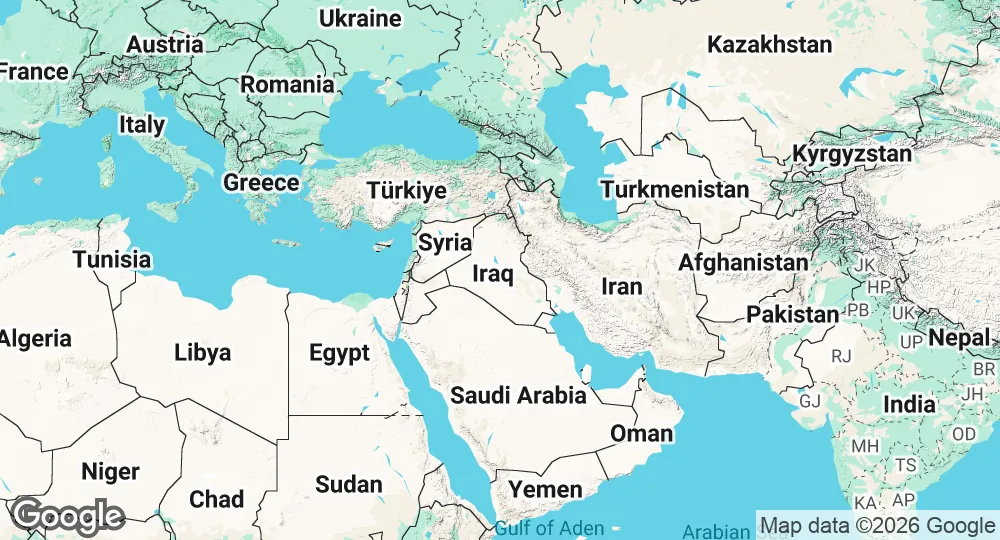
Iraq occupies a central position in the Middle East, bordered by Iran, Turkey, Syria, Jordan, Saudi Arabia, and Kuwait. Primary security concerns involve the persistence of insurgent remnants, border security, and the preservation of national sovereignty amidst regional rivalries. The country is a member of the Arab League and the United Nations.
A significant shift in Iraq’s defense posture is occurring through the phased conclusion of the United States-led Global Coalition mission (Operation Inherent Resolve). Under a bilateral agreement, coalition forces are scheduled to conclude their mission in Baghdad and western Iraq by September 2025, with a final drawdown from the Kurdistan region expected by the end of 2026. This transition moves Iraq toward a bilateral security framework with the United States and other former coalition partners, focusing on advisory roles, intelligence sharing, and counter-terrorism cooperation rather than active combat operations.
Iraq’s relationship with Turkey has evolved through a 2025 memorandum of understanding on military and security cooperation. This agreement established a Joint Security Coordination Center in Baghdad and a Joint Training and Cooperation Center at the Bashiqa base. These facilities are designed to coordinate counter-terrorism efforts against the Kurdistan Workers' Party (PKK), which Iraq officially designated as a banned organization in 2024. Simultaneously, Iraq maintains a complex security relationship with Iran, balanced by the presence of state-sanctioned paramilitary groups within the national security architecture.
Military Forces
The Iraqi Armed Forces are organized under the Ministry of Defense and the Office of the Commander-in-Chief. The structure includes the Ground Forces Command, the Air Force, the Navy, and the Air Defense Command. Two additional major components operate with high degrees of autonomy: the Counter-Terrorism Service (CTS) and the Popular Mobilization Forces (PMF).
Personnel numbers are approximately 200,000 active-duty troops in the conventional branches, with the PMF providing an additional 150,000 to 200,000 personnel. The CTS, an elite specialized unit, maintains a smaller force of approximately 20,000 to 30,000.
Ground Forces: The army operates a diverse inventory of armored vehicles. Main battle tanks include the M1A1 Abrams, T-90S, and T-72 models. The force utilizes BMP-1 and BMP-3 infantry fighting vehicles, alongside BTR-4, BTR-80, and M113 armored personnel carriers. Specialized mobility is provided by Mine-Resistant Ambush Protected (MRAP) vehicles and HMMWVs.
Air Force: The fixed-wing fleet is centered on F-16IQ Fighting Falcons, supplemented by Su-25 attack aircraft and Aero L-159 light combat jets. Pilot training is conducted using T-50IQ advanced trainers and Cessna platforms. In 2025, Iraq moved into the final stages of a contract to acquire Rafale F4 multirole fighters from France to enhance its air superiority and interception capabilities.
Navy: The naval force is primarily a coastal and offshore infrastructure protection service. It operates patrol boats, offshore support vessels, and fast intervention craft concentrated around the port of Umm Qasr and Persian Gulf oil terminals.
Counter-Terrorism Service: This branch serves as the premier specialized force for high-value targeting and urban operations, maintaining its own command structure independent of the traditional army.
Defense Industry
The Iraqi Defence Industries Commission (DIC) oversees domestic arms production through the State Company for Military Industries (SCMI). In 2025, the DIC announced initiatives to increase self-sufficiency by expanding production lines for mortars, rocket launchers, and light-to-medium artillery. Domestic manufacturing also includes the assembly of light small arms, such as the Tariq pistol (a licensed Beretta variant), and the production of small-arms ammunition and mortar shells. While Iraq remains heavily dependent on foreign imports for high-technology systems like radar and advanced aircraft, local facilities increasingly handle the maintenance and repair of armored vehicles and helicopters.
Strategic Trends
Iraq’s defense budget for 2025 is approximately $6.2 billion, representing roughly 1.9% of GDP. Procurement priorities have shifted from counter-insurgency hardware to conventional air defense and sovereign airspace protection. A major component of this shift is the $2.8 billion acquisition of the South Korean KM-SAM II (Cheongung-II) medium-range surface-to-air missile system, with initial deliveries expected in 2026. This is complemented by the procurement of French Thales Ground Master radars.
Force modernization efforts are constrained by high personnel costs, which consume a large portion of the defense budget, and the challenge of integrating the PMF into the formal military chain of command. The transition to a bilateral security model in 2026 requires the Iraqi military to assume full responsibility for logistics, air support, and technical maintenance previously provided by international partners. Future force structure shifts emphasize "fleet simplification," specifically in the Air Force, as Baghdad seeks to replace older or maintenance-intensive airframes with modern multirole platforms like the Rafale and Caracal helicopters.
Military Expenditure: CIA World Factbook. Last updated on 4 August 2026. Suggest a change
Frequently Asked Questions
How large is Iraq's military?
What is Iraq's defense budget?
How does Iraq rank militarily in the world?
Does Iraq have nuclear weapons?
How many aircraft does Iraq's air force have?
How large is Iraq's navy?
How many tanks does Iraq have?
What percentage of GDP does Iraq spend on defense?
What is Iraq's military personnel per capita?
Does Iraq have paramilitary forces?
- AUG 42026 Updated Global Military Index updated in a site-wide editorial pass
- JUL 162026 Updated Global Military Index updated in a site-wide editorial pass
- JUN 162026 Updated Yearly statistics, military spending and 2 more fields updated
- MAR 172026 Updated Paramilitary personnel updated
- JAN 232026 Updated Rank insignia updated (4 entries)
- JAN 212026 Updated Rank insignia updated (51 entries)
- JAN 172026 Updated Main battle tank count and Global Military Index updated