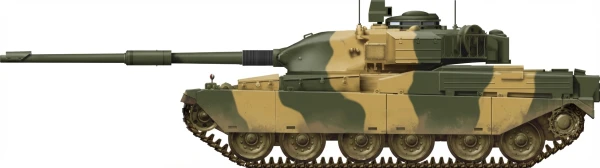
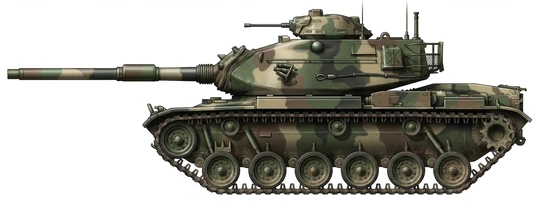
The FV4201 Chieftain and the M60A3 TTS Patton served as primary main battle tanks for the United Kingdom and United States respectively during the latter half of the Cold War. While the British design prioritized heavy armor and a large-caliber rifled gun to counter Soviet long-range threats, the American platform focused on upgrading an existing chassis with advanced fire control and thermal imaging optics as a transitional measure before the M1 Abrams fielding.
Development and Design
Leyland Motors developed the Chieftain to combine the Centurion's mobility with the Conqueror's firepower. Entering service in 1967, it introduced a supine driver position, allowing a steeply angled glacis plate for increased ballistic deflection and a reduced silhouette. Conversely, the M60A3, standardized in 1978, represented the final modernization of the M60 series. Manufactured by the Detroit Tank Plant, the M60A3 integrated modular upgrades into the M60A1 hull, specifically targeting fire control electronics rather than fundamental structural changes. The Chieftain utilized a bespoke hull design, while the M60A3 retained the taller profile of the Patton lineage.
Protection and Firepower
The Chieftain mounts the L11A5 120 mm rifled gun, utilizing a bagged charge system stored in wet-stowage lockers to mitigate propellant ignition risks. Its protection relies on heavily sloped cast steel, with later Marks receiving Stillbrew composite appliqué and the export Shir 2 variant incorporating Chobham armor. The M60A3 TTS utilizes the smaller M68E1 105 mm rifled gun but integrates the advanced AN/VSG2 Tank Thermal Sight. This mercury-cadmium-telluride detector provided the M60A3 with superior target acquisition capabilities in low-visibility conditions compared to early Chieftain variants. While the Chieftain offered higher kinetic energy output per shot, the M60A3 emphasized first-round hit probability through the M21 fire control system.
Mobility and Logistics
Both vehicles list a maximum road speed of 48.0 km/h, though the Chieftain is lighter at 55.0 tons compared to the M60A3's 60.0 tons based on provided data. The British tank is powered by the Leyland L60 two-stroke multi-fuel engine, a unit that faced mechanical reliability challenges in service. The M60A3 utilizes the air-cooled Continental AVDS-1790 V12 diesel engine paired with a cross-drive transmission. The Chieftain offers a slightly longer operational range of 500 km versus the M60A3's 450 km.
Deployment and Combat Record
The Chieftain saw extensive combat with Iranian forces during the Iran-Iraq War, participating in major armored engagements where terrain often challenged its automotive components. Kuwaiti Chieftains engaged Iraqi forces at the Battle of the Bridges in 1990. The M60A3 formed the backbone of US armored forces in Europe during the 1980s. While US M60A3s saw limited combat before retirement after Operation Desert Storm, the platform remains widely exported, with Egypt, Turkey, and Saudi Arabia maintaining large fleets.
Conclusion
The Chieftain is optimized for defensive hull-down positions where its ballistic shaping and heavy 120 mm armament provide advantages against kinetic threats. The M60A3 TTS remains a viable platform in asymmetrical conflicts or against older armor due to its thermal imaging capabilities and established logistical footprint. The British design pushed the boundaries of ballistic protection, whereas the American update extended the relevance of an older chassis through superior electronics.
Which is faster, the Royal Ordnance Chieftain or M60A3 TTS Patton?
The M60A3 TTS Patton is faster with a maximum road speed of 48 km/h compared to the Royal Ordnance Chieftain's 48 km/h.
Which has longer operational range, the Royal Ordnance Chieftain or M60A3 TTS Patton?
The Royal Ordnance Chieftain has a longer operational range at 500 km compared to the M60A3 TTS Patton's 450 km.
Which is heavier, the Royal Ordnance Chieftain or M60A3 TTS Patton?
The Royal Ordnance Chieftain is heavier at 55.0 tons combat weight compared to the M60A3 TTS Patton's 52.6 tons.
Which is larger, the Royal Ordnance Chieftain or M60A3 TTS Patton?
The Royal Ordnance Chieftain is longer at 9.99 meters compared to the M60A3 TTS Patton's 9.75 meters.
How many crew members do the Royal Ordnance Chieftain and M60A3 TTS Patton require?
Both the Royal Ordnance Chieftain and M60A3 TTS Patton require a crew of 4.
Which is more expensive, the Royal Ordnance Chieftain or M60A3 TTS Patton?
The M60A3 TTS Patton is more expensive at approximately $1.3 million per unit compared to the Royal Ordnance Chieftain at $0.3 million.
Which has been built in greater numbers, the Royal Ordnance Chieftain or M60A3 TTS Patton?
The M60A3 TTS Patton has been produced in greater numbers with 8,931 units compared to 1,056 units of the Royal Ordnance Chieftain.
What are the main armaments of the Royal Ordnance Chieftain and M60A3 TTS Patton?
The Royal Ordnance Chieftain is armed with 1 L11A5 120mm rifled barrel gun while the M60A3 TTS Patton carries 1 M68 105mm rifled barrel (63 shells) gun as its main armament.