Oman Military Forces
Open-source order of battle for 2026: 42,600 active troops, 126 aircraft, 17 warships, 1,058 ground vehicles.
Armed Forces in 2026
| Domain | Strength | Composition |
|---|---|---|
| Royal Air Force of Oman | 126 aircraft | 35 combat 40 helicopters 3 air bases |
| Royal Navy of Oman | 17 warships | |
| Ground Forces | 1,058 vehicles | 150 main battle tanks |
| Personnel | 42,600 active | 4,400 paramilitary |
ARMS Index (Aggregate Rating of Military Strength)
Full ranking →| Pillar | Weight | Score | Basis |
|---|---|---|---|
| Manpower | 15% | 58.5 | Active, reserve & paramilitary personnel |
| Ground forces | 20% | 49.6 | Tanks, armor & artillery weighted by type |
| Naval power | 20% | 23.5 | Weighted by hull type: carrier tiers, nuclear vs conventional submarines |
| Air power | 25% | 40.7 | Weighted by aircraft type and fleet age |
| Nuclear deterrent | 10% | 0.0 | No declared nuclear capability |
| Defense budget | 10% | 48.8 | Annual spending, purchasing-power adjusted |
| Readiness | modifier | ×1.10 | Budget per soldier: proxy for training, maintenance & technology |
Country File
| Population | 5.3M (2024) |
| GDP | $107.1 billion (2024) |
| GDP per capita | $20,285 |
| Military budget | $6.4B (2024) |
| Share of GDP | 6.0% (2024) |
| Military spending per capita | $1,217 (2024) |
| Inflation rate | 0.59% (2024) |
| Capital | Muscat |
| Region | Asia |
| Land area | 309,500 km² |
| Coastline | 2,092 km |
| Land borders | 1,374 km |
| Bordering countries | 3 |
| Currency | OMR |
Strategic Overview in 2026
Strategic Position
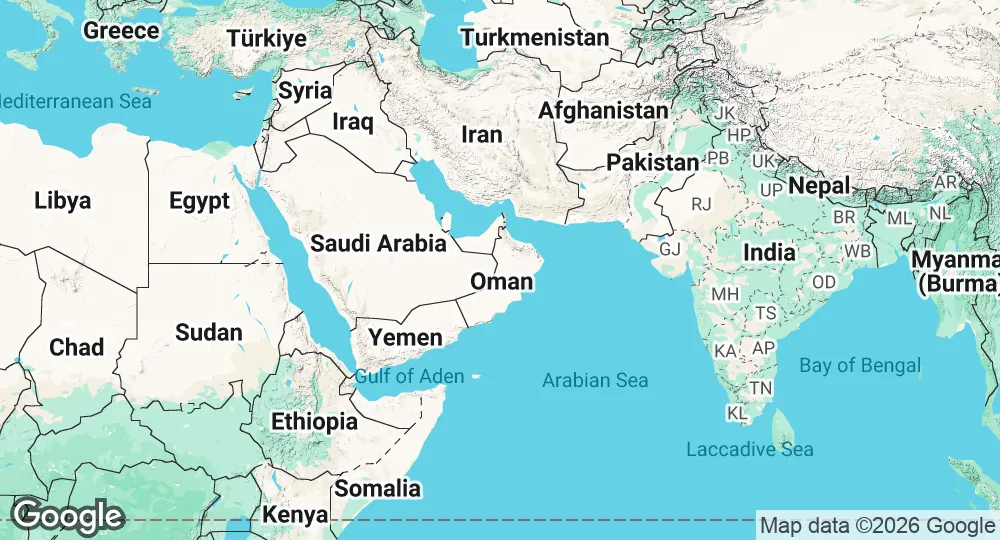
Oman occupies a geography defined by its control over the southern coast of the Strait of Hormuz, through which a significant portion of global petroleum exports passes. The Musandam Peninsula enclave provides the military with direct oversight of this maritime chokepoint. National defense doctrine is centered on a policy of strategic neutrality, often described as "friend to all, enemy to none." This allows the Sultanate to maintain concurrent security relationships with Western powers, regional neighbors, and Iran.
Oman maintains a long-standing defense relationship with the United Kingdom, formalized in various treaties of friendship including a 2019 Joint Defense Agreement. This relationship facilitates the use of the Joint Training Area at Ras Al Madrakah. A similar agreement with the United States, dating to 1980 and expanded in 2019, provides U.S. forces with access to facilities at Duqm, Salalah, and various airbases. Duqm is capable of supporting the repair and logistics of large-tonnage naval vessels, including aircraft carriers.
As a member of the Gulf Cooperation Council (GCC), Oman participates in regional security frameworks but has historically opted out of direct military interventions, such as the conflict in Yemen. Instead, its strategic priority involves acting as a regional mediator and securing its own borders against spillover from neighboring instability.
Military Forces
The Sultan’s Armed Forces (SAF) are organized into four primary branches under the command of the Sultan, who serves as the Supreme Commander-in-Chief. The total active personnel strength is approximately 45,000.
Royal Army of Oman (RAO): The largest branch, with approximately 25,000 personnel. It is organized into several brigades, including armored, infantry, and border guard units. The army operates Challenger 2 and M60A3 main battle tanks. Mechanized and reconnaissance units field Piranha and PARS armored vehicles. Artillery capabilities include G6 self-propelled howitzers and various towed systems.
Royal Air Force of Oman (RAFO): The air branch operates F-16C/D Fighting Falcon and Eurofighter Typhoon multirole fighters for air defense and strike missions. It maintains a fleet of BAe Hawk advanced trainers for light attack and pilot instruction. Transport requirements are met by C-130 Hercules and C-295 aircraft. The helicopter fleet consists of NH90 and Super Lynx models, supporting utility and maritime roles.
Royal Navy of Oman (RNO): Tasked with coastal defense and securing the Strait of Hormuz, the navy operates Khareef-class corvettes and Qahir-class corvettes. The fleet also includes Al-Ofouq-class offshore patrol vessels and various fast attack craft. It does not operate a submarine force.
Royal Guard of Oman (RGO) and Sultan’s Special Forces (SSF): The RGO is an elite unit responsible for the protection of the Sultan and royal installations, maintaining independent armor and infantry capabilities. The SSF is a highly specialized force focused on counter-terrorism and unconventional warfare.
Paramilitary Forces: The Royal Oman Police (ROP) maintains a Coast Guard and an Air Wing, which assist in border security, anti-smuggling, and search-and-rescue operations.
Defense Industry
Oman maintains a modest domestic defense industry primarily focused on ammunition and maintenance. The Oman Munitions Production Company (OMPC) produces small arms ammunition for the armed forces. Strategic focus in 2025 and 2026 has shifted toward the localization of maintenance, repair, and overhaul (MRO) services.
In February 2025, the Turkish electronics firm Aselsan opened a dedicated office in Muscat to provide localized technical support and post-sales service for electronics, radar, and communication systems used by the SAF. This follows a broader trend of partnering with international manufacturers for co-production or localized maintenance under the government's "Partnership for Development" (Offset) program. Despite these efforts, the military remains heavily reliant on imports from the UK, USA, and Turkey for high-end platforms.
Strategic Trends
Defense spending remains high relative to the national economy, with current expenditures estimated at approximately 6% of GDP. Under the Vision 2040 economic plan, the Ministry of Defense is increasingly integrating "Offset" requirements into procurement contracts to ensure knowledge transfer and domestic job creation.
Current modernization priorities for 2025 and 2026 include:
-
Land Force Modernization: Evaluation of new main battle tanks to replace aging M60 variants, with the South Korean K2 Black Panther under consideration.
-
Cyber Defense: In early 2026, the government advanced plans for an advanced cyber excellence center at the Military Technological College to address growing regional cyber threats.
-
Maritime Security: Continued investment in maritime domain awareness and patrol capabilities to secure the Strait of Hormuz against asymmetrical threats and maritime interference.
-
Public-Private Partnerships: For 2026, the Ministry of Finance has identified over 20 projects, including the construction of specialized workshops for helicopter rotor blade repair and military equipment maintenance, to be implemented through private sector collaboration.
Military Expenditure: CIA World Factbook. Last updated on 4 August 2026. Suggest a change
Omani Defense Manufacturing
Designed in OmanFrequently Asked Questions
How large is Oman's military?
What is Oman's defense budget?
How does Oman rank militarily in the world?
Does Oman have nuclear weapons?
How many aircraft does Oman's air force have?
How large is Oman's navy?
How many tanks does Oman have?
What percentage of GDP does Oman spend on defense?
What is Oman's military personnel per capita?
Does Oman have paramilitary forces?
- AUG 42026 Updated Global Military Index updated in a site-wide editorial pass
- JUL 222026 Updated Rank insignia and ranks overview added
- JUL 162026 Updated Global Military Index updated in a site-wide editorial pass
- JUN 162026 Updated Yearly statistics, military spending and 2 more fields updated
- JAN 172026 Updated Main battle tank count and Global Military Index updated
- JAN 132026 Updated Description updated