Expeditionary Fighting Vehicle (EFV)
American amphibious APC, cancelled in 2011 at the prototype stage, designed for ship-to-shore transport of Marine Corps infantry. Key figures: weight 38 t, top speed 72 km/h, range 523 km, unit cost $22M, built 19. In service with 1 army — United States.
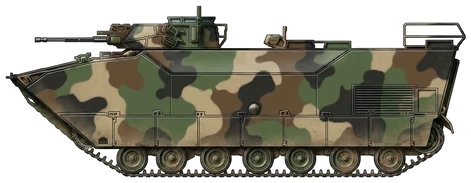
| Sub-type | Amphibious Armored Personnel Carrier |
| Crew | 3 personnels |
| Range | 523 km |
| Mass | 38.0 tons |
| Height | 3.28 m (10.8 ft) |
| Width | 3.66 m (12.0 ft) |
| Length | 10.67 m (35.0 ft) |
| Max. speed | 72 km/h (45 mph) |
| Engine | MTU MT 883 Ka-523 Diesel Engine with 850 hp |
| Weapon 1 | 1 Mk-44 40mm gun |
| Weapon 2 | 1 M240 7.62mm machine gun |
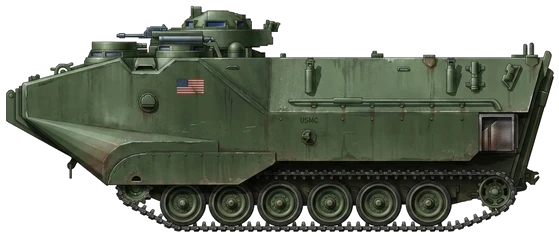
Description
The Expeditionary Fighting Vehicle (EFV), originally designated the Advanced Amphibious Assault Vehicle (AAAV), was an amphibious armored vehicle developed by General Dynamics for the United States Marine Corps. The program originated from the Landing Vehicle Assault (LVA) prototypes of the 1970s and 1980s, intended to replace the AAV-7A1. The vehicle was a component of the "over the horizon" strategy, designed to be launched from amphibious ships located at distances that protected the fleet from shore-based defenses.
General Dynamics Land Systems was awarded the engineering development contract in 1996, and the program entered the systems development and demonstration phase in 2001. The AAAV was officially renamed the EFV in 2003. Throughout the mid-2000s, the program encountered delays and prototype failures related to mechanical reliability. In January 2011, Secretary of Defense Robert Gates recommended the cancellation of the program due to cost increases and reliability issues. The program was subsequently terminated in favor of the Amphibious Combat Vehicle and service life extensions for existing platforms.
The EFV features an aluminum hull and a space frame structure. It is powered by an MTU Friedrichshafen MT 883 Ka-524 V-12 diesel engine with two distinct operating modes: a high-power mode for waterborne planing and a low-power mode for land travel. Water propulsion is provided by two side-integrated shrouded waterjet propulsors. To facilitate high-speed water travel, the vehicle utilizes a hydraulically actuated bow flap and chines that cover the tracks. The suspension system consists of 14 retractable independent hydraulic units.
Armor protection is provided by three-layer panels composed of ceramic, S-2 fiberglass, and a Kevlar-like woven fabric. This configuration offers protection against 14.5mm armor-piercing rounds and fragments from 155mm or 152mm artillery shells. Testing indicated that the flat-bottomed hull, required for waterborne planing, provides underbelly blast protection equivalent to Category-2 Mine Resistant Ambush Protected (MRAP) vehicles. The vehicle also incorporates a nuclear, biological, and chemical defense system.
Two primary variants were developed:
- EFVP (Personnel): Features a crew of three and accommodations for 17 fully equipped marines. It is equipped with an MK46 turret housing a stabilized Mk44 Bushmaster II 30mm cannon and a coaxial M240 7.62mm machine gun. The cannon is capable of single, burst, and fully automatic fire.
- EFVC (Command): Designed as a tactical command post for battalion and regimental levels. It carries a command staff of seven and is armed with a 7.62mm machine gun.
The EFV was intended for use by the United States Marine Corps but did not reach full-rate production or operational deployment prior to its cancellation.
Frequently Asked Questions
What type of vehicle is the Expeditionary Fighting Vehicle (EFV)?
What is the weight of the Expeditionary Fighting Vehicle (EFV)?
What is the maximum speed of the Expeditionary Fighting Vehicle (EFV)?
What is the operational range of the Expeditionary Fighting Vehicle (EFV)?
How many crew members does the Expeditionary Fighting Vehicle (EFV) require?
How many Expeditionary Fighting Vehicle (EFV) have been built?
What weapons does the Expeditionary Fighting Vehicle (EFV) carry?
- SEP 42026 Verified Weight verified against the published specifications
- AUG 112026 Updated Category updated
- AUG 42026 Updated Number built added
- JUL 272026 Updated Cost and service status added; summary text updated; number built removed
- APR 82026 Updated Description updated
- APR 72026 Updated Description added
- JAN 172026 Updated Description added