AAV-7A1 vs Expeditionary Fighting Vehicle (EFV)
AAV-7A1 vs Expeditionary Fighting Vehicle (EFV) at a glance — weight 24,000 vs 38,000 kg, top speed 72 vs 72 km/h, range 480 vs 523 km, crew — vs 3.
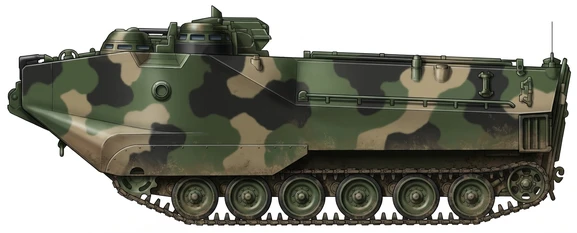
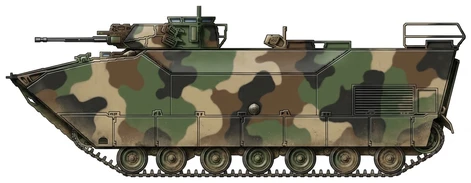
| AAV-7A1 | Expeditionary Fighting Vehicle (EFV) | |
|---|---|---|
| Origin country | 🇺🇸 United States | 🇺🇸 United States |
| Category | Armored Personnel Carrier | Infantry Fighting Vehicle |
| Type | Amphibious armored personnel carrier | Amphibious Armored Personnel Carrier |
| Manufacturer | BAE Systems Platforms & Services | General Dynamics Land Systems |
| Number produced | 942 units | 19 units |
| Estimated unit price | $2.5 million | $22.3 million |
| Combat weight | 24.0 tons | 38.0 tons |
| Maximum speed | 72 km/h | 72 km/h |
| Operational range | 480 km | 523 km |
| Length | 7.94 m | 10.67 m |
| Width | 3.27 m | 3.66 m |
| Height | 3.26 m | 3.28 m |
| Crew | 3+21 | 3 |
| AAV-7A1 | Expeditionary Fighting Vehicle (EFV) | |
|---|---|---|
| Main armament | Mk 19 40 mm automatic grenade launcher | 1 Mk-44 40mm gun |
| Secondary weapon | 12.7 mm M2HB heavy machine gun | 1 M240 7.62mm machine gun |
| Engine | Cummins VTA-903T (P-7A1), 525 hp | MTU MT 883 Ka-523 Diesel Engine with 850 hp |
Detailed Comparison
The U.S. Marine Corps' amphibious assault capability rested for fifty years on the 24-ton AAV-7A1, a high-capacity armored personnel carrier designed to deliver 21 marines through the surf zone. Its intended successor, the 38-ton Expeditionary Fighting Vehicle (EFV), attempted to counter anti-access/area denial (A2/AD) threats by planing across the water at high speeds from ships staged over the horizon—a mechanical leap that ultimately broke the acquisition budget.
Development and Design
FMC Corporation designed the AAV-7A1 in the late 1960s with a simple displacement hull and conventional tracks, maximizing internal volume to carry a reinforced rifle squad. General Dynamics took an entirely different trajectory in 1996 with the EFV. To achieve water speeds allowing ships to launch from beyond visual range, the EFV required a complex hydro-pneumatic retractable suspension, deployable bow flaps, and an MTU diesel engine. This mechanical complexity generated persistent reliability failures that led Secretary of Defense Robert Gates to terminate the program in 2011.
Protection and Firepower
Firepower on the EFV dwarfs the AAV-7A1. The EFV integrates a stabilized Mk44 Bushmaster II 30mm cannon, offering stand-off engagement ranges and programmable munitions that the AAV’s manual or CROWS-mounted Mk 19 40mm grenade launcher and 12.7mm M2HB cannot match. The AAV-7A1 relies on an aluminum hull retrofitted with Enhanced Applique Armor Kits (EAAK) to stop 14.5mm rounds. The EFV utilizes a multi-layer ceramic, S-2 fiberglass, and woven fabric array achieving similar ballistic protection. The EFV achieved Category-2 MRAP underbelly blast protection despite a flat-bottomed planing hull, a stark contrast to the AAV-7A1’s flat aluminum belly, which proved fatal against buried IEDs in Iraq.
Mobility and Logistics
On land, both vehicles govern at 72 km/h. The AAV-7A1 utilizes a 525-hp Cummins VTA-903T, modernized through the RAM/RS program with M2 Bradley suspension components to handle the weight of add-on armor. The 38-ton EFV operates an 850-hp MTU diesel configured for dual land/water modes, driving two shrouded waterjets. The EFV’s logistics tail was projected to be unsustainable; its retractable suspension and hydraulic chines required extensive maintenance hours per operating hour, whereas the AAV-7A1 operates with basic mechanized infantry support equipment.
Deployment and Combat Record
The EFV never advanced beyond testing. The AAV-7A1 accumulated a five-decade operational record:
- Deployed by Argentina during the 1982 Falklands invasion.
- Used heavily by U.S. forces in Grenada (1983) and the 1991 Gulf War.
- Sustained severe losses during the 2003 Battle of Nasiriyah, where its large silhouette and thin base armor proved highly vulnerable to RPGs and mortars.
Its combat career ended ignominiously. Following a 2020 sinking off San Clemente Island that killed nine personnel, the USMC permanently restricted the fleet from maritime deployments.
Conclusion
The AAV-7A1 holds the definitive edge in pure amphibious utility and mechanical reliability, serving successfully for five decades before modern threat environments and metal fatigue retired it. The EFV was structurally flawed from inception. By demanding a tracked armored vehicle capable of waterborne planing, the program forced aerodynamic and hydrodynamic compromises that resulted in a 38-ton maintenance nightmare. While the EFV offered vastly superior firepower and IED protection, its failure to function reliably outside a controlled test environment renders it inferior to the proven, albeit highly vulnerable, AAV-7A1.