BMP-3
Russian IFV, entered service in 1987, manufactured by Kurganmashzavod with around 2000 units built. Key figures: weight 18.7 t, top speed 72 km/h, range 600 km, unit cost $3.2M, built 2,000. In service with 9 armies — United Arab Emirates (652), Russia (650), Iraq (300) and 6 others.
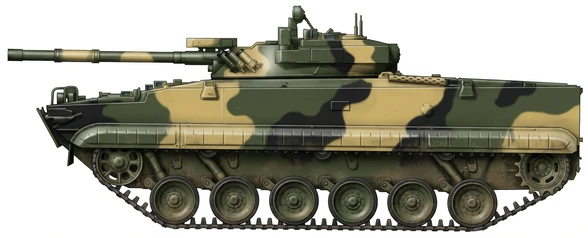
| Sub-type | Infantry fighting vehicle |
| Crew | 3 (commander, gunner, driver) + 7 troopers (+ 2 additional seats) personnels |
| Range | 600 km |
| Mass | 18.7 tons |
| Height | 2.4 m (7.9 ft) |
| Width | 3.2 m (10.5 ft) |
| Length | 7.14 m (23.4 ft) |
| Max. speed | 72 km/h (45 mph) |
| Engine | UTD-29M diesel 500 hp (375 kW) |
| Weapon 1 | 100 mm 2A70 cannon |
| Weapon 2 | 30 mm 2A72 autocannon |
| Weapon 3 | 3 × 7.62 mm PKT machine guns |
| Weapon 4 | 9M117 Bastion Anti Tank Guided Missiles |
Description
The BMP-3 is a Soviet and Russian infantry fighting vehicle developed as the successor to the BMP-1 and BMP-2. Its design, designated Obyekt 688M, originated from the Obyekt 685 light tank prototype developed in 1975. While that prototype did not enter series production, the chassis and engine served as the basis for the Obyekt 688, designed by A. Blagonravov’s bureau. Following the rejection of the initial weapon configuration, the 2K23 armament system was selected. The vehicle was developed during the early 1980s and officially entered service with the Soviet Army in 1987. It made its first public appearance during the 1990 Victory Day parade.
The vehicle features an unconventional layout with the engine situated at the rear right, requiring the driver and two infantrymen to sit forward and the remaining five infantrymen to sit aft of the turret. Troops enter and exit the vehicle over the engine compartment. The hull and turret are constructed from high-strength aluminum alloy, supplemented by steel plates and spaced armor on the frontal arc. This configuration provides protection against 30mm rounds at a range of 200 meters. Defensive features include self-sealing fuel tanks designed to resist shaped charges, Kaktus explosive reactive armor, the Shtora-1 electro-optical jammer, and the Nakidka camouflage system. Drone suppression systems were introduced to the production line in 2024.
Armament is centered on the 2K23 system, incorporating a 2A70 100mm rifled gun, a coaxial 2A72 30mm autocannon, and a 7.62mm PKT machine gun. The 100mm gun fires conventional high-explosive fragmentation shells and 9M117 Bastion anti-tank guided missiles. Additional firepower is provided by two bow-mounted machine guns. Fire control is managed through systems such as the Sodema sight, which includes a laser rangefinder and thermal imaging. The vehicle is powered by UTD-29 or UTD-29M diesel engines and utilizes water-jet propulsion for amphibious operations.
The BMP-3 is operated by several countries, including Russia, the United Arab Emirates, Kuwait, and Indonesia. It saw combat during the First and Second Chechen Wars and was deployed by Emirati forces during the intervention in Yemen and as part of peacekeeping operations in Kosovo. It has also seen use in the Second Nagorno-Karabakh War. During the Russian invasion of Ukraine, the vehicle has been used extensively by Russian forces, while Ukrainian forces have operated units captured during the conflict. In recent engagements, the vehicle has been utilized for indirect fire support. Open-source intelligence has confirmed the loss of several hundred units during the conflict.
Frequently Asked Questions
What type of vehicle is the BMP-3?
What is the weight of the BMP-3?
What is the maximum speed of the BMP-3?
What is the operational range of the BMP-3?
How many crew members does the BMP-3 require?
How many BMP-3 have been built?
What weapons does the BMP-3 carry?
- SEP 42026 Verified Weight verified against the published specifications
- AUG 112026 Updated Category updated
- JAN 242026 Updated Cost added
- JAN 172026 Created Page created: BMP-3