M10 Booker
An American assault gun built by General Dynamics for infantry fire support, delivered from February 2024 and cancelled in May 2025 after 26 vehicles, largely over its 42-tonne weight. Key figures: weight 42 t, top speed 64 km/h, range 480 km, built 26. In service with 1 army — United States (26).
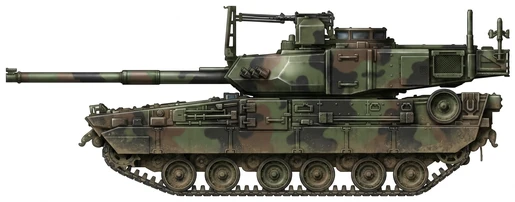
| Sub-type | Assault gun |
| Crew | 4 (commander, gunner, driver, loader) personnels |
| Range | 480 km |
| Mass | 42.0 tons |
| Max. speed | 64 km/h (40 mph) |
| Engine | MTU 8V199 TE23 diesel, 15.9 L, 800 hp |
| Weapon 1 | 1 x 105 mm M35 tank gun |
| Weapon 2 | 1 x 12.7 mm M2HB heavy machine gun |
| Weapon 3 | 1 x 7.62 mm M240 machine gun |
Description
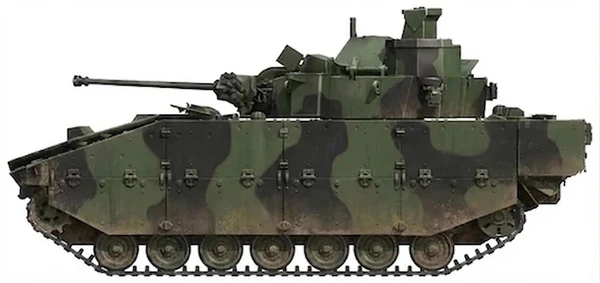
The M10 Booker is an American assault gun developed by General Dynamics Land Systems (GDLS) for the United States Army under the Mobile Protected Firepower (MPF) program. Derived from the GDLS Griffin II—which was based on the Austrian-Spanish ASCOD 2 infantry fighting vehicle chassis—the vehicle was developed to provide direct fire support for Infantry Brigade Combat Teams by suppressing fortifications, gun positions, and light armor. GDLS presented its prototype in April 2020 and was awarded the production contract in June 2022. Officially named in June 2023 after Medal of Honor recipient Private Robert D. Booker and Distinguished Service Cross recipient Staff Sergeant Stevon Booker, the vehicle was designated as an armored infantry support vehicle rather than a light tank or reconnaissance vehicle. First deliveries occurred in February 2024, followed by environmental testing in Arizona and Alaska. The Department of Defense canceled the program in May 2025 due to military budget shifts and vehicle mass constraints that impacted air transport and military base bridge capacity.
The tracked vehicle accommodates a four-person crew. Armament consists of a 105 mm M35 main gun, an M240C 7.62 mm coaxial machine gun, and a commander's .50 caliber M2 machine gun. The main gun is paired with the M1A2 Abrams fire control system. Vehicle sensors include the Safran Optics 1 PASEO Commander's Independent Tactical Viewer. Protection features include modular armor, ammunition stowage blowout panels, smoke grenade launchers, and an automatic fire suppression system. Air transport capability is limited to one vehicle per C-17 Globemaster III flight.
The vehicle was operated solely by the United States Army, which received a small quantity of production units prior to cancellation. Vehicles were assigned to the 82nd Airborne Division, the 101st Airborne Division, the 4th Infantry Division, and the Joint Readiness Training Center. The M10 Booker saw no combat service. Following cancellation, the remaining fleet was designated for potential reassignment to armored units, foreign military sales, or storage.
Frequently Asked Questions
What type of vehicle is the M10 Booker?
What is the weight of the M10 Booker?
What is the maximum speed of the M10 Booker?
What is the operational range of the M10 Booker?
How many crew members does the M10 Booker require?
How many M10 Booker have been built?
What weapons does the M10 Booker carry?
- AUG 52026 Created Page created: M10 Booker