M46 Patton
American main battle tank, manufactured at the Detroit Tank Plant, was a further development of the M26 Pershing. Key figures: weight 44 t, top speed 48 km/h, range 130 km, built 1,160. In service with 5 armies — Belgium, France, Italy and 2 others.
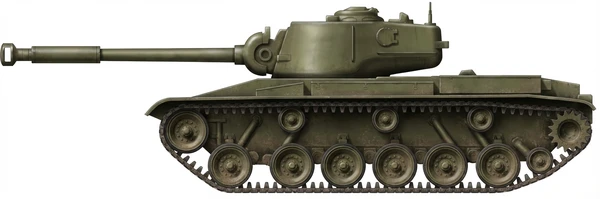
| Sub-type | Medium Main Battle Tank |
| Crew | 5 personnels |
| Range | 130 km |
| Mass | 44.0 tons |
| Height | 3.0 m (9.8 ft) |
| Width | 3.48 m (11.4 ft) |
| Length | 7.04 m (23.1 ft) |
| Max. speed | 48 km/h (30 mph) |
| Engine | Continental AV-1790-5V-12 Diesel Engine with 704 hp |
| Weapon 1 | 1 M3A1 90mm gun |
| Weapon 2 | 1 M2 12.7mm machine gun |
| Weapon 3 | 1 7.92mm M1919 machine gun |
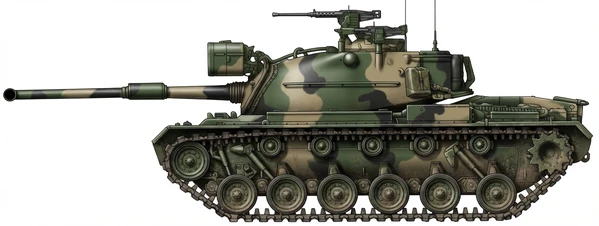
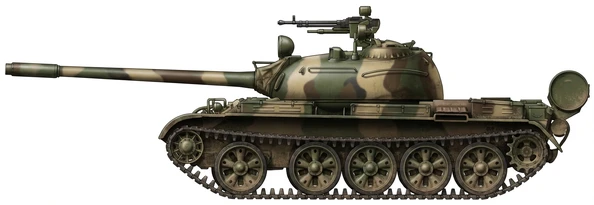
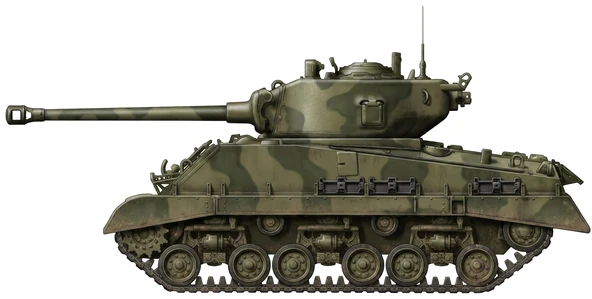
Description
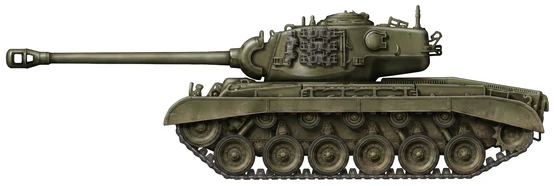
The M46 Patton is an American medium tank developed by the Detroit Arsenal Tank Plant between 1948 and 1949. It was designed to replace the M26 Pershing and M4 Sherman, serving as a principal medium tank for the U.S. Army during the early Cold War. Development began in January 1948 under the designation M26E2 to address mobility deficiencies in the M26 Pershing, which utilized an engine and transmission originally intended for the lighter M4A3. The design was re-designated as the M46 following the integration of a Continental AV1790-3 engine and Allison CD-850-1 cross-drive transmission. Named after General George S. Patton Jr., the first production model was completed in November 1948.
The M46 is operated by a crew of five, including a commander, gunner, loader, driver, and assistant driver. The primary armament is a 90 mm M3A1 gun equipped with a bore evacuator and 70 rounds of ammunition. Secondary armament includes two .30 caliber M1919A4 machine guns and one .50 caliber M2 machine gun. The vehicle's armor provides protection up to 102 mm. Power is supplied by a Continental AV-1790 series V12 air-cooled twin-turbo gasoline engine and a General Motors cross-drive transmission. The chassis uses a torsion bar suspension system. The M46A1 variant incorporated improvements to the braking, cooling, fire suppression, and electrical systems.
The Korean War was the only conflict involving American combat use of the M46. The first vehicles reached South Korea in August 1950 with the 6th Tank Battalion. The M46 was employed against North Korean T-34 medium tanks and allowed for the withdrawal of the M26 Pershing from the theater by 1951. U.S. operators included the 1st Marine Division and the 2nd, 3rd, 7th, 24th, 40th, and 45th Infantry Divisions. Outside of U.S. service, the Republic of Korea operated the type following the war. Small numbers were exported to Belgium or leased to France and Italy to train personnel for the introduction of the M47 Patton. A total of 1,160 units were produced across all variants. The M46 was withdrawn from U.S. service in 1957.
Frequently Asked Questions
What type of vehicle is the M46 Patton?
What is the weight of the M46 Patton?
What is the maximum speed of the M46 Patton?
What is the operational range of the M46 Patton?
How many crew members does the M46 Patton require?
How many M46 Patton have been built?
What weapons does the M46 Patton carry?
- SEP 42026 Verified Weight verified against the published specifications
- JUL 272026 Updated M46 Patton: service entry year added; M46 Patton: built added; M46 Patton: service status added
- APR 72026 Updated Description added
- JAN 172026 Updated Description added