M26 Pershing vs M46 Patton
M26 Pershing vs M46 Patton at a glance — weight 41,900 vs 44,000 kg, top speed 40 vs 48 km/h, range 161 vs 130 km, crew 5 vs 5.
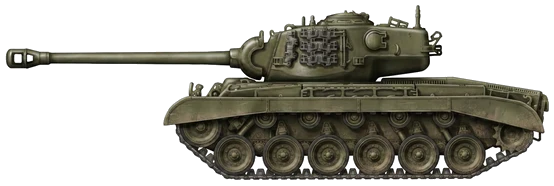
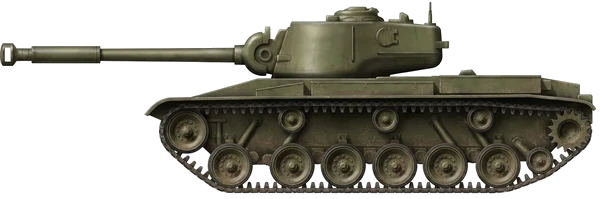
| M26 Pershing | M46 Patton | |
|---|---|---|
| Origin country | 🇺🇸 United States | 🇺🇸 United States |
| Category | Main Battle Tank | Main Battle Tank |
| Type | Heavy Main Battle Tank | Medium Main Battle Tank |
| Manufacturer | U.S. Army Ordnance | Detroit Tank Plant |
| Number produced | 2,000 units | 1,160 units |
| Estimated unit price | $0.1 million | $-- million |
| Combat weight | 41.9 tons | 44.0 tons |
| Maximum speed | 40 km/h | 48 km/h |
| Operational range | 161 km | 130 km |
| Length | 8.65 m | 7.04 m |
| Width | 3.51 m | 3.48 m |
| Height | 2.78 m | 3.00 m |
| Crew | 5 | 5 |
| M26 Pershing | M46 Patton | |
|---|---|---|
| Main armament | 1 M3 90mm gun | 1 M3A1 90mm gun |
| Secondary weapon | 1 M2 HB 12.7mm machine gun | 1 M2 12.7mm machine gun |
| Engine | Ford GAF V8 Diesel Engine with 500 hp | Continental AV-1790-5V-12 Diesel Engine with 704 hp |
Detailed Comparison
The M46 Patton is an emergency automotive correction of the M26 Pershing. While outward appearances and armor profiles suggest two identical vehicles, the mechanical engineering beneath the hull dictates their respective combat utilities. The M26 established the ballistic and structural baseline for postwar U.S. armor, but it was the M46 that delivered the mechanical reliability required for armored maneuver warfare.
Development and Design
The M26 emerged from the T20 prototype series, delayed by a U.S. Tank Destroyer doctrine that prioritized towed and lightly armored platforms for anti-tank operations. Entering service in 1944 as a 41.9-ton heavy tank, it was reclassified as a medium tank in 1946. Its fatal design flaw was retaining the 500 hp Ford GAF engine from the 30-ton M4A3 Sherman, resulting in a deficit of power (11.9 hp/ton). The M46 Patton, initiated in 1948 as the M26E2, was a direct remediation effort. Detroit Tank Plant integrated the 704 hp Continental AV-1790-5V-12 engine and Allison CD-850 cross-drive transmission, increasing vehicle weight to 44 tons but drastically improving handling.
Protection and Firepower
Armor profiles remained static across both platforms, maxing out at 102 mm on the upper hull and 76 mm on the sides. While adequate against late-WWII German 75mm guns, this protection proved vulnerable to the Soviet 85mm weapons encountered in Korea. Lethality saw an incremental but necessary upgrade. Both utilized 90 mm main guns, but the M46 integrated the M3A1 variant.
- The M3A1 added a bore evacuator, resolving the M26's issue of propellant gases blinding and asphyxiating the crew during sustained engagements.
- Secondary armament remained consistent, retaining the standard U.S. configuration of a .50 caliber M2 roof gun and .30 caliber coaxial and bow machine guns.
Mobility and Logistics
The M26's mobility was a tactical liability. In the mountainous terrain of the Korean peninsula, its transmission routinely failed, and engines overheated under the strain of moving a 41.9-ton hull up inclines. Its top speed of 40 km/h was rarely achievable off-road. The M46 corrected this, pushing top speed to 48 km/h and raising the power-to-weight ratio to 16 hp/ton. However, this power increase extracted a logistical cost: the larger AV-1790 engine consumed fuel at a higher rate, reducing the M46's operational range to 130 km compared to the M26's 161 km.
Deployment and Combat Record
The M26 arrived in Europe in January 1945 via the Zebra Mission, engaging German Panthers in Cologne and securing the Ludendorff Bridge. Its definitive combat test occurred in Korea starting in July 1950, where its 90 mm gun successfully penetrated North Korean T-34-85s. However, widespread automotive failures forced the M26's withdrawal by 1951. The M46 replaced it directly in theater, deployed with units including the 1st Marine Division. The M46 sustained combat operations without the mechanical breakdowns of its predecessor, confirming the viability of the cross-drive transmission.
Conclusion
The M46 Patton holds an absolute advantage over the M26 Pershing. The M26 was an underpowered stopgap that forced a medium tank's powerplant into a heavy tank's chassis, resulting in a vehicle incapable of sustaining operations in demanding terrain. By integrating the Continental AV-1790 and the cross-drive transmission, the M46 resolved the Pershing’s mobility flaws and finalized the baseline architecture that would define U.S. main battle tanks through the M48 and M60 series.