PT-76
Soviet light tank, entered service in the early 1950s, featuring amphibious capabilities for river crossings. Key figures: weight 14.6 t, top speed 44 km/h, range 480 km, built 12,000. In service with 4 armies — North Korea (560), Vietnam (300), Cuba (50) and 1 other.
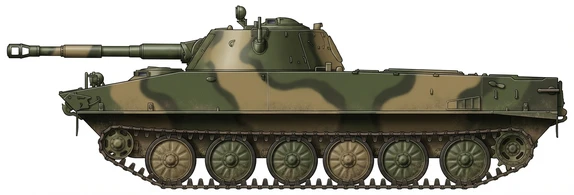
| Sub-type | Amphibious Light Tank |
| Crew | 3 personnels |
| Range | 480 km |
| Mass | 14.6 tons |
| Height | 2.32 m (7.6 ft) |
| Width | 3.14 m (10.3 ft) |
| Length | 7.63 m (25.0 ft) |
| Max. speed | 44 km/h (27 mph) |
| Engine | 6-Cylinder Diesel Engine with 240 hp |
| Weapon 1 | 1 D-56T 76.2mm rifled barrel (40 shells) gun |
| Weapon 2 | 1 PKT 7.62mm machine gun (2000 rounds) |
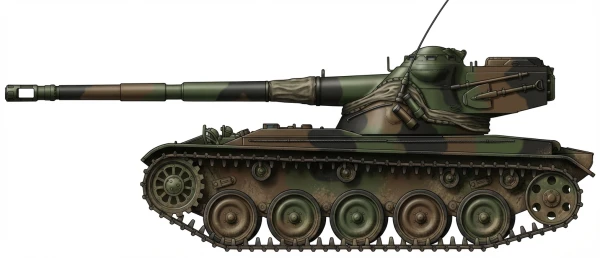
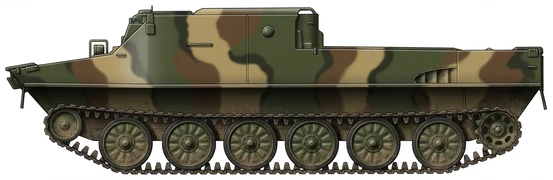
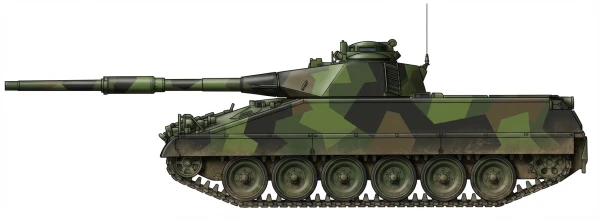
Description
The PT-76 (Floating Tank-76) is a Soviet amphibious light tank developed between 1949 and 1951 to fulfill a requirement for a reconnaissance vehicle capable of fording water obstacles without extensive preparation. N. Shashmurin designed the Object 740 prototype at the VNII-100 institute under the supervision of Josef Kotin. Following trials of a prototype built at the Kirov Plant in 1950, the Soviet Union officially adopted the vehicle on August 6, 1951. Production continued until 1969 at the Stalingrad Tractor Factory and the Kirov Factory.
The design utilizes a boat-shaped hull of welded homogeneous steel. The internal layout consists of a forward steering compartment, a central combat compartment, and a rear engine compartment. The vehicle is operated by a three-man crew. The commander serves as both gunner and radio operator, while the driver is positioned centrally in the hull front. Armor provides protection against 7.62 mm small arms fire and light shell fragments, though the vehicle remains vulnerable to 12.7 mm or .50-caliber ammunition.
Armament centers on the 76.2 mm D-56T series rifled gun, which was later updated to the stabilized D-56TS in the PT-76B variant. The vehicle carries ammunition including Frag-HE, AP-T, API-T, and HEAT projectiles. A 7.62 mm coaxial machine gun provides secondary firepower. Propulsion is provided by a six-cylinder diesel engine. The suspension uses torsion bars and six hollow road wheels, which increase buoyancy. For water travel, the vehicle uses a hydrojet system designed by N. Konowalow, complemented by electric bilge pumps and a retractable trim vane.
Soviet and Warsaw Pact forces utilized the PT-76 as a standard reconnaissance tank. The chassis served as the basis for several other vehicles, including the BTR-50 armored personnel carrier, the ASU-85 self-propelled gun, and the ZSU-23-4 anti-aircraft system. The vehicle was widely exported to countries in Africa, Asia, and the Middle East. Combat history includes the Vietnam War, where North Vietnamese units used the tank during the assault on Lang Vei and the Battle of Ben Het. During the 1971 Indo-Pakistani War, Indian forces deployed the PT-76 at the Battle of Garibpur. Egyptian units utilized the tank’s amphibious capabilities during the 1973 crossing of the Great Bitter Lake. Other engagements include the Six-Day War, the Angolan Civil War, the Yugoslav Wars, and the Second Chechen War. Several countries continue to operate the vehicle in various capacities.
Frequently Asked Questions
What type of vehicle is the PT-76?
What is the weight of the PT-76?
What is the maximum speed of the PT-76?
What is the operational range of the PT-76?
How many crew members does the PT-76 require?
How many PT-76 have been built?
What weapons does the PT-76 carry?
- JUL 272026 Updated Service entry year added; number built added; service status added
- APR 72026 Updated Description added
- JAN 172026 Updated Description added