FV101 Scorpion
British light tank, 174 units built, manufactured by Royal Ordnance Factory. Key figures: weight 7.93 t, top speed 87 km/h, range 640 km, built 174. In service with 8 armies — Nigeria (157), Oman (120), Thailand (104) and 5 others.
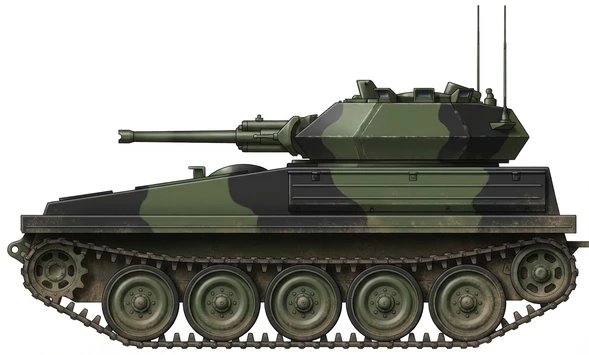
| Sub-type | Light reconnaissance tank |
| Crew | 3 personnels |
| Range | 640 km |
| Mass | 7.9 tons |
| Height | 2.1 m (6.9 ft) |
| Width | 2.2 m (7.2 ft) |
| Length | 4.88 m (16.0 ft) |
| Max. speed | 87 km/h (54 mph) |
| Engine | Diesel Engine with 195 hp |
| Weapon 1 | 1 L23 76mm rifled barrel (45 shells) gun |
| Weapon 2 | 1 MAG 7.62mm machine gun (3000 rounds) |
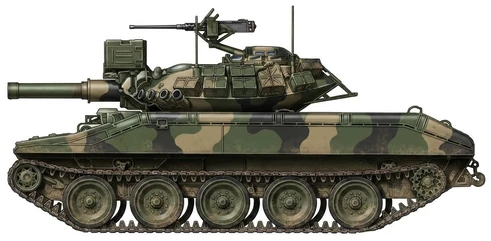
Description
The FV101 Scorpion is a British armored reconnaissance vehicle and light tank, developed by Alvis as the lead vehicle for the Combat Vehicle Reconnaissance (Tracked) (CVR(T)) family. The project originated from a British Army requirement for an armored fighting vehicle capable of rapid air transport. Alvis was awarded the contract for prototypes in 1967. Following trials in Norway, Australia, Abu Dhabi, and Canada, the British Army accepted the design in 1970. Production began in 1972, and the vehicle officially entered service with the Blues and Royals in 1973. While the British Army withdrew the Scorpion from active service in 1994, it remains in use with several international operators.
The hull and turret are constructed from aluminum alloy armor, utilizing both cast components and plate. The frontal arc provides protection against 14.5 mm rounds, while the sides and rear protect the crew from 7.62 mm fire and shell fragments. To facilitate air portability, the vehicle was initially powered by a Jaguar J60 petrol engine, though many were later retrofitted with diesel engines from manufacturers such as Cummins, Perkins, or Steyr. The design emphasizes low ground pressure for operation in boggy or soft terrain.
The primary armament is a 76 mm L23A1 gun capable of firing high-explosive, HESH, smoke, and canister rounds. This weapon is mounted in a 360-degree traversing turret, operated via manual hand cranks. Secondary armament includes a coaxial 7.62 mm machine gun and multi-barreled smoke grenade launchers. A variant known as the Scorpion 90 is equipped with a long-barreled Cockerill Mk3 90 mm gun. Standard systems include nuclear, biological, and chemical (NBC) protection, image intensification sights, a boiling vessel for crew rations, and a flotation screen.
The Scorpion was produced in large numbers and exported to numerous countries, including Belgium, Iran, Thailand, and Nigeria. In British service, the vehicle was deployed to Cyprus in 1974 and saw combat during the Falklands War in 1982, where it provided fire support during the attack on Mount Tumbledown. In the 1991 Gulf War, Scorpions were used for force reconnaissance by the 1st The Queen's Dragoon Guards and the 16th/5th The Queen's Royal Lancers. The Iranian Army utilized the Scorpion during the Iran-Iraq War, employing the vehicle’s fire to stall infantry offensives near Ilam, though the platform was outmatched in direct engagements against Iraqi T-62 tanks. Other deployments include the 1989 Philippine coup d'état attempt and the Zamboanga City crisis. Some operators integrated the Scorpion turret onto other chassis, such as the Australian M113 and the Canadian AVGP Cougar.
Frequently Asked Questions
What type of vehicle is the FV101 Scorpion?
What is the weight of the FV101 Scorpion?
What is the maximum speed of the FV101 Scorpion?
What is the operational range of the FV101 Scorpion?
How many crew members does the FV101 Scorpion require?
How many FV101 Scorpion have been built?
What weapons does the FV101 Scorpion carry?
- AUG 112026 Updated Type updated
- JUL 272026 Updated FV101 Scorpion: service entry year added; FV101 Scorpion: service status added
- APR 72026 Updated Description added
- JAN 242026 Updated Category updated
- JAN 172026 Updated Description added
- JAN 52026 Updated Name updated