Leopard 2
German main battle tank, entering service in 1979, manufactured by Krauss-Maffei with over 3600 units built. Key figures: weight 62.5 t, top speed 70 km/h, range 340 km, unit cost $29M, built 3,600. In service with 23 armies — Greece (353), Turkey (316), Germany (296) and 20 others.
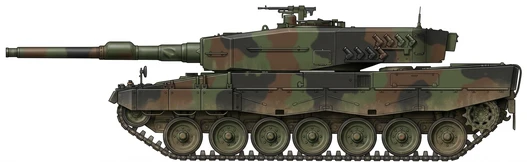
| Sub-type | Heavy Main Battle Tank |
| Crew | 4 personnels |
| Range | 340 km |
| Mass | 62.5 tons |
| Height | 3.0 m (9.8 ft) |
| Width | 3.76 m (12.3 ft) |
| Length | 9.97 m (32.7 ft) |
| Max. speed | 70 km/h (43 mph) |
| Engine | MTU MB 873 MTCA Diesel Engine with 1500 hp |
| Weapon 1 | Rheinmetall 120 mm L/55 |
| Weapon 2 | 7.62 mm MG3A1 or 7.62 mm FN MAG |
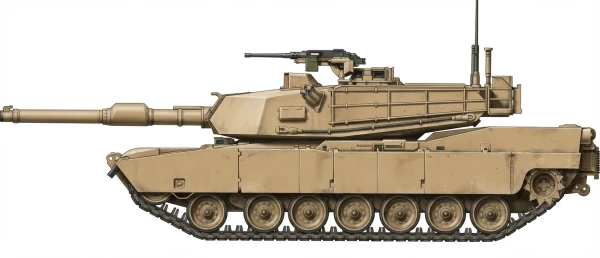
Description
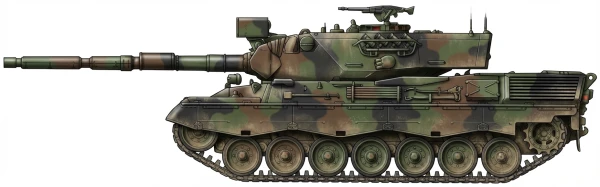
The genesis of this main battle tank dates to the 1970s, entering service in 1979 as a successor to an earlier West German vehicle. Aspirations for an enhanced tank had emerged earlier, spurring a cooperative development in 1963. When this initiative faced uncertainties by 1967, national efforts pivoted towards upgrading the existing platform through a study focused on integrating advanced technologies. Following this, an "experimental development" phase created new components to meet demanding firepower standards, partly influenced by another discontinued international project. A definitive path was chosen in 1971, building upon a late-1960s national prototype series, leading to this tank's formal designation. Series production commenced after design refinements from extensive trials, including an American evaluation, and was underpinned by studies affirming its superior combat potential.
A third-generation main battle tank, this vehicle features progressive enhancements across its variants. Early models had vertically-faced turret armour, while later versions, from the A5 onwards, incorporated angled, arrow-shaped appliqué armour and other improvements. Its principal armament is a smoothbore 120 mm cannon, evolving from an L/44 to a longer L/55 version, coupled with a sophisticated digital fire control system, laser rangefinder, and advanced thermal imaging. Propulsion is by a V12 twin-turbo diesel engine. Crew protection relies on advanced spaced multilayer armour, offering significant resistance, especially frontally. Turret ammunition is stored in a bustle with blow-off panels, though a secondary hull supply lacks this feature. Armour has been continually upgraded with modular additions, improved belly protection, and pathways for active protection systems. Comprehensive NBC defenses and automated fire suppression systems are standard. The tank's prioritized mobility is ensured by a robust torsion bar suspension and versatile track system, enabling high operational tempo and deep-water fording with preparation. A relatively low acoustic signature has also been noted.
Since its introduction, this tank has been operated by German forces and numerous international partners across Europe and globally, including Canada, Chile, Indonesia, and Singapore, with some nations undertaking local production. Its combat record began with German peacekeeping in Kosovo. Subsequently, Canadian, Danish, and Dutch forces utilized their variants in Afghanistan with ISAF, where its protection against IEDs and firepower were validated. Turkish forces later employed their A4 models in the Syrian Civil War against ISIS, facing ATGMs and IEDs, testing the platform's resilience and highlighting upgrade needs. Since 2023, various Leopard 2 models, some augmented with reactive armour by Ukraine, have been engaged in high-intensity combat in the Russo-Ukrainian War, participating in offensive operations against diverse modern threats.
Frequently Asked Questions
What type of vehicle is the Leopard 2?
What is the weight of the Leopard 2?
What is the maximum speed of the Leopard 2?
What is the operational range of the Leopard 2?
How many crew members does the Leopard 2 require?
How many Leopard 2 have been built?
What weapons does the Leopard 2 carry?
- SEP 42026 Verified Weight verified against the published specifications
- JUL 232026 Updated Sources and cross-references refreshed