Puma IFV
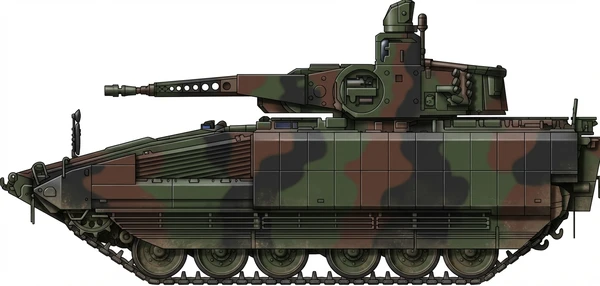
German IFV, entering service in 2015, has a modular design for varied mission requirements. Key figures: weight 43 t, top speed 70 km/h, range 600 km, unit cost $21M, built 350. In service with 1 army — Germany (337).
| Sub-type | Infantry fighting vehicle |
| Crew | 3 personnels |
| Range | 600 km |
| Mass | 43.0 tons |
| Height | 3.6 m (11.8 ft) |
| Width | 4.0 m (13.1 ft) |
| Length | 7.4 m (24.3 ft) |
| Max. speed | 70 km/h (43 mph) |
| Engine | MTU Fried. MT 892 Ka-501 v10 11.1-litre 1,088 PS (800 kW) |
| Weapon 1 | 30 mm MK 30-2/ABM autocannon |
| Weapon 2 | HK MG5 (7.62×51mm NATO) |
| Weapon 3 | Spike LR (MELLS) ATGM |
| Weapon 4 | Multishot grenade launcher |
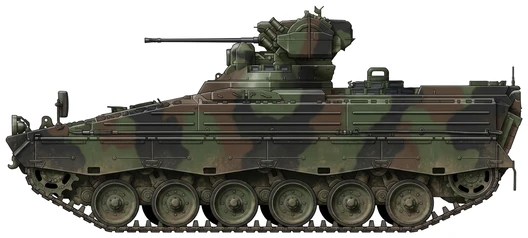
Description
The Schützenpanzer Puma is a German infantry fighting vehicle developed to replace the Marder fleet. Development originated from the 1996 Neue Gepanzerte Plattformen project, which sought a common base vehicle for multiple roles. Following the conclusion of that project in 2001, planning for the Puma began in 2002 under a joint venture between Krauss-Maffei Wegmann and Rheinmetall Landsysteme. Serial production commenced in 2009. The vehicle underwent environmental trials in Norway and the United Arab Emirates before entering official service with the German military in 2015.
The vehicle is designed with a compact, one-piece crew cabin that houses the three crew members and six passengers in a single protected volume. It utilizes an unmanned, double-asymmetrical turret positioned on the left side of the hull, with the main armament mounted on the right side of the turret. Protection is provided by a modular armor system using AMAP composite materials. The base configuration protects against medium-caliber projectiles and heavy machine gun fire, while an additional modular kit increases resistance to kinetic energy rounds, rocket-propelled grenades, and artillery sub-munitions. The upper flanks are fitted with non-metallic explosive reactive armor. Further survivability features include decoupled seating to mitigate mine blasts, an NBC-proof cabin, and the Multifunktionales Selbstschutz-System (MUSS), a softkill active protection system designed to defeat guided missiles.
Primary armament consists of a 30 mm MK 30-2/ABM autocannon capable of firing sub-caliber armor-piercing and kinetic energy-timed fuse munitions. Secondary armament includes a coaxially mounted machine gun—the MG4 or MG5—and a Spike LR anti-tank guided missile launcher. For close-in defense, the vehicle is equipped with a 40 mm multishot grenade launcher at the rear. Mobility is provided by an MTU Diesel engine and a hydropneumatic suspension system designed to limit vibrations and improve cross-country performance.
The Puma is operated by the German Army. In 2022, the German government temporarily paused further purchases following an exercise where 18 participating vehicles became inoperable. The manufacturer subsequently attributed the damage to improper operation. A modernization program is underway to upgrade the fleet to the S1 standard, which integrates the MELLS missile system, new digital radios, and high-resolution day and night cameras for the crew and mounted squad. Additional batches have been ordered to continue the replacement of older armored platforms.
Frequently Asked Questions
What type of vehicle is the Puma IFV?
What is the weight of the Puma IFV?
What is the maximum speed of the Puma IFV?
What is the operational range of the Puma IFV?
How many crew members does the Puma IFV require?
How many Puma IFV have been built?
What weapons does the Puma IFV carry?
- SEP 42026 Verified Weight verified against the published specifications
- AUG 112026 Updated Category updated
- JAN 242026 Updated Cost added
- JAN 172026 Created Page created: Puma IFV