K21 vs Puma IFV
K21 vs Puma IFV at a glance — weight 25,600 vs 43,000 kg, top speed 70 vs 70 km/h, range 500 vs 600 km, crew 3 crew + 9 passengers vs 3.
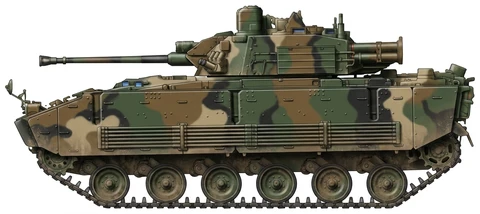
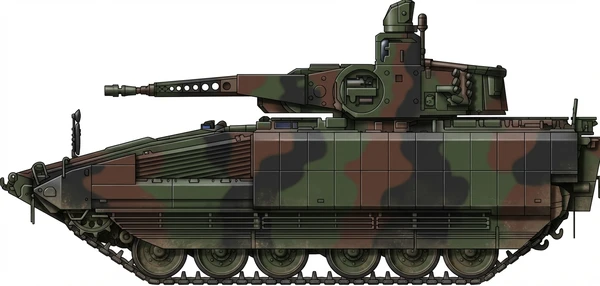
| K21 | Puma IFV | |
|---|---|---|
| Origin country | 🇰🇷 South Korea | 🇩🇪 Germany |
| Category | Infantry Fighting Vehicle | Infantry Fighting Vehicle |
| Type | Infantry fighting vehicle | Infantry fighting vehicle |
| Manufacturer | Hanwha Defense | PSM |
| Number produced | 466 units | 350 units |
| Estimated unit price | $3.5 million | $21 million |
| Combat weight | 25.6 tons | 43.0 tons |
| Maximum speed | 70 km/h | 70 km/h |
| Operational range | 500 km | 600 km |
| Length | 6.90 m | 7.40 m |
| Width | 3.40 m | 4.00 m |
| Height | 2.60 m | 3.60 m |
| Crew | 3 crew + 9 passengers | 3 |
Detailed Comparison
At $3.5 million per unit, Hanwha Defense’s K21 costs one-sixth of Krauss-Maffei Wegmann and Rheinmetall’s $21.0 million Puma. This price gap dictates their acquisition strategies: South Korea built 466 K21s for mass deployment across the Korean peninsula, while Germany capped Puma production at 350 units to serve as heavily armored nodes within mechanized brigades.
Development and Design
The Puma originated from the 1996 Neue Gepanzerte Plattformen project to replace the Marder fleet, standardizing around a compact crew cabin with an unmanned turret. This isolates the three-man crew and six dismounts from ammunition cook-offs. The K21, developed from 1999 to replace the K200, prioritizes infantry capacity. It retains a traditional manned turret and carries a nine-man squad. South Korea optimized the K21 for the peninsula's mountainous, river-dense terrain, incorporating an amphibious pontoon system—a requirement that led to early sinkings in 2009 and 2010 before redesigns corrected the drainage and buoyancy mechanics.
Protection and Firepower
The Puma trades passenger capacity for raw mass, weighing 43.0 tons compared to the K21’s 25.6 tons. The German vehicle utilizes AMAP modular composite armor and explosive reactive armor, with its base configuration absorbing 30mm kinetic energy rounds. It integrates the MUSS soft-kill active protection system (APS) standard. The base K21 relies on glass-fiber reinforced ceramics over an aluminum hull, rated for 14.5mm rounds and 30mm APDS frontally.
Firepower diverges by caliber and doctrine:
- The K21 uses an SNT Dynamics 40mm autocannon firing APFSDS rounds, supplemented by two Raybolt ATGM launchers.
- The Puma employs a 30mm MK 30-2/ABM autocannon focused on airburst munitions, paired with the Spike LR (MELLS) ATGM.
Mobility and Logistics
Both vehicles reach 70 km/h, but they use different mechanical paradigms. The Puma relies on a 1,088 hp MTU V10 diesel to move its 43 tons, resulting in a power-to-weight ratio of 25.3 hp/t. The K21 achieves 32.8 hp/t from its 840 hp Doosan engine, granting higher acceleration and softer soil traversal. Logistically, the Puma’s $21 million price tag and complex electronics have caused severe availability shortfalls, culminating in an 18-vehicle readiness failure during a 2022 Bundeswehr exercise. The K21 is cheaper to sustain, though its baseline aluminum chassis poses repair complications compared to steel armor.
Deployment and Combat Record
Neither platform has sustained combat deployments, but their design trajectories reflect export realities. Germany is upgrading Pumas to the S1 standard to fix electronic and integration flaws. Hanwha leveraged the K21’s baseline to develop the AS21 Redback. Australia selected the Redback over the Puma's cousin, the Lynx KF41, validating the South Korean chassis when up-armored and stripped of its amphibious requirement.
Conclusion
The Puma possesses greater base survivability, aligning with the lessons from Ukraine where heavy IFVs preserve crews against shaped charges and artillery fragmentation better than lighter platforms. However, the Puma's prohibitive cost and poor readiness rates negate its armor advantage. The K21 wins the procurement calculus. By offering a cheap, reliable, and easily modified base chassis—proven by the heavily armored AS21 derivative—Hanwha provides a scalable platform that arrives on the battlefield in usable numbers, while the Puma remains an expensive, over-engineered liability.