STRV-103 "S"
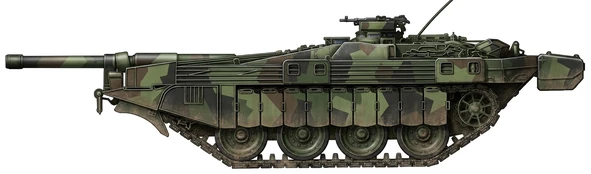
Swedish tank, with 260 units built, used a turretless design with a fixed gun. Key figures: weight 42.5 t, top speed 50 km/h, range 390 km, unit cost $0.443M, built 260. In service with 1 army — Sweden.
| Sub-type | Medium Main Battle Tank |
| Crew | 3 personnels |
| Range | 390 km |
| Mass | 42.5 tons |
| Height | 2.14 m (7.0 ft) |
| Width | 3.63 m (11.9 ft) |
| Length | 8.99 m (29.5 ft) |
| Max. speed | 50 km/h (31 mph) |
| Engine | Diesel Engine with 490 hp |
| Weapon 1 | 1 L74 105mm rifled barrel (50 shells) gun |
| Weapon 2 | 3 7.62mm machine guns (2750 rounds) |
Description
The Stridsvagn 103 (Strv 103), designated the "S-tank," was developed in Sweden starting in 1956 under the direction of designer Sven Berge at Bofors. The project originated from a requirement to replace the Swedish Army's Centurion fleet. Following the evaluation of foreign designs under "Alternative A" and "Alternative T," the Swedish government selected the domestic "Alternative S" proposal in 1958. This decision was based on the industrial benefits for Sweden and the specific requirements of Swedish neutral doctrine. Development was informed by combat data from World War II and the Korean War, which indicated that lower vehicle silhouettes reduced the probability of turret penetrations. Following pre-production testing, full production occurred between 1967 and 1971.
The Strv 103 is a turretless main battle tank featuring a fixed Bofors L74 rifled gun. Gun laying is achieved by traversing the entire hull using the tracks and adjusting elevation or depression through a hydropneumatic suspension system. This configuration allows for a low profile, intended to minimize the vehicle's exposure in hull-down firing positions. The gun is equipped with an autoloader, which facilitates a high rate of fire and enables a three-man crew consisting of a commander, a gunner/driver, and a rear driver. The rear driver is equipped with a full set of controls and vision blocks, allowing the vehicle to be driven in reverse at the same speed as forward. The propulsion system is a hybrid arrangement consisting of a diesel engine for maneuvering and aiming, paired with a gas turbine for high-speed travel. Protection features include sloped frontal armor and a slat armor grid designed to neutralize high-explosive anti-tank (HEAT) rounds. The vehicle is amphibious when fitted with a flotation screen and carries an integral dozer blade for field engineering and hull protection.
The Swedish Army was the sole operator of the Strv 103, maintaining the type in service from 1967 until 1997. The tanks were assigned to assault brigades tasked with counter-offensive operations against beachheads or airborne landings. The Strv 103 saw no combat history. During its service life, the vehicle underwent several upgrades, including the 103C variant which introduced new engines, laser rangefinders, and improved fire control systems. Comparative trials conducted by the United Kingdom, the United States, and Norway evaluated the turretless concept against conventional designs like the Leopard 1 and M60. These observations noted the vehicle's accuracy and acquisition speed when stationary, though it could not fire on the move. The Strv 103 was eventually phased out in favor of Leopard 2 variants.
Frequently Asked Questions
What type of vehicle is the STRV-103 "S"?
What is the weight of the STRV-103 "S"?
What is the maximum speed of the STRV-103 "S"?
What is the operational range of the STRV-103 "S"?
How many crew members does the STRV-103 "S" require?
How many STRV-103 "S" have been built?
What weapons does the STRV-103 "S" carry?
- SEP 42026 Verified Weight verified against the published specifications
- JUL 272026 Updated STRV-103 "S": service entry year added; STRV-103 "S": cost added; STRV-103 "S": service status added
- APR 72026 Updated Description added
- JAN 172026 Updated Description added