T-10
Soviet main battle tank, production reached 2,500 units, never officially entered service. Key figures: weight 52 t, top speed 42 km/h, range 240 km, built 2,500. In service with 1 army — Russia.
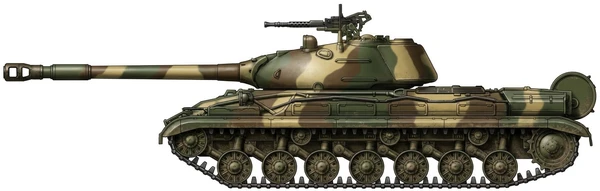
| Sub-type | Heavy Main Battle Tank |
| Crew | 4 personnels |
| Range | 240 km |
| Mass | 52.0 tons |
| Height | 2.43 m (8.0 ft) |
| Width | 3.56 m (11.7 ft) |
| Length | 7.4 m (24.3 ft) |
| Max. speed | 42 km/h (26 mph) |
| Engine | V2-IS Diesel Engine with 690 hp |
| Weapon 1 | 1 D-74 122mm gun |
| Weapon 2 | 2 KPV 14.5mm machine guns |
| Weapon 3 | 1 12.7mm DShK machine gun |
Description
The T-10, developed between 1949 and 1953 under the direction of Jozef Kotin, was the final heavy tank produced by the Soviet Union. Originally designated Object 730, the design was intended to replace the IS-2, IS-3, and IS-4 series by addressing mechanical unreliability and logistical limitations associated with preceding heavy tank models. It was accepted into service as the IS-8 in 1953 but was redesignated T-10 shortly thereafter as part of the de-stalinization process. Production occurred at Factory 185 and Factory 174 between 1954 and 1966.
The vehicle features a cast hull divided into driver, fighting, and engine compartments, with a stamped steel floor in a shallow V shape. The torsion bar suspension utilizes seven road wheels per side. The turret is constructed of rolled steel and houses a 122mm main gun—the D-25TA on initial models and the M-62-T2 on the modernized T-10M. Secondary armament transitioned from 12.7mm DShKM machine guns to 14.5mm KPVT heavy machine guns in the T-10M variant. Fire control capabilities were updated throughout the production cycle, starting with the single-plane PUOT-2 "Grom" stabilizer and progressing to two-plane stabilization on the T-10B and T-10M. The T-10M also introduced infrared night vision, NBC protection, and deep-wading equipment. The main gun utilizes separate loading ammunition, resulting in a rate of fire of three rounds per minute.
The Soviet Union deployed the T-10 in independent tank regiments and battalions to support infantry operations and perform breakthroughs. The vehicle was used during the 1968 Warsaw Pact invasion of Czechoslovakia. While the T-10 was not officially exported to Warsaw Pact nations, Soviet units stationed in those countries were equipped with the type. Conflicting reports exist regarding export to Egypt and Syria; some sources claim T-10s destroyed M48 Patton tanks during the Yom Kippur War, though these accounts are often attributed to the misidentification of IS-3 tanks. The T-10 was withdrawn from frontline Soviet service in 1967 and remained in reserve status in Russia until 1996.
Frequently Asked Questions
What type of vehicle is the T-10?
What is the weight of the T-10?
What is the maximum speed of the T-10?
What is the operational range of the T-10?
How many crew members does the T-10 require?
How many T-10 have been built?
What weapons does the T-10 carry?
- SEP 42026 Verified Weight verified against the published specifications
- JUL 272026 Updated Service entry year added; service status added
- APR 72026 Updated Description added
- JAN 172026 Updated Description added