RAF Barford St John
RAF Barford St John is an active military air base in the United Kingdom, operated by the US Air Force. It has 3 runways (longest 1,670 m). Home to No. 15 Service Flying Training School RAF, No. 16 Operational Training Unit, No. 1655 Mosquito Training Unit RAF, No. 4 Squadron RAF and 3 other units.
Facility Details
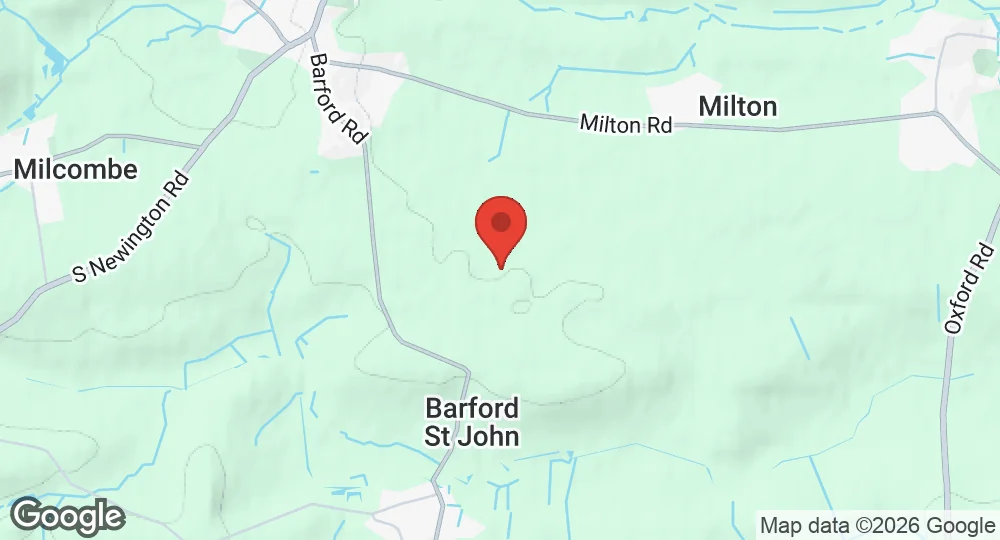
52.0036°N, 1.3600°W · 116 m elevation
| Operating Country | 🇬🇧 United Kingdom • 🇺🇸 United States |
| Location | 🇬🇧 United Kingdom |
| Status | Active |
| Usage | Military only |
| Year built | 1941 |
| Operating Organization | US Air Force |
| Units |
No. 15 Service Flying Training School RAFNo. 16 Operational Training UnitNo. 1655 Mosquito Training Unit RAFNo. 4 Squadron RAFNo. 21 Heavy Glider Conversion Unit RAFNo. 169 Squadron RAFNo. 170 Squadron RAF
|
| Elevation | 116 m (381 ft) |
| Runways |
09/27 · 1,670 m (5,479 ft) · Asphalt16/34 · 1,215 m (3,986 ft) · Asphalt02/20 · 1,210 m (3,970 ft) · Asphalt
|
- 12 km RAF Croughton 422nd Air Base Group
- 17 km RAF Weston-on-the-Green Airborne Delivery Wing
- 28 km Little Rissington Airfield 612 Volunteer Gliding Squadron
- 32 km RAF Brize Norton No. 10 Squadron
- 46 km RAF Fairford 501st Combat Support Wing
- 47 km RAF Benson No. 22 Squadron
 No. 4 Squadron RAF
Description
RAF Barford St John is a Royal Air Force station located north of Barford St. John, Oxfordshire, England. It was constructed in 1941. The site is currently a non-flying facility operated by the United States Air Force as a communications center, functioning as a satellite of RAF Croughton. It features numerous large communications aerials.
The base opened on July 30, 1941, under RAF Flying Training Command, initially utilizing three grass runways for Airspeed Oxfords of No. 15 Service Flying Training School RAF. In December 1942, it was rebuilt as an RAF Bomber Command airfield with paved runways and night operations equipment, serving as a satellite for RAF Upper Heyford. During 1943, it functioned as a flight test center for Gloster E.28/39 and Gloster Meteor jet aircraft. Bomber Command's No. 16 Operational Training Unit, equipped with Vickers Wellingtons, was stationed there until December 1944, followed by No. 1655 Mosquito Training Unit RAF. Other units present at various times included No. 4 Squadron RAF, No. 21 Heavy Glider Conversion Unit RAF, No. 169 Squadron RAF, and No. 170 Squadron RAF.
Flying operations ceased in 1946, and the airfield was placed into care and maintenance. In 1951, the United States Air Force reactivated the site as a communications (transmitter) center. It hosts a Scope Signal III installation, which was part of the modernization of Strategic Air Command's global command and control network, "Giant Talk." The air base has three asphalt runways: 09/27 measuring 1,670 meters, 16/34 measuring 1,215 meters, and 02/20 measuring 1,210 meters. The elevation of the site is 116 meters above mean sea level.
- AUG 132026 Updated Runway designations, surfaces and lengths recorded
- JAN 122026 Updated Sources and cross-references refreshed
- JUL 12025 Updated Airbase data reviewed and updated