Gloster Meteor
British twin-engined jet fighter, the first British jet fighter and the only Allied jet to fly combat in the Second World War, later serving as night fighter and trainer. Key figures: top speed 966 km/h, range 966 km, service ceiling 13,106 m, max takeoff weight 7,121 kg, built 3,947.
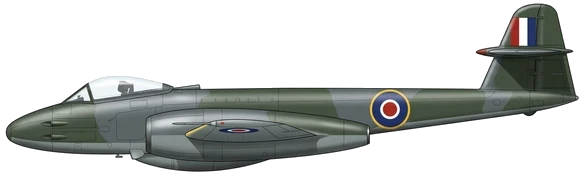
| Crew | 1 |
| Length | 13.6 m (44.6 ft) |
| Wingspan | 11.3 m (37.2 ft) |
| Height | 4.0 m (13.0 ft) |
| Wing area | 32.5 m² (349.8 sqft) |
| Empty weight | 4,846 kg (10,684 lbs) |
| Max. takeoff weight | 7,121 kg (15,699 lbs) |
| Powerplant | 2 × turbojets Rolls-Royce Derwent 8 1,633 kgf each |
| Maximum speed | 966 km/h (600 mph) |
| Operational range | 966 km (600 mi) |
| Service ceiling | 13,106 m (42,999 ft) |
| Climb rate | 35.6 m/s (116.8 ft/s) |
- Unguided Bomb 1,000 lb bomb
- Rocket Pod RP-3 60 lb rocket
- Rocket Pod HVAR 5-inch rocket
Description
The Gloster Meteor is a British twin-engined jet fighter designed and primarily produced by the Gloster Aircraft Company, with turbojet engines based on designs by Power Jets Ltd. It was the first British jet fighter and began operations with No. 616 Squadron RAF on 27 July 1944. It was the only Allied jet aircraft to engage in combat during the Second World War. Later versions served as fighters, reconnaissance aircraft, night fighters, trainers and target drones. As of 2023, two Meteors remained in use with Martin-Baker as ejection seat testbeds.
Development
Engine work began in 1936, and development of the Gloster Meteor began in 1940. In February 1941, Gloster received an order for twelve prototypes under Specification F9/40, later reduced to eight. A letter of intent for 300 aircraft, initially named Thunderbolt, followed on 21 June 1941.
Engine delays at subcontractor Rover postponed flight testing. Rolls-Royce then took over the W.2B engine. The fifth prototype, DG206, flew first on 5 March 1943 at RAF Cranwell, powered by de Havilland Halford H.1 engines. The first F.1 flew on 12 January 1944, and 20 were built, followed by 210 F.3s.
Gloster could not meet the demand of 80 aircraft per month, so fuselage sections were subcontracted to several firms. Armstrong Whitworth completed whole aircraft from the F.4 onwards and also designed and built the night fighter versions. Avions Fairey and Fokker licence-built the F.8. Thousands of Meteors were built in total.
Design
The Gloster Meteor is an all-metal aircraft with a tricycle undercarriage and low, straight wings. Its engines are mounted in nacelles between the front and rear spars, and the tailplane is set high to clear the jet exhaust. Each airframe was built in five modular sections with a stressed duralumin skin, which allowed production to be dispersed.
The F.1 used two Rolls-Royce Welland engines rated at 1,700 lbf, giving 417 mph at 9,800 ft. The F.8 used Derwent 8 engines rated at 3,600 lbf each. It also introduced a 30 in fuselage stretch, a new tail, a Martin-Baker ejection seat and a teardrop canopy. The F.8 reached 600 mph at 10,000 ft and had a service ceiling of 43,000 ft.
Night fighters carried AI Mk 10 radar in the NF.11 and APS-21 in the NF.12. Endurance was under one hour. In RAF service, 890 Meteors were lost and 450 pilots were killed.
Armament
The F.1 carried four nose-mounted 20 mm Hispano Mk V cannon. On night fighters, the cannon were moved into the wings outboard of the engines to make room for radar. The F.8 could carry up to sixteen 60 lb RP-3 rockets or eight 5-inch HVAR rockets under the outer wings, plus two 1,000 lb bombs. Israeli F.8s were modified to carry HVARs, and Argentine Meteors were refitted with bomb pylons and rocket rails after 1960.
Operational History
Meteors destroyed 14 V-1 flying bombs, with the first two kills on 4 August 1944. By the end of the war, they had also destroyed 46 German aircraft in ground attacks.
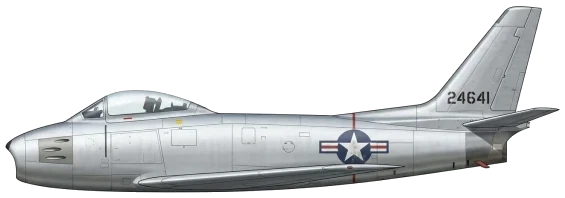
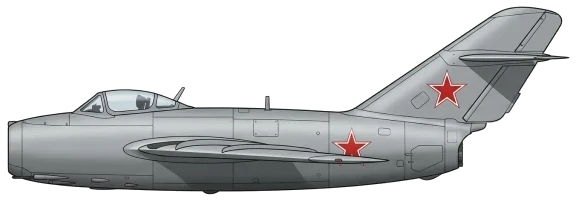
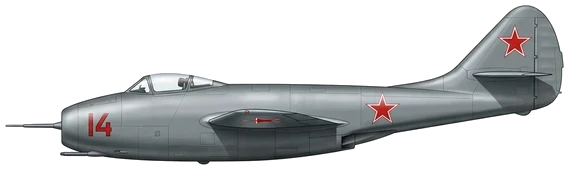
In Korea, No. 77 Squadron RAAF flew 4,836 missions. It destroyed six MiG-15s and lost about 30 Meteors, mostly to anti-aircraft fire.
Argentine Meteors flew on both sides of the 1955 revolts. Egyptian, Israeli and Syrian Meteors saw action during the Suez Crisis. A Syrian Gloster Meteor shot down an RAF Canberra on 6 November 1956, and an Israeli NF.13 shot down an Egyptian Il-14 on 28 October 1956. French Meteors served in the Algerian War.
Other operators included Australia, Belgium, Brazil, Denmark, Ecuador and the Netherlands. In 1945, a Meteor F.3 set the first official jet airspeed record at 606 mph.
Variants
- F.1: Initial production fighter with Welland engines, of which 20 were built.
- F.4: Derwent 5-powered fighter with a strengthened fuselage, exported to Argentina, Belgium, Denmark, Egypt and the Netherlands.
- T.7: Unarmed two-seat trainer derived from the F.4, with more than 650 manufactured.
- F.8: Definitive fighter with a longer fuselage, a new tail and an ejection seat, forming the bulk of RAF Fighter Command from 1950 to 1955.
- NF.11: Armstrong Whitworth night fighter with AI Mk 10 radar and wing-mounted cannon.
Frequently Asked Questions
What type of aircraft is the Gloster Meteor?
What is the maximum speed of the Gloster Meteor?
What is the range of the Gloster Meteor?
When did the Gloster Meteor first fly?
How many Gloster Meteor have been built?
Which countries operate the Gloster Meteor?
What is the service ceiling of the Gloster Meteor?
- SEP 302026 Created Page created: Gloster Meteor