RAF Molesworth
RAF Molesworth is an active military air base in the United Kingdom, operated by the US Air Force. Home to the 423rd Air Base Group, Joint Intelligence Operations Center Europe Analytic Center, US Africa Command Intelligence and Knowledge Directorate-Molesworth, NATO Intelligence Fusion Centre.
Facility Details
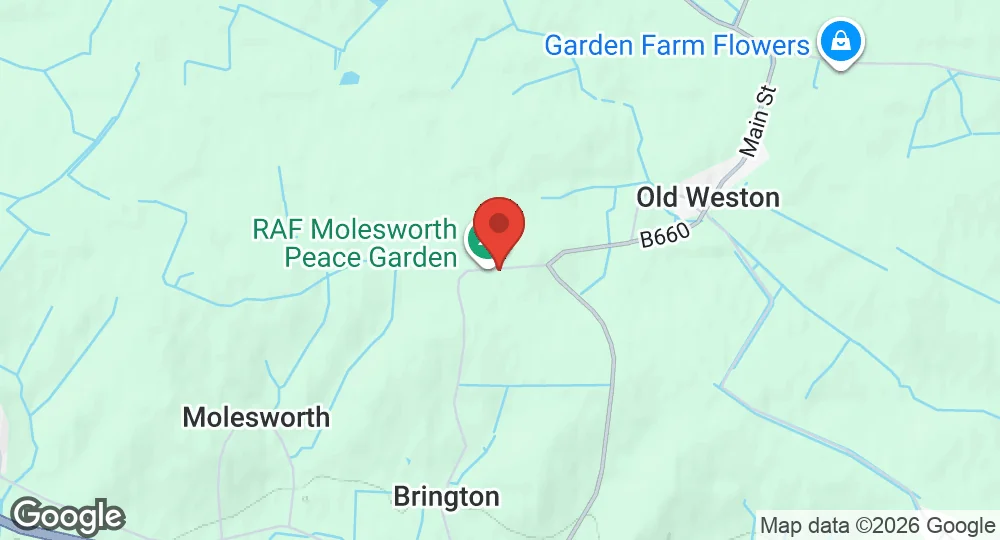
52.3794°N, 0.4050°W · 77 m elevation
| Operating Country | 🇬🇧 United Kingdom • 🇺🇸 United States |
| Location | 🇬🇧 United Kingdom |
| Status | Active |
| Usage | Military only |
| Year built | 1940 |
| Operating Organization | US Air Force |
| Units |
423rd Air Base GroupJoint Intelligence Operations Center Europe Analytic CenterUS Africa Command Intelligence and Knowledge Directorate-MolesworthNATO Intelligence Fusion Centre
|
| Elevation | 77 m (253 ft) |
- 12 km RAF Alconbury 423d Air Base Group
- 20 km RAF Wyton National Centre for Geospatial Intelligence
- 26 km RAF Wittering No. 42 (Expeditionary Support) Wing
- 41 km RAF Henlow RAF Centre of Aerospace Medicine
- 60 km RAF Mildenhall 100th Air Refueling Wing
- 64 km RAF Feltwell 73rd Intelligence, Surveillance and Reconnaissance Squadron
 NATO Intelligence Fusion Centre
Description
RAF Molesworth is a non-flying Royal Air Force station in Cambridgeshire, England, owned by the UK Ministry of Defence and operated by the United States Air Force as a joint intelligence site. Its runway closed in 1973 and no aircraft are based there; the station houses the US European Command's Joint Intelligence Operations Center Europe Analytic Center (JAC), the theatre intelligence analysis centre managed by the Defense Intelligence Agency, the Molesworth detachment of US Africa Command's intelligence directorate (J2-M), and the NATO Intelligence Fusion Centre (NIFC), which produces operational and strategic intelligence for the Supreme Allied Commander Europe with the United States as framework nation and the United Kingdom as host. Base support comes from the 423rd Air Base Group, headquartered at nearby RAF Alconbury under the 501st Combat Support Wing. A new Joint Intelligence Analysis Complex, US-funded under a £219 million Defence Infrastructure Organisation contract awarded in July 2023, broke ground on 12 April 2024 and is due for completion in 2028, replacing some twenty dispersed buildings.
A Royal Flying Corps training field in 1917, the site was rebuilt as a bomber airfield in 1940–1941. Allocated to the US Army Air Forces as Station 107 and extended to a 1,830 m (2,000 yd) main runway, it received the 15th Bombardment Squadron and its Douglas Bostons on 9 June 1942; on 4 July 1942 six of its crews joined six from No. 226 Squadron RAF in a low-level attack on Luftwaffe airfields in the Netherlands, the first bombing mission flown by a USAAF unit over occupied Europe, from which two of the American aircraft did not return.
From the autumn of 1942 Molesworth was home to the 303rd Bombardment Group, "Hell's Angels", whose 358th, 359th, 360th and 427th Bombardment Squadrons flew Boeing B-17 Flying Fortresses. The group flew its first mission on 17 November 1942 and its last, against Pilsen, on 25 April 1945: 364 missions for 165 aircraft lost. It took part in the Eighth Air Force's first heavy-bomber raid on Germany, against Wilhelmshaven on 27 January 1943, and its B-17F 41-24577 "Hell's Angels" became, on 13 May 1943, the first Eighth Air Force heavy bomber to complete 25 missions, ahead of the "Memphis Belle". The group left on 31 May 1945; its memorial stands inside the main gate.
The US Air Force returned in 1951 with the 582nd Air Resupply Group, a special-operations support unit inactivated as the 42nd Troop Carrier Squadron on 8 December 1957; the airfield, by then with a 2,740 m (9,000 ft) jet runway, was formally closed in 1973. Following NATO's December 1979 dual-track decision, Molesworth was selected in June 1980 as the second British base, after RAF Greenham Common, for the BGM-109G Gryphon ground-launched cruise missile, with 64 missiles planned. The runways were removed and a GLCM Alert and Maintenance Area built in their place: four hardened shelters, each for a transporter-erector-launcher, sixteen missiles and two launch control centres, the missiles flown into Alconbury and moved by road.
The deployment made the station a focus of the anti-nuclear movement. A peace camp opened at the south-east gate on 28 December 1981, and from August 1984 campaigners and travellers occupied part of the still-unfenced airfield as "Rainbow Village". On 6 February 1985 some 1,500 troops and police cleared the site and fenced its 11 km (7 mi) perimeter in a single operation, the Secretary of State for Defence arriving by helicopter; the peace chapel left inside the wire was demolished on 14 April 1986. The 303rd Tactical Missile Wing was activated on 12 December 1986, but the Intermediate-Range Nuclear Forces Treaty of 8 December 1987 ended the mission almost as soon as it began: all missiles had left by the end of October 1988 and the wing was inactivated on 30 January 1989.
The intelligence role was announced on 11 January 1990, and the Joint Analysis Center, set up at Molesworth because European Command's Stuttgart headquarters lacked the space, began operations in October 1991. The NATO Intelligence Fusion Centre, created by the NATO Military Committee in 2006, became fully operational at Molesworth in December 2007 and now draws staff from 28 NATO and three partner nations. On 8 January 2015 the US European Infrastructure Consolidation review announced that the Molesworth and Alconbury missions would move to RAF Croughton and both stations be returned to the Ministry of Defence. The plan was reassessed from spring 2018, and in February 2019 the Ministry of Defence confirmed the station would be retained, the United States choosing instead to rebuild at Molesworth.
- OCT 92026 Updated Description expanded (current intelligence tenants, Second World War and cruise missile history); wartime designation added
- JAN 122026 Updated Sources and cross-references refreshed
- JUL 12025 Updated Airbase data reviewed and updated