T129 ATAK
Turkish twin-engine attack helicopter, introduced in the 2010s, deployed for armed reconnaissance and attack missions in hot and high environments. Key figures: top speed 281 km/h, range 537 km, service ceiling 4,572 m, max takeoff weight 5,056 kg, unit price $50M. In service with 3 air forces as of 2026 — Turkey (58), Nigeria (6), Philippines (6).
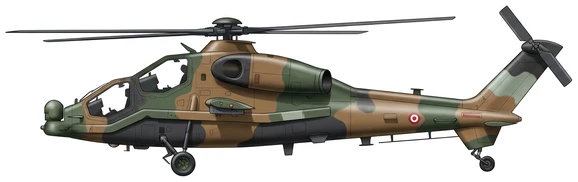
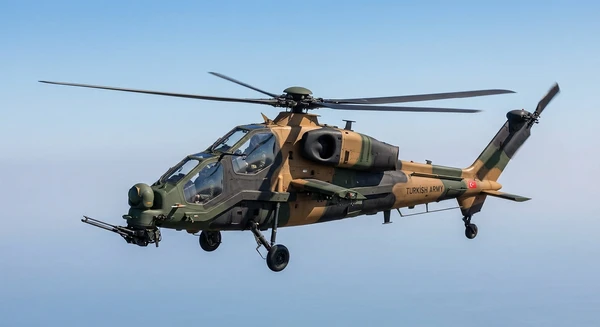
| Crew | 2 |
| Length | 14.5 m (47.7 ft) |
| Wingspan | 11.9 m (39.0 ft) |
| Height | 3.4 m (11.2 ft) |
| Wing area | 111.2 m² (1197.2 sqft) |
| Empty weight | 2,350 kg (5,181 lbs) |
| Max. takeoff weight | 5,056 kg (11,147 lbs) |
| Powerplant | 2 × LHTEC CTS800-4A 1,024 kW each |
| Maximum speed | 281 km/h (175 mph) |
| Operational range | 537 km (334 mi) |
| Endurance | 3 hours |
| Service ceiling | 4,572 m (15,000 ft) |
| Climb rate | 13.26 m/s (43.5 ft/s) |



- Anti-Tank UMTAS
- Air-to-Surface Cirit
- Air-to-Air Short-Range Stinger
- Rocket Pod MKE FFAR
- Rocket Pod Hydra 70
- Rocket Pod CRV7
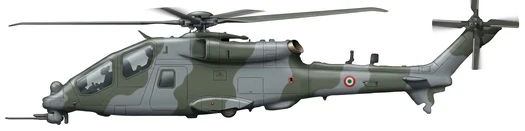
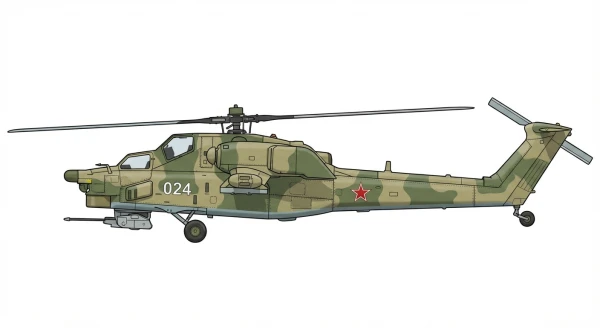
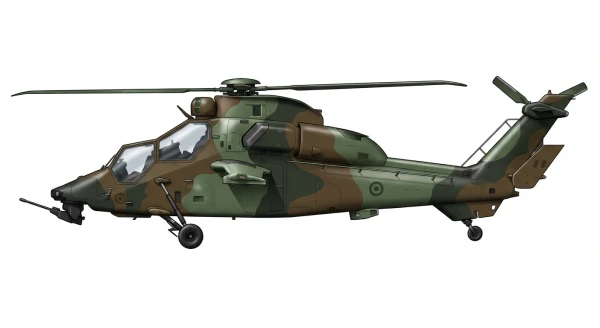
Description
The TAI/AgustaWestland T129 ATAK is a twin-engine, tandem-seat attack helicopter produced by Turkish Aerospace Industries in partnership with Leonardo S.p.A. Based on the Agusta A129 Mangusta platform, it was developed to perform armed reconnaissance and ground attack missions in hot and high environments. The aircraft entered service with the Turkish Land Forces in 2014. It is characterized by the integration of Turkish-developed avionics, structural modifications, upgraded powerplants, and native weapon systems onto the original airframe.
Development
The ATAK program was initiated to meet the Turkish Armed Forces' requirement for an armed tactical reconnaissance and attack helicopter. In September 2007, a $1.2 billion contract was signed with AgustaWestland to co-develop and produce 51 helicopters in Turkey. The maiden flight of the P1 prototype occurred on 28 September 2009 in Italy, followed by the flight of the first Turkish-assembled prototype, P6, on 17 August 2011. Early trials identified weight distribution issues, which required adding 137 kg of ballast to the tail section. Formal deliveries of serial production aircraft to the Turkish Land Forces began on 22 April 2014. To bypass US export vetoes on the standard LHTEC CTS800-4N engines, Turkey developed the indigenous TEI TS1400 engine for export platforms.
Design
The T129 features a tandem-seat cockpit layout and is powered by two LHTEC CTS800-4A turboshaft engines, each producing 1,024 kW. Targeting and navigation are supported by the Hunter Kaska helmet-mounted control system, which automatically cues weapon systems to the pilot's line of sight. Primary optical targeting is provided by an Aselsan ASELFLIR-300T electro-optical sensor. Integrated survivability systems include a Radar Warning Receiver, Radar Frequency Mixer, Laser Receiver, and an automatic Countermeasure Firing System.
Armament
Internal armament consists of a nose-turreted M197 20 mm three-barrel rotary cannon with 500 rounds of ammunition. Ordnance is carried across four wing hardpoints. Available payloads include up to eight UMTAS 160 mm anti-tank guided missiles, 16 CIRIT 70 mm laser-guided missiles, 76 unguided 70 mm rockets, or eight Air-to-Air Stinger short-range missiles.
Operational History
The Turkish Land Forces first deployed the T129 in combat in April 2015 during counter-terrorism operations in Siirt Province. On 10 February 2018, a Turkish Army T129 was shot down by YPG anti-aircraft fire during operations in Afrin, Syria. Export deliveries began with the Philippine Air Force, which acquired six T129Bs between 2021 and May 2024 for its 15th Strike Wing. Nigeria took delivery of its first two T129s in November 2023 for counter-insurgency missions, while Somalia received six aircraft in 2025. A planned sale of 30 units to Pakistan stalled after the United States declined to issue export licenses for the LHTEC engines.
Variants
- T129A EDH: Interim combat support variant armed with a 20 mm rotary cannon and 70 mm unguided rockets.
- T129B: Primary multi-role production variant fitted with electronic warfare suites and capability to launch guided anti-tank and air-to-air missiles.
Frequently Asked Questions
What type of aircraft is the T129 ATAK?
What is the maximum speed of the T129 ATAK?
What is the range of the T129 ATAK?
When did the T129 ATAK first fly?
Which countries operate the T129 ATAK?
How much does a T129 ATAK cost?
What is the service ceiling of the T129 ATAK?
- AUG 52026 Updated Thrust updated
- AUG 42026 Created Page created: T129 ATAK; then thrust updated