BAe 146
British short-haul and regional airliner, developed in the late 20th century, widely used for regional passenger transport, cargo, and military VIP operations. Key figures: top speed 789 km/h, range 3,650 km, service ceiling 10,668 m, max takeoff weight 42,184 kg, built 387.
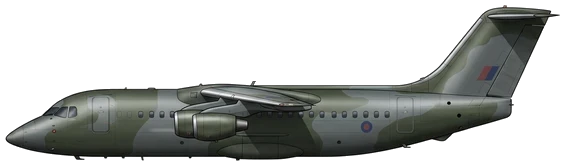
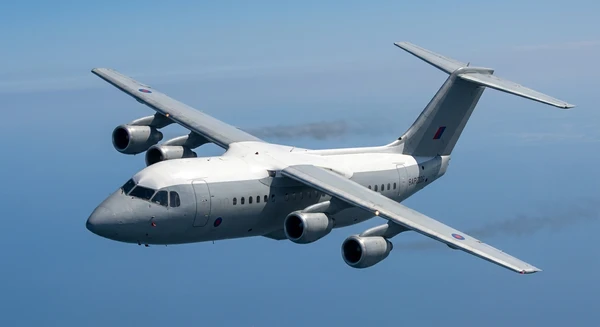
| Crew | 2 |
| Length | 28.6 m (93.7 ft) |
| Wingspan | 26.3 m (86.4 ft) |
| Height | 8.6 m (28.2 ft) |
| Wing area | 77.3 m² (832.0 sqft) |
| Empty weight | 24,600 kg (54,234 lbs) |
| Max. takeoff weight | 42,184 kg (93,000 lbs) |
| Powerplant | 4 × Lycoming ALF 502R-5 / Honeywell LF 507-1F 31 kN each |
| Maximum speed | 789 km/h (490 mph) |
| Operational range | 3,650 km (2,268 mi) |
| Service ceiling | 10,668 m (35,000 ft) |
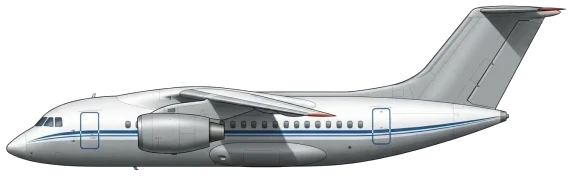
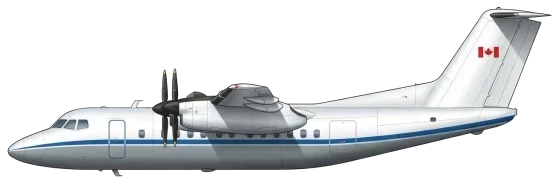
Description
The BAe 146 was developed as a regional airliner to fill the market gap between turboprop airliners and small jet transports. Hawker Siddeley initiated the design as the HS.146 in 1973, but halted work in 1974 due to the global economic downturn. British Aerospace relaunched the project in 1978. The aircraft made its first flight on 3 September 1981 and received its Certificate of Airworthiness on 8 February 1983. A total of 387 aircraft, including the upgraded Avro RJ series, were produced before production ended in 2001. Manufacturing was distributed internationally, with Textron in the United States building the wings and Saab-Scania in Sweden producing the tailplane.
Design
The BAe 146 is a high-wing cantilever monoplane with a T-tail and retractable landing gear. It is powered by four Avco Lycoming ALF 502 geared turbofans; Avro RJ variants use higher-thrust LF 507 engines. Geared fans keep blade tip speeds subsonic to reduce noise. The wing has an uninterrupted top surface without leading-edge extensions. The engines lack thrust reversers, relying instead on a clamshell tail airbrake and full-width wing spoilers. Construction utilizes carbon brakes and minimal composite materials. Early models featured manual flight controls and conventional cockpits, while the Avro RJ series introduced Electronic Flight Instrument Systems (EFIS). Operators can fit auxiliary under-floor or wing fuel tanks and a gravel kit for rough-field operations.
Operational History
The aircraft entered service with Dan-Air in May 1983. The Royal Air Force (RAF) operated the type from 1986 to 2022. The RAF fleet included the CC Mk 2 for VIP transport, the C Mk 3 transport with a 10.6-ton payload capacity, and the C3 variant equipped with flare dispensers and infrared countermeasures for use in Afghanistan. Civil and utility operators include Pacific Southwest Airlines, Crossair, and National Jet Express. Multiple retired airliner airframes have been converted for aerial firefighting, operated by Conair and Neptune Aviation in North America.
Variants
- BAe 146-100 / Avro RJ70: The initial short-fuselage variant that first flew on 3 September 1981, with the RJ70 update adding LF 507 engines with FADEC and digital avionics.
- BAe 146-200 / Avro RJ85: A variant featuring a 2.41-meter fuselage extension first flown in August 1982, with the RJ85 version introducing an improved cabin and LF 507 engines.
- BAe 146-300 / Avro RJ100: A variant with a 2.34-meter fuselage stretch compared to the -200, which entered service in December 1988 and was developed into the RJ100 with avionics and engine upgrades.
- BAe 146STA: A proposed military transport version based on the 146QT cargo aircraft, featuring a nose-mounted refueling probe and an air-openable paratroop door.
- BAe 146M: A military conversion program launched in 2009 that retrofits ex-civilian aircraft with glass cockpits, defensive systems, and additional fuel tanks.
Frequently Asked Questions
What type of aircraft is the BAe 146?
What is the maximum speed of the BAe 146?
What is the range of the BAe 146?
When did the BAe 146 first fly?
How many BAe 146 have been built?
Which countries operate the BAe 146?
What is the service ceiling of the BAe 146?
- JUN 302026 Created Page created: BAe 146