Be-6 Madge
Soviet long-range flying boat designed for maritime reconnaissance, patrol, torpedo/bombing strikes, and transport operations, operated from the late 1940s to the late 1960s. Key figures: top speed 414 km/h, range 4,800 km, service ceiling 6,100 m, max takeoff weight 29,000 kg, built 123.
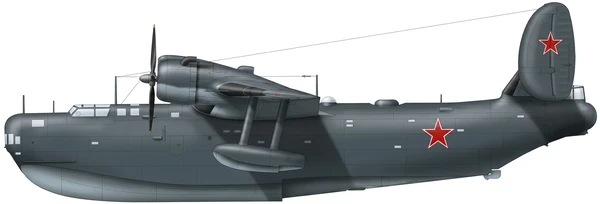
| Crew | 8 |
| Length | 23.5 m (77.1 ft) |
| Wingspan | 33 m (108.3 ft) |
| Height | 7.6 m (25.1 ft) |
| Wing area | 120 m² (1291.7 sqft) |
| Empty weight | 18,827 kg (41,506 lbs) |
| Max. takeoff weight | 29,000 kg (63,934 lbs) |
| Powerplant | 2 × radial piston engines Shvetsov ASh-73TK 1,800 kW each |
| Maximum speed | 414 km/h (257 mph) |
| Operational range | 4,800 km (2,983 mi) |
| Service ceiling | 6,100 m (20,013 ft) |
- Unguided Bomb General ordnance
Description
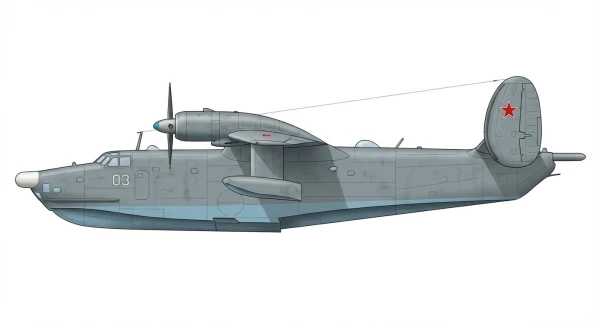
The Beriev Be-6 (USAF/DoD designation Type 34, NATO reporting name "Madge") is a Soviet maritime reconnaissance flying boat produced by the Beriev OKB. The type was operated in roles including long-range maritime reconnaissance, coastal and supply line patrol, torpedo and bombing strikes, mine-laying, and transport operations.
Development
The prototype, designated LL-143, conducted its maiden flight in March 1945. Serial production took place at the Beriev plant in Taganrog between 1949 and 1957. A total of 123 aircraft were constructed across 19 variants during the production run.
Design
The Be-6 features an all-metal deep fuselage with a gull wing and twin oval vertical stabilizers, with fabric used only on the rudders and ailerons. Power is provided by two wing-mounted Shvetsov ASh-73TK 18-cylinder air-cooled radial piston engines producing 1,800 kW (2,400 hp) each, driving four-bladed V-3BA-5 constant-speed propellers. Underwing cantilever racks support outrigger floats, with each float divided into four watertight compartments.
Armament
Defensive armament consists of five 23 mm Nudelman-Rikhter NR-23 autocannons fitted in three remotely controlled turrets. Offensive payloads include general bomb ordnance, two 1,000 kg torpedoes, or eight naval mines.
Operational History
The Be-6 entered service with Soviet Naval Aviation and remained operational through the late 1960s, after which some airframes served as unarmed civilian transports in Arctic regions. The aircraft was also exported to the People's Liberation Army Naval Air Force of China to patrol coastal waters. During the 1970s, China retrofitted several airframes with WoJiang WJ-6 turboprop engines in new nacelles to replace original radial engines.
Variants
- LL-143: Prototype flying boat powered by Shvetsov ASh-72 radial engines and armed with six 12.7 mm UBT machine guns mounted in nose, beam, ventral, and tail positions.
- Be-6: Standard production variant powered by Shvetsov ASh-73 radial piston engines.
- Qing-6: Chinese PLANAF Be-6 aircraft re-engined with turboprop engines in new nacelles.
Frequently Asked Questions
What type of aircraft is the Be-6 Madge?
What is the maximum speed of the Be-6 Madge?
What is the range of the Be-6 Madge?
When did the Be-6 Madge first fly?
How many Be-6 Madge have been built?
What is the service ceiling of the Be-6 Madge?
- AUG 62026 Created Page created: Be-6 Madge