ShinMaywa US-2
Japanese amphibious aircraft, prominently utilized for air-sea rescue operations, predominantly during the early 21st century. Key figures: top speed 560 km/h, range 4,700 km, service ceiling 7,195 m, max takeoff weight 47,700 kg, unit price $113M, built 8. In service with 1 air force as of 2026 — Japan (7).
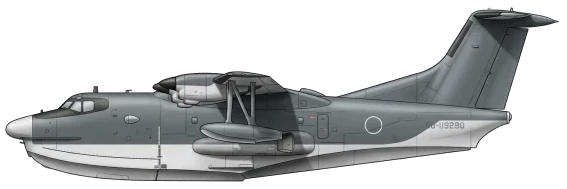
| Length | 33.5 m (109.8 ft) |
| Wingspan | 33.2 m (108.8 ft) |
| Height | 9.8 m (32.2 ft) |
| Wing area | 136 m² (1463.9 sqft) |
| Empty weight | 25,630 kg (56,504 lbs) |
| Max. takeoff weight | 47,700 kg (105,160 lbs) |
| Powerplant | 4 × turboprops Rolls-Royce AE 2100J 3,424 kW each |
| Maximum speed | 560 km/h (348 mph) |
| Operational range | 4,700 km (2,920 mi) |
| Service ceiling | 7,195 m (23,606 ft) |
| Takeoff distance | 490 m (1,608 ft) |

Description
The ShinMaywa US-2 is a Japanese short takeoff and landing (STOL) turboprop amphibious aircraft produced by ShinMaywa for the Japan Maritime Self-Defense Force. Operating primarily in the air-sea rescue role, it entered service as a replacement for the earlier US-1A. The aircraft is known for its boundary layer control system, which provides enhanced STOL performance and stall suppression, allowing operations in sea states with wave heights up to 3 meters.
Development
Development began in 1995 under the designation US-1A kai to modernise the aging US-1A fleet of the Japan Maritime Self-Defense Force. Flight testing of the prototype commenced in December 2003 under the US-2 designation, and commercial production was launched in early 2007. Production is shared across Japanese aerospace companies: Mitsubishi manufactures the outer wings and rear engine nacelles, NIPPI Corporation builds the landing gear housings, Kawasaki Heavy Industries produces the cockpit, and ShinMaywa performs final assembly. The first production aircraft was delivered to the Ministry of Defense in 2009, with the assembly line configured to build two aircraft simultaneously.
Design
The US-2 features a pressurized hull, aerodynamic refinements over the US-1A, electronic cockpit instrumentation, and onboard patient transfer facilities for search-and-rescue operations. Primary propulsion is supplied by four Rolls-Royce AE 2100J turboprop engines driving six-bladed Dowty R414 propellers. A secondary LHTEC T800 turboshaft engine powers a dedicated compressor for the boundary layer control system. Airframe dimensions include a length of 33.46 meters, a wingspan of 33.15 meters, and a maximum land takeoff weight of 47,700 kg.
Operational History
The Japan Maritime Self-Defense Force planned to purchase up to 14 US-2 aircraft, assigning them to the 31st Fleet Air Wing operating from Iwakuni and Atsugi air bases. Deliveries allowed the full retirement of the preceding US-1A fleet by December 2017, and the first US-2 was retired in August 2024. Operational events include an April 2015 accident off Cape Ashizuri where aircraft 9905 sustained hull damage during a training mission and was subsequently written off. In April 2026, a JMSDF US-2 conducted a casualty evacuation water landing in the West Philippine Sea near Palawan as part of Exercise Balikatan 2026. Export talks with India for 12 to 18 aircraft and with Indonesia were ultimately stalled or ended due to pricing disputes and competing acquisitions.
Variants
-
US-2 SAR: The primary search-and-rescue production variant operated by the Japan Maritime Self-Defense Force with a maximum range of 4,700 km.
-
Civil fire-fighting variant: A proposed firefighting configuration developed in 2010 that replaces an internal fuel tank with a 15-tonne water tank and automated drop systems.
Frequently Asked Questions
What type of aircraft is the ShinMaywa US-2?
What is the maximum speed of the ShinMaywa US-2?
What is the range of the ShinMaywa US-2?
When did the ShinMaywa US-2 first fly?
How many ShinMaywa US-2 have been built?
Which countries operate the ShinMaywa US-2?
How much does a ShinMaywa US-2 cost?
What is the service ceiling of the ShinMaywa US-2?
- AUG 62026 Updated Description updated
- JUL 272026 Updated Name updated
- APR 72026 Updated Sources and cross-references refreshed
- JAN 122026 Updated US-2: range added; US-2: price added