P-3 Orion
American maritime patrol aircraft, actively used in the Cold War, notable for anti-submarine warfare and surveillance operations. Key figures: top speed 750 km/h, range 2,491 km, service ceiling 8,626 m, max takeoff weight 64,410 kg, unit price $36M, built 757. In service with 12 air forces as of 2026 — Japan (49), South Korea (15), Canada (14) and 9 others.
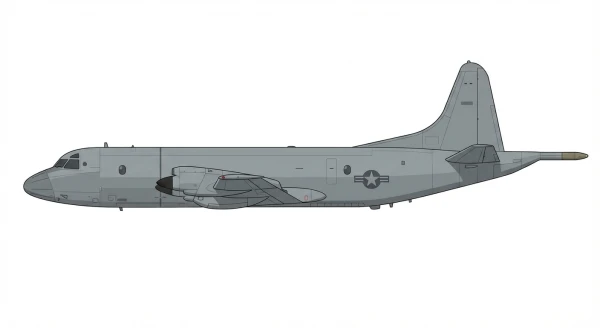
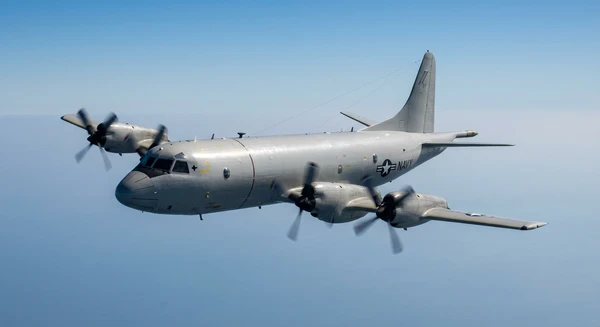
| Crew | 5–21 |
| Length | 35.6 m (116.8 ft) |
| Wingspan | 30.4 m (99.7 ft) |
| Height | 11.8 m (38.7 ft) |
| Wing area | 121 m² (1302.4 sqft) |
| Empty weight | 35,017 kg (77,199 lbs) |
| Max. takeoff weight | 64,410 kg (142,000 lbs) |
| Powerplant | 4 × turboprops Allison T56-A-14 3,430 kW each |
| Maximum speed | 750 km/h (466 mph) |
| Operational range | 2,491 km (1,548 mi) |
| Endurance | 12 hours |
| Service ceiling | 8,626 m (28,301 ft) |
| Climb rate | 16.0 m/s (52.5 ft/s) |
-
 Japan
49
Japan
49
-
 South Korea
15
South Korea
15
-
 Canada
14
Canada
14
-
 Taiwan
12
Taiwan
12
-
 United States
8
United States
8
-
 Pakistan
6
Pakistan
6
-
 Portugal
5
Portugal
5
-
 Brazil
3
Brazil
3
-
 Iran
3
Iran
3
-
 Chile
2
Chile
2
-
 Greece
1 +4
Greece
1 +4
-
 Argentina
1
Argentina
1
- Air-to-Surface AGM-65 Maverick
- Air-to-Surface AGM-84 Harpoon
Recent Events — P-3 Orion
3 events →
Description
The Lockheed P-3 Orion is a four-engined turboprop maritime patrol and anti-submarine warfare aircraft built by Lockheed for the United States Navy. It entered squadron service in August 1962 and is derived from the L-188 Electra airliner, from which it is distinguished by its tail-mounted magnetic anomaly detection (MAD) boom. A total of 757 airframes were built, and the type has served with more than a dozen navies and air forces for maritime patrol, reconnaissance, anti-surface and anti-submarine warfare.
Development
In August 1957 the U.S. Navy issued a requirement to replace the piston-engined Lockheed P2V Neptune and Martin P5M Marlin, specifying a modified existing airframe to limit cost. Lockheed proposed a military version of the L-188 Electra and won the competition in April 1958, receiving a research-and-development contract in May. The aerodynamic prototype YP3V-1 (BuNo 148276), converted from the third Electra airframe, first flew on 19 August 1958. Compared with the Electra it had 7 ft (2.1 m) less fuselage ahead of the wing, a bomb bay, a pointed nose radome, wing hardpoints and the MAD boom. The first production P3V-1 was rolled out on 15 April 1961, with deliveries to VP-8 and VP-44 at NAS Patuxent River from August 1962; the designation became P-3 on 18 September 1962. In 1963 Univac Defense Systems was contracted under Project A-NEW to develop the CP-823/U (UNIVAC 1830) computer, delivered in 1965 and leading to the P-3C's mission computers. Production ran to 1990 with 734 aircraft; Kawasaki also built over 100 under licence in Japan. Lockheed Martin opened a new wing production line in 2008 under the Aircraft Service Life Extension Program. The P-7 and Orion 21 replacement proposals were both abandoned, the latter losing to the Boeing P-8 Poseidon.
Design
The airframe is powered by four Allison T56-A-14 turboprops of 4,910 shp driving four-bladed Hamilton Standard propellers, giving 411 kn maximum speed and a ferry range of 4,830 nmi. On station one engine, normally No. 1, is shut down to extend endurance; the record time aloft is 21.5 hours, set by RNZAF No. 5 Squadron in 1972. Sensors include AN/APS-115 and AN/APS-137D(V)5 ISAR radar, the ASQ-81 MAD in the fiberglass tail stinger, ALR-66 and ALR-95(V)2 ESM, ASX-4 and ASX-6 imaging sensors, and the IBM Proteus UYS-1 acoustic processor with sonobuoys. U.S. Navy crew complement was 12, reduced to 11 in the early 2000s.
Armament
The internal bomb bay under the forward fuselage carries Mk 46, Mk 50 and Mk 54 torpedoes and nuclear depth bombs. Ten wing stations and eight bomb bay stations provide a 20,000 lb capacity for AGM-84 Harpoon, AGM-84E/H/K SLAM and SLAM-ER, AGM-65 Maverick, 5-inch Zuni rockets, Mk 82/83/84 bombs, Mk 20 Rockeye and mines including Mk 60 CAPTOR and Mk 62 Quickstrike. The AGM-12 Bullpup and B57 nuclear bomb were carried until withdrawal, the latter in 1993.
Operational History
P-3As flew blockade patrols off Cuba in October 1962. From 1964 the type flew Operation Market Time coastal patrols from the Philippines and South Vietnam; a VP-26 P-3B was shot down by anti-aircraft fire over the Gulf of Thailand in April 1968 with all 12 crew lost. In 1990–91 P-3Cs deployed within 48 hours of the Iraqi invasion of Kuwait; the "Outlaw Hunter" over-the-horizon targeting prototype directed strikes that destroyed 11 vessels near Bubiyan Island, and P-3Cs targeted 55 of the 108 Iraqi vessels destroyed. Navy P-3s operated from Kandahar, and RAAF AP-3Cs from Minhad Air Base from 2003 to November 2012. On 28 March 2011 a P-3C fired AGM-65 Mavericks at the Libyan vessel Vittoria off Misrata. On 1 April 2001 a VQ-1 EP-3E collided with a PLAN J-8II near Hainan. Pakistani P-3Cs flew during the Kargil conflict and Operation Rah-e-Nijat; two were destroyed at PNS Mehran on 22 May 2011. Spanish, Portuguese, Japanese and German aircraft have flown anti-piracy patrols off Somalia. Export and licence operators include Australia, Argentina, Brazil, Canada, Chile, Germany, Greece, Iran, Japan, the Netherlands, New Zealand, Norway, Pakistan, Portugal, South Korea, Spain, Taiwan and Thailand. VP-40 completed transition to the P-8 in May 2020, ending active-duty P-3C service; VQ-1 retired its last EP-3E and P-3C in February 2025.
Variants
- WP-3D: Two aircraft modified on the production line for NOAA weather and hurricane research.
- EP-3E Aries II: Twelve P-3Cs converted to ELINT configuration, replacing the earlier EP-3E fleet.
- AP-3C: RAAF P-3C/W aircraft upgraded by L-3 Communications with Elta SAR/ISAR radar and a General Dynamics Canada acoustic processor.
- CP-140 Aurora: Canadian long-range patrol aircraft on the P-3C airframe with S-3 Viking electronics; 18 built.
- P-3K2: Six RNZAF aircraft rebuilt by L-3 Mission Integration with glass cockpit and new tactical rail systems.
Frequently Asked Questions
What type of aircraft is the P-3 Orion?
What is the maximum speed of the P-3 Orion?
What is the range of the P-3 Orion?
When did the P-3 Orion first fly?
How many P-3 Orion have been built?
Which countries operate the P-3 Orion?
How much does a P-3 Orion cost?
What is the service ceiling of the P-3 Orion?
- AUG 302026 Updated Description updated
- JUL 232026 Updated Sources and cross-references refreshed
- APR 72026 Updated Sources and cross-references refreshed
- FEB 72026 Updated Endurance added
- JAN 122026 Updated Range updated in a site-wide editorial pass